
Sand lizard
Lacerta viridis
Description
How to identify
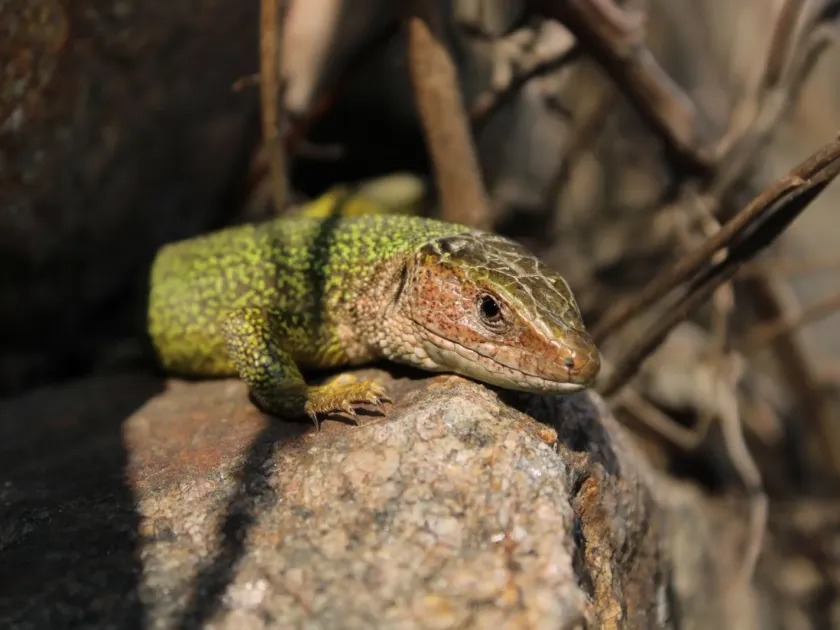
The sand lizard (Lacerta agilis) is a small, terrestrial reptile belonging to the Lacertidae family, common throughout temperate Europe and parts of Asia.
Adults typically reach a total length of approximately 20 to 25 cm, with a robust body and a tail that usually accounts for more than half of the total length.
The coloration of males becomes vibrant green during the breeding season, while females exhibit more cryptic brown or grey patterns to blend into the soil.
They are characterized by a series of spots or stripes along their back, providing excellent camouflage against dry leaves, twigs, and sandy soil surfaces.
As ectothermic animals, they depend entirely on external heat sources, which makes them highly visible during sunny days in fields and garden edges.
What it damages
The sand lizard is not considered an agricultural pest, as it is strictly a carnivorous predator rather than a plant-eating species.
It plays a significant role in the food chain by consuming various invertebrates, such as beetles, spiders, grasshoppers, and small garden insects.
The species does not cause mechanical damage to roots, leaves, or fruits, nor does it affect crop quality or yield during its life cycle.
Some growers might perceive them as a nuisance due to their sudden movements or digging, but this has no negative impact on plant health or development.
In fact, the presence of sand lizards is generally viewed as an indicator of a healthy, non-toxic environment suitable for diverse plant life.
When it appears
Their active season begins in spring, usually from March or April, once the soil and ambient temperatures rise sufficiently to allow for their metabolic activity.
Peak activity occurs during May and June, which corresponds with their breeding season, leading to more frequent sightings in open garden spaces.
During the peak of summer, they often adapt by hunting in the cooler early morning or late evening to avoid excessive heat stress.
As autumn approaches and temperatures drop in September, their activity levels decrease significantly as they prepare for hibernation.
They hibernate during the cold winter months, typically burrowing deep into loose soil, compost heaps, or under log piles to stay below the frost line.
Signs of infestation
The most common sign of their presence is simply seeing the lizards basking on stones, garden walls, or warm patches of bare soil on sunny days.
You may hear a sudden, swift rustling sound in dry vegetation, which indicates a lizard quickly retreating into cover as you approach.
On loose or sandy soil, you might spot thin, winding tracks left by their bodies and tails, or small, shallow holes where they have been active.
- Shed pieces of thin, translucent skin (slough) found near basking areas.
- Small, burrow-like holes under debris or stacked materials.
- A noticeable decrease in the population of certain insects in the immediate area.
If you see damage to leaves or fruit, you should look for evidence of slugs, rodents, or insects, as these are the true culprits in an garden setting.
Control measures
No formal pest control measures are required for the sand lizard, as it is a beneficial part of the garden ecosystem that helps manage insect populations.
To discourage their presence in specific areas, maintain a clean garden by removing excessive debris, large piles of rocks, or stacks of rotting wood.
Regular maintenance, such as keeping grass short and removing dense brush near sensitive crop areas, will naturally lead them to seek more wild habitats.
Avoid any use of insecticides or chemical pesticides, as these chemicals can harm the lizards indirectly and disrupt the entire local ecosystem balance.
Promotion of natural balance is the best strategy, as their presence indicates a functional environment that is free from excessive and harmful chemical usage.
Taxonomy
- Latin name
- Lacerta viridis
- Family
- Lacertidae
- EPPO code
- LACEVI
Discussion
No discussions yet — be the first.