

Pest · Diptera (flies) · affects Wild cabbage, Winter wheat, Rose
Especially harmful
Yellow cereal fly
Opomyza florum
Description
How to identify
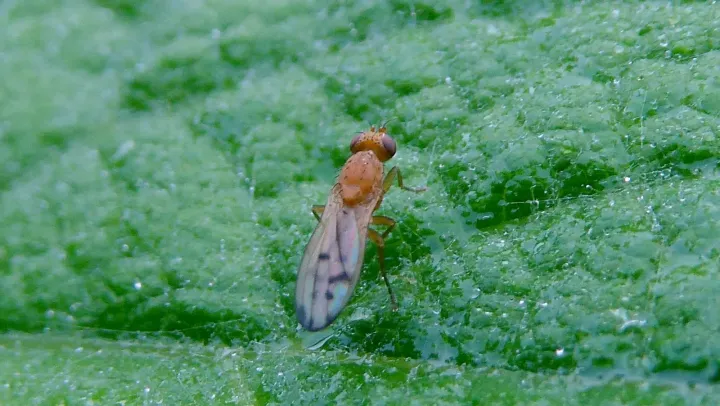
The yellow cereal fly (Opomyza florum) belongs to the family Opomyzidae, order Diptera. Adults are small insects, approximately 3–4 mm long, with yellowish-brown bodies and characteristic dark spots on the wings.
The larvae are cylindrical, legless, and white or pale yellow in color, reaching up to 5 mm in length. They possess small mouth hooks used for feeding on plant tissues.
Eggs are small (about 0.7 mm), white, and have longitudinal ribs. Females deposit them in the soil near the seedlings of winter cereal crops.
The life cycle consists of the egg stage, three larval instars, pupa, and adult. In most regions, this species completes one generation per year.
The insect typically overwinters in the egg stage within the upper layer of the soil in fields planted with winter cereals.
What it damages
The primary hosts for the yellow cereal fly are winter cereals, specifically winter wheat and barley, where larvae cause significant damage by feeding inside the stems.
While various plants like fodder beet, cabbage, hemp, or alfalfa are mentioned in historical literature, these are not significant hosts for the species.
Damage to non-cereal crops is accidental and generally does not cause economic harm or require specific pest control interventions.
Larvae penetrate the stem of young plants, destroying the central shoot and the growing point, which prevents the plant from developing further.
Large-scale infestation results in sparse plant populations, reduced tillering, and potential harvest losses if left unmanaged.
When it appears
Adult flies emerge and are active in late summer and autumn, which corresponds with the egg-laying period in soil near emerging winter crops.
Larvae usually hatch and begin feeding during the autumn or early spring, depending on the climatic conditions and the time of crop emergence.
The peak activity of larvae, causing visible damage to crops, typically occurs in early spring when winter cereals resume their active growth phase.
Pupation takes place within the damaged stems or in the soil near the host plant in late spring before the emergence of the next generation of adults.
The timing of the pest's development is closely synchronized with the phenology of winter cereal crops.
Signs of infestation
The most prominent sign of infestation is the yellowing and wilting of the central leaf, often referred to as "dead heart" in young cereal plants.
An inspection of the inner stem of a wilting plant often reveals the presence of a white larva or tunnels created by its feeding activity.
Infested plants fail to tiller properly and often stop growing, leading to a stunted appearance and eventual drying out of the stem.
In fields with high infestation levels, one can observe localized patches of stunted or dead seedlings, disrupting the uniformity of the crop.
Early diagnosis is crucial, as the damage caused by the larvae is irreversible once the central growing point of the plant is destroyed.
Control measures
Effective crop rotation is a fundamental management practice, preventing the buildup of pest populations in fields where winter cereals are planted.
Optimizing the sowing date can help the crop reach a growth stage that is less susceptible to initial larval damage by the time flies are active.
Seed treatment with systemic insecticides before planting provides essential protection for young seedlings against early larval attack.
Eliminating volunteer cereals (self-seeded plants) in the post-harvest period is vital to deprive the flies of suitable sites for egg-laying.
Chemical control via foliar application of insecticides can be deployed in spring if scouting indicates high larvae density and potential economic damage.
In brief
11
Damages crops
Content graph
Damages crops · 11
Content graph
Connections · Yellow cereal fly
Most often together:
Marketplace
Products · 2

Biology
Taxonomy
- Latin name
- Opomyza florum
- Order
- Diptera (flies)
- Family
- Opomyzidae
- EPPO code
- OPOMFL
Community
Discussion
No discussions yet — be the first.