
Australian sugarcane soldier fly
Inopus rubriceps
Description
How to identify
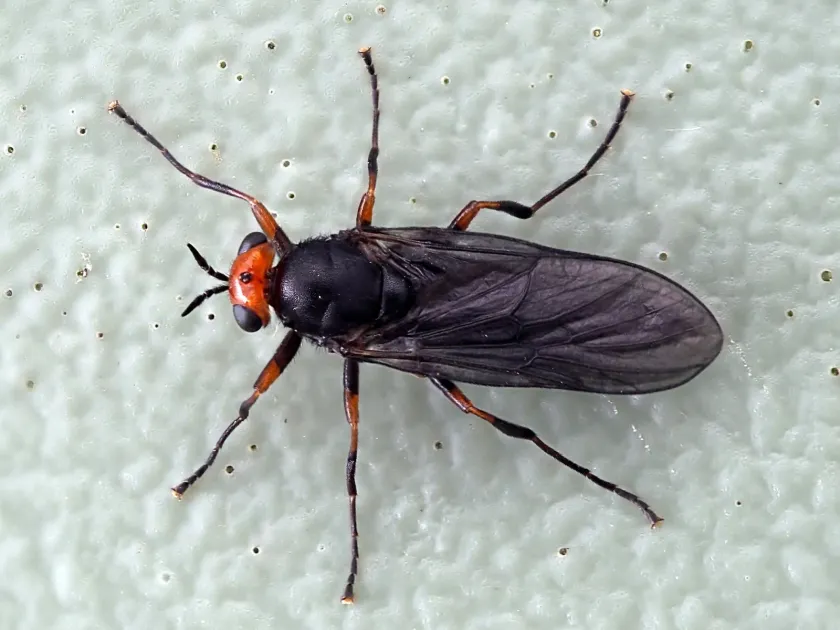
The Australian sugarcane soldier fly (Inopus rubriceps) belongs to the Stratiomyidae family of the order Diptera. Adults are small, dark-colored flies characterized by a distinctive reddish-orange head, which makes them relatively easy to identify.
The larvae, which represent the harmful stage, are cylindrical and possess a tough, sclerotized cuticle. This morphology allows them to thrive in complex soil environments and protects them from common environmental stressors.
Adult flies are active during the day and are commonly found on flowers, feeding on nectar. They are harmless to crops and serve mainly for reproductive purposes, including mating and oviposition.
Field identification is best achieved by inspecting the root zone of affected plants. Soil samples are carefully excavated and examined to detect the presence of creamy-colored larvae near the roots.
The life cycle undergoes complete metamorphosis. While the adult stage is ephemeral, the larval stage is long-lived and poses the most significant threat to agricultural productivity.
What it damages
This pest primarily attacks graminaceous crops, including sugarcane, wheat, barley, and various pasture grasses. It has a broad host range, making it a persistent issue in diverse agricultural systems.
Larval damage occurs below the soil surface. They feed on the root systems of host plants, causing physical destruction of roots and preventing the uptake of water and essential soil nutrients.
Seedlings and young plants are the most vulnerable. High larval density can lead to total crop failure, characterized by stunted growth, leaf chlorosis, and the rapid death of the entire plant.
In addition to direct feeding damage, the wounds created by the larvae serve as entry points for secondary soil-borne pathogens, including fungi and bacteria, which further weaken the plant.
Economic damage is severe, particularly in pastures and large-scale grain production, where the pest can destroy hectares of crops, necessitating costly replanting procedures.
When it appears
The biological cycle of Inopus rubriceps is highly dependent on environmental moisture. Larval activity peaks during seasons with moderate temperatures and adequate soil moisture levels.
Mass emergence of adult flies typically occurs during warm periods of the year. During this time, they engage in mating and laying eggs directly into the soil, favoring organic-rich substrates.
Larvae can withstand harsh conditions by migrating deeper into the soil profile during dry spells. However, they return to the root zone once environmental conditions become favorable for plant growth.
In various climates, the development from egg to adult may take several months to a year. This variability makes it necessary for farmers to perform year-round monitoring to track population dynamics.
Predictive modeling based on accumulated temperature units helps agronomists anticipate the peak risk periods and deploy control measures before the larvae reach their most destructive stages.
Signs of infestation
The first noticeable symptom of an infestation is the general decline of plant health. Affected plants appear yellow, lack vigor, and fail to grow even under optimal irrigation and fertilization.
If you examine the roots, you will see visible damage. The root system will often look pruned, fragmented, or necrotic, indicating sustained larval feeding activity.
The presence of larvae in the soil surrounding the roots is the definitive diagnostic sign of an infestation, distinguishing it from nutrient deficiencies or irrigation issues.
In turf and pasture, circular or irregular dead patches of vegetation ("bare spots") are typical indicators of long-term soldier fly colonization.
If plants wilt suddenly despite adequate water supply, it is a strong indicator that the root integrity is compromised, and soil inspection for Inopus rubriceps should be prioritized.
Control measures
Effective management begins with mechanical control. Deep tillage or plowing before planting can disrupt the soil, exposing larvae to predators and causing physical damage to the population.
Crop rotation is one of the most effective non-chemical strategies. Moving away from susceptible grass species to broadleaf crops breaks the food chain, preventing the larvae from maturing.
Chemical control involves the application of soil-incorporated insecticides at the time of planting or during peak risk seasons, aimed at targeting early larval instars.
Biological control using entomopathogenic fungi, such as Beauveria bassiana, or specialized nematodes has shown promise in suppressing larval populations without the need for synthetic chemicals.
- Deep plowing to disturb larval habitat.
- Strategic crop rotation.
- Targeted application of soil-active insecticides.
- Introduction of biological control agents.
- Monitoring adults with light or suction traps.
Taxonomy
- Latin name
- Inopus rubriceps
- Order
- Diptera (flies)
- Family
- Stratiomyidae
- EPPO code
- ATMPRU
Discussion
No discussions yet — be the first.