
Pine hawk-moth
Hyloicus pinastri
Description
How to identify
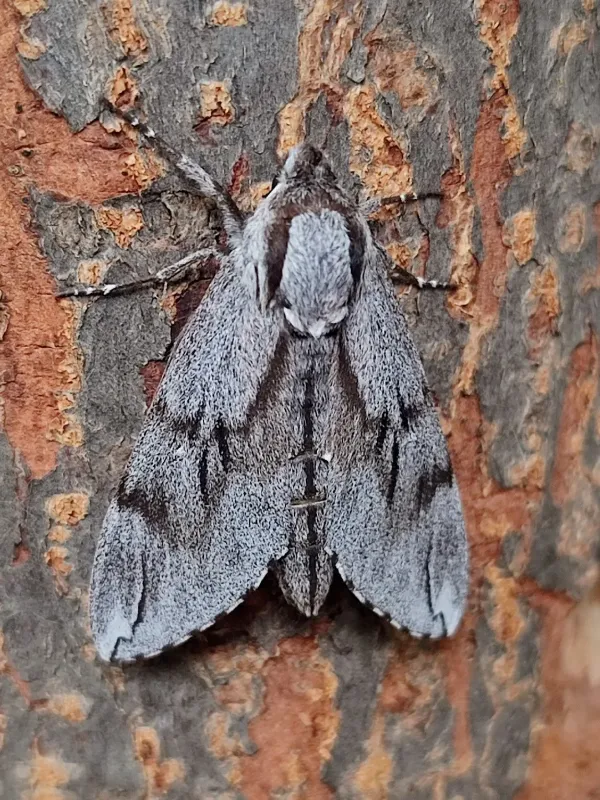
The pine hawk-moth (Hyloicus pinastri) is a moth belonging to the Sphingidae family within the order Lepidoptera. It is a large nocturnal insect with a wingspan of 80–90 mm.
The adult moth features a grey-brown camouflage pattern with dark streaks, allowing it to blend perfectly into the bark of coniferous trees.
The caterpillar can grow up to 80 mm long. It is typically green or brown with light lateral stripes and a distinct, curved horn on the posterior segment.
The pupa is dark brown or black and remains dormant in the soil or forest litter throughout the winter months.
The species undergoes a complete metamorphosis cycle, progressing through egg, larval, pupal, and adult stages.
What it damages
The primary hosts for the caterpillars are Scots pine (Pinus sylvestris), although they occasionally feed on spruce and larch needles.
Young larvae consume parts of the needles, while older, more mature larvae are capable of stripping entire branches, leading to heavy defoliation.
During outbreaks, this moth causes significant stress to the trees, making them highly susceptible to secondary attacks by bark beetles and pathogens.
Young plantations and shelterbelts are the most vulnerable, where severe feeding can reduce tree vitality and stunt growth significantly.
Consistent loss of foliage over several seasons leads to a decline in tree health, eventually resulting in dieback in high-density populations.
When it appears
The flight period for adult moths occurs from late May to mid-July, with peak activity during twilight and night hours.
Eggs are deposited individually or in small clusters on the needles in the upper crown canopy of the host tree.
Larval development takes place throughout the summer, specifically from July to September, which is the period of highest foliage consumption.
Pupation occurs in autumn as the larvae descend to the ground, where they enter diapause for the winter.
The species typically completes one generation per year, though warmer climates may occasionally support a partial second generation.
Signs of infestation
The first indicator of infestation is visible damage to the pine needles, which appear jagged or partially chewed.
Large amounts of larval droppings, which are distinct cylindrical pellets, accumulate on the ground beneath the host tree.
The visual presence of bare twigs and branches in the upper canopy is a major warning sign of a high-density infestation.
Due to their cryptic coloration, the larvae are often difficult to spot during routine inspections of the tree crown.
Increased bird activity in the canopy during the summer can often indicate the presence of large quantities of larvae.
Control measures
Integrated forest management includes promoting natural predators, such as insectivorous birds and predatory ants, to maintain a natural balance.
Biological control using Bacillus thuringiensis sprays is highly effective against early-instar larvae while remaining eco-friendly.
Chemical insecticides are generally reserved for nurseries or high-value ornamental trees where manual or biological control is insufficient.
Pheromone and light traps are used for early detection and population monitoring to ensure that interventions are timely.
Removing forest litter or tilling the soil around the base of trees in autumn can physically destroy the overwintering pupae.
Taxonomy
- Latin name
- Hyloicus pinastri
- Order
- Lepidoptera (butterflies)
- Family
- Sphingidae
- EPPO code
- SPHXPI
Discussion
No discussions yet — be the first.