
Pine hawk-moth
Hyloicus
Description
How to identify
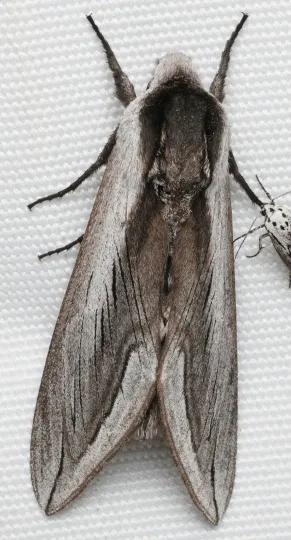
The Pine hawk-moth (lat. Hyloicus pinastri) belongs to the family Sphingidae. It is a large nocturnal moth with a wingspan of up to 90 mm, featuring cryptic grey-brown coloration that perfectly camouflages it against tree bark.
The caterpillar can grow up to 80 mm long. It is typically green or brown with longitudinal stripes and a distinct horn-like protrusion on its posterior end, a diagnostic feature of the Sphinx family.
The pupae are dark chestnut in color, featuring a specialized sheath for the proboscis. They overwinter in the forest litter or soil, often buried several centimeters deep.
The life cycle involves a complete metamorphosis. In most temperate regions, there is one generation per year, although warmer climates may permit a second generation.
Adult moths are strictly nocturnal. During the day, they remain immobile on trunks, perfectly mimicking the texture and color of dry pine bark to avoid detection by predators.
What it damages
The primary host plant is Scots pine. However, the larvae can also feed on spruce, larch, and fir, making the moth a potential threat to various coniferous plantation types.
Young larvae consume surface tissues, but older caterpillars devour entire needles, often stripping branches bare and leaving only the twig structure behind.
Severe defoliation weakens the tree's immune system, making it susceptible to secondary pests like wood-boring beetles and bark beetles which can kill the tree.
In urban landscapes and nurseries, the damage is primarily aesthetic and can lead to the slow decline of the ornamental tree over several years of repeated infestation.
Outbreaks can impact large forest areas, causing significant stress to the stand and reducing annual timber growth due to the loss of photosynthetic area.
When it appears
The flight period typically spans from late May through July, depending on local weather conditions, during which mating and egg-laying occur.
Larvae hatch in mid-summer and begin a period of intensive feeding. This is the peak time to observe the damage on the foliage of conifers.
Feeding continues until late August or early September, after which the fully grown caterpillars descend to the soil to pupate in the leaf litter.
The pupal stage is the overwintering phase. Their survival during this time is heavily dependent on winter temperatures and soil moisture levels.
The spring emergence of adults is synchronized with the new growth of pine needles, ensuring that the next generation of larvae has access to fresh, tender foliage.
Signs of infestation
The primary indicator of an infestation is the presence of partially consumed needles or needles cleanly cut off, often found scattered on the ground.
- Accumulation of frass (caterpillar droppings) at the base of the tree.
- Defoliated sections of the canopy visible from the ground.
- Large caterpillars found on trunks during evening observations.
- Empty pupal cases found in the topsoil near the roots.
- Needles hanging from silk strands indicating recent feeding activity by young larvae.
Control measures
Monitoring population density using pheromone traps is the standard approach to predict potential outbreaks and determine the timing for intervention.
Biological control using microbial insecticides, specifically those containing Bacillus thuringiensis, is effective and environmentally friendly against young larvae.
Chemical control with systemic insecticides is reserved for high-value stands or severe outbreaks where the risk of total defoliation is immediate.
Silvicultural practices, such as removing thick forest litter or maintaining stand diversity, can help disrupt the moth's ability to successfully pupate.
Encouraging natural predators, such as insectivorous birds and predatory wasps, provides long-term suppression of hawk-moth populations in healthy forests.
Taxonomy
- Latin name
- Hyloicus
- Order
- Lepidoptera (butterflies)
- Family
- Sphingidae
- EPPO code
- HYLKSP
Discussion
No discussions yet — be the first.