
Wilson's Sphinx Moth
Hyles wilsoni
Description
How to identify
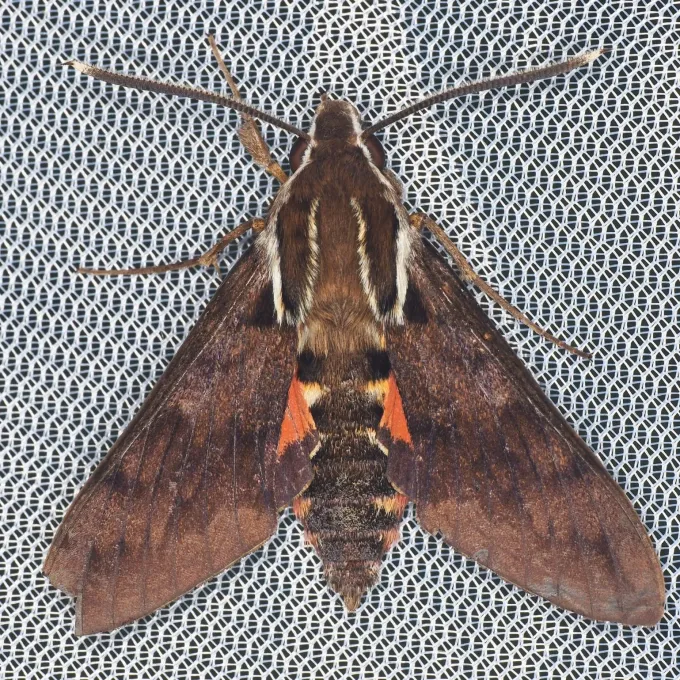
Wilson's Sphinx moth (Hyles wilsoni) is a rare species of moth belonging to the family Sphingidae, order Lepidoptera. Adults are known for their spindle-shaped bodies and narrow, powerful wings that enable high-speed flight and precise hovering capabilities.
The larvae of this species, commonly known as caterpillars, undergo several developmental stages (instars). They are easily recognizable by the distinct horn located on the posterior end of their body, which is a hallmark of the sphinx moth family.
Adults are primarily crepuscular or nocturnal, feeding on nectar while hovering in front of flowers, a behavior that often leads observers to mistake them for hummingbirds. Their wing patterns typically provide excellent camouflage, mimicking bark or dried foliage.
The life cycle encompasses four stages: egg, larva, pupa, and adult. In favorable climates, these moths can produce one or more generations per year, with the pupal stage typically overwintering within the top layers of the soil.
Taxonomically, the species is part of the Hyles genus, which includes many morphologically similar moths. Identification can be challenging due to color variations in the larvae, which are often influenced by their host plant and environmental conditions.
What it damages
Wilson's Sphinx moth larvae are specialist feeders. The primary damage occurs during the larval stage, as the caterpillars consume significant amounts of foliage to accumulate the biomass necessary for their upcoming pupation.
The host range includes a variety of plants, ranging from wild flora to ornamental shrubs and nursery crops. Young plants are particularly vulnerable, as heavy defoliation can severely stunt their growth and compromise their structural integrity.
Massive infestations may result in total defoliation of specific branches or entire plants. This loss of photosynthetic capacity weakens the plant, making it more susceptible to environmental stress, pests, and secondary pathogens.
The characteristic damage appears as large, ragged holes along the leaf margins or complete skeletonization of the leaf, leaving behind only the primary veins. Caterpillars may also feed on young shoots and flower buds, causing deformation.
While the economic impact in large-scale agriculture is usually moderate, the damage in private gardens or nurseries can be significant due to the sheer volume of leaf material a single mature larva can consume.
Signs of infestation
A primary indicator of a sphinx moth infestation is the presence of large, cylindrical frass (excrement) pellets found under the plant canopy. This is often the most reliable way to detect the presence of the larvae.
Inspect plants for leaves with irregular, torn edges. Unlike smaller insect pests, sphinx moth larvae cause conspicuous damage, often leaving behind bare stems and large gaps in the foliage canopy within a short period.
Evening scouting is effective, as the larvae are most active during the twilight hours. Despite their camouflage, the large larvae can be easily spotted using a flashlight as they feed on the leaves.
Searching for exuviae (cast-off skins) near the base of the plant can also confirm the current presence of larvae. Checking the soil surface around the plant can sometimes reveal where the caterpillars hide during the heat of the day.
Increased activity of insectivorous birds within the canopy can also serve as a signal, as these birds often prey on the larger, nutrient-rich larvae of the sphinx moth.
Control measures
Hand-picking the caterpillars is the most practical and environmentally friendly method for small-scale gardens. This process is most effective when performed during the early morning or evening when the larvae are actively feeding.
Biological control using formulations containing Bacillus thuringiensis (Bt) is highly effective. These microbial insecticides are specific to lepidopteran larvae and pose minimal risk to beneficial insects, pollinators, and other garden wildlife.
In cases of severe infestation where manual removal is not feasible, the application of systemic or contact-stomach insecticides registered for use on specific host plants may be required to prevent extensive damage.
Cultural practices, such as tilling the soil under host plants in the late autumn, can help disrupt the pupal stage. This mechanical disturbance kills overwintering pupae and helps reduce the population size for the following season.
Encouraging natural predators, such as predatory wasps, beetles, and birds, creates a balanced ecosystem that helps naturally regulate the moth population and reduces the need for chemical intervention.
Taxonomy
- Latin name
- Hyles wilsoni
- Order
- Lepidoptera (butterflies)
- Family
- Sphingidae
- EPPO code
- HYLXWI
Discussion
No discussions yet — be the first.