
Striped hawk-moth
Hyles livornica
Description
How to identify
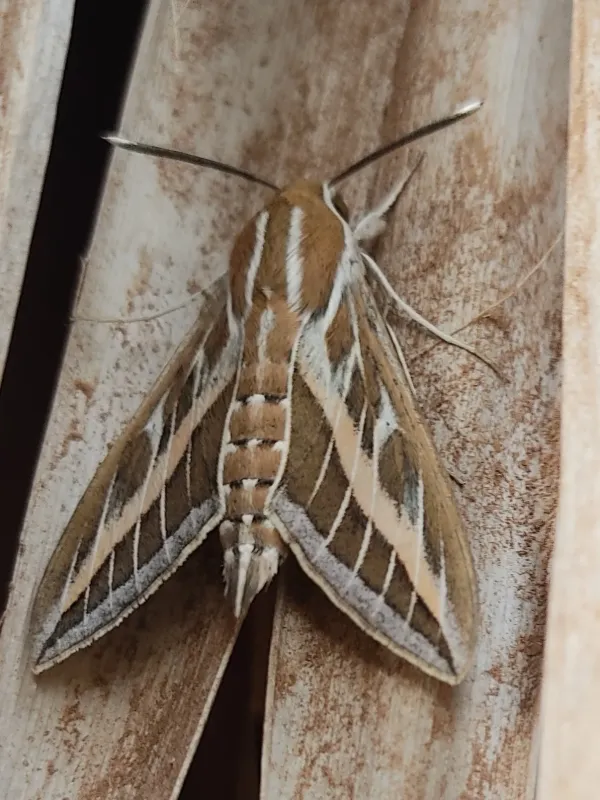
The striped hawk-moth (Hyles livornica) belongs to the family Sphingidae. This large moth has a wingspan of up to 80 mm and features distinctive white stripes on its forewings and a reddish-pink hue on the hindwings.
Larvae (caterpillars) transition through various growth stages, changing color from light green to dark tones with conspicuous longitudinal stripes and a prominent horn on the posterior end.
Adult moths are primarily nocturnal and crepuscular, feeding on nectar. Their powerful wings allow for significant migratory behavior, often leading to sudden outbreaks in unexpected regions.
The species is highly thermophilic, meaning its life cycle is tightly coupled with temperature. In warmer climates, it can produce multiple generations per season, increasing its status as a recurring pest.
Pupae are found within the soil or amongst plant debris in a sturdy cocoon, which serves as a protective shell against environmental fluctuations during their development.
What it damages
The damage is caused by the caterpillars, which possess robust mandibles for chewing. They are voracious eaters capable of defoliating significant portions of plant foliage in a short period.
Target crops include grapes, potatoes, beets, and legumes, alongside various weeds that serve as alternative hosts during the early stages of their life cycle.
Heavy infestations lead to complete defoliation, which severely limits the plant's ability to conduct photosynthesis, resulting in weakened plant health and reduced yields.
In vineyards, damage occurring during the bud formation or fruiting stages can have long-term negative effects on the vine's productivity and overall vigor for the next season.
Beyond physical consumption, the exposed plant tissue often becomes a site for secondary infections by various fungal and bacterial pathogens common in agricultural environments.
When it appears
The flight of the first generation of adults typically begins in late spring or early summer, synchronized with the arrival of stable, warm weather conditions.
Eggs are laid on the underside of host plant leaves, and hatching occurs within one to two weeks, after which the larvae begin their aggressive feeding cycle.
Peak damage is most observed during mid-to-late summer, when the caterpillars are in their later instars and require significantly more energy for growth and pupation.
In regions with an extended autumn, a second generation may emerge, posing a continued threat to late-harvest vegetable crops and secondary vegetation.
The overall duration of the development phases is highly variable, depending on the cumulative active temperatures experienced during the peak growth months.
Signs of infestation
One of the earliest signs of infestation is the presence of frass (caterpillar droppings) on the soil surface or around the base of the affected plants.
Visual identification of the larvae is possible as they are large and distinct, though they often hide on the underside of leaves or within dense foliage during daylight hours.
Skeletonized leaves, where only the vein structure remains, provide clear evidence of active feeding by the later-stage caterpillars in the immediate vicinity.
General wilting or premature yellowing of leaves can also be a secondary sign that the caterpillars have been feeding on stems and petioles, affecting nutrient transport.
- Large, brightly colored caterpillars on leaves.
- Visible frass deposits on the soil.
- Skeletonized leaf patterns.
- Reduced vigor and stunted growth of young shoots.
Control measures
Cultural control methods include deep tillage in vineyard rows or fields, which disrupts pupation sites and kills overwintering pupae by exposing them to extreme conditions.
Sanitation practices such as weed management are critical, as removing alternative host plants significantly lowers the moth's capacity to establish a breeding population.
Hand-picking caterpillars is a highly effective, non-toxic strategy for small gardens or limited infestations due to the large size and visibility of the larvae.
Biological control using Bacillus thuringiensis (Bt) is effective against younger larval stages while remaining safe for non-target beneficial insects and pollinators.
Chemical intervention should be reserved for severe outbreaks, utilizing approved insecticides according to local agricultural regulations and strict pre-harvest intervals.
Taxonomy
- Latin name
- Hyles livornica
- Order
- Lepidoptera (butterflies)
- Family
- Sphingidae
- EPPO code
- HYLXLI
Discussion
No discussions yet — be the first.