
Two-spotted horsefly
Hybomitra bimaculata
Description
How to identify
The Two-spotted horsefly (Hybomitra bimaculata) is a member of the Tabanidae family, known for being a significant pest in agricultural environments.
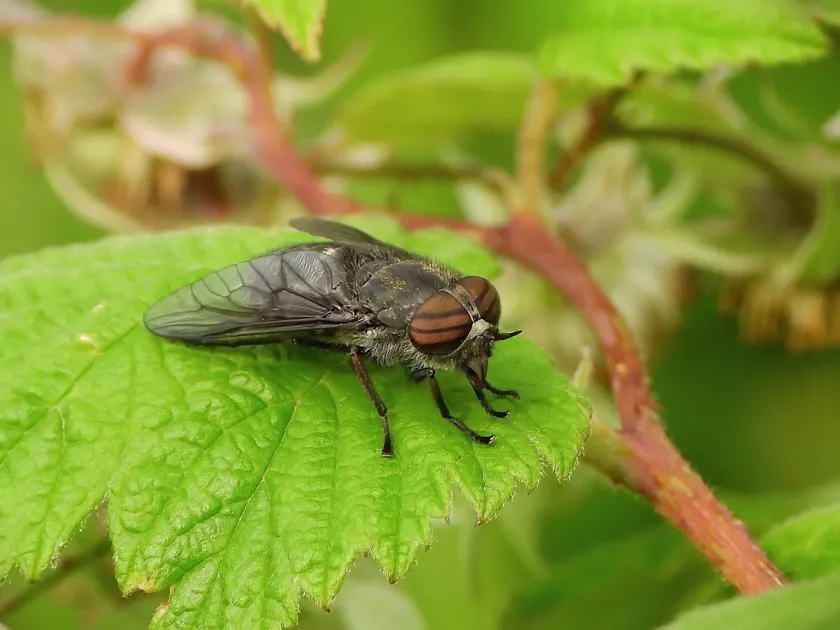
These flies are easily identified by two distinct pale or orange spots on the second abdominal segment, which distinguishes them from other species.
Females are characterized by robust piercing-sucking mouthparts used to draw blood from mammals, while males are strictly nectar-feeders.
They are large insects with strong wings and multi-colored eyes, adapted for fast flight and tracking their hosts over long distances.
The insect possesses a high level of agility, making it difficult for animals to brush them off once they have landed for a bite.
What it damages
The primary economic damage caused by Hybomitra bimaculata is the stress and health degradation of livestock, including cattle, horses, and sheep.
Constant biting causes significant animal distress, leading to reduced grazing time, loss of appetite, and eventually lower milk yield and weight gain.
The bite of a horsefly is physically painful and leaves a wound that can become infected or attract other parasites, leading to dermatological issues.
They act as mechanical vectors for several diseases, including tularemia and various blood-borne pathogens that can spread rapidly through a herd.
Large swarms can lead to animals stampeding, which increases the risk of physical injuries and infrastructure damage in pastures.
When it appears
Adult flies are typically active during the warm summer months, generally from June through August, when conditions favor their survival.
Their flight activity is highly dependent on weather; they thrive in sunny, warm conditions and are significantly less active on cloudy or windy days.
The life cycle is complete, with eggs laid in moist environments, followed by a larval stage that develops in damp soil near water bodies.
Pupation occurs in spring, ensuring that the next generation of adults emerges just as livestock are moved to pastures for the season.
Population densities are higher in years with wet springs, as this increases the available breeding sites for the larval development stage.
Control measures
Management strategies focus on a combination of chemical repellents, environmental modification, and physical protection for livestock.
Applying pyrethroid-based insecticides to livestock skin serves as a temporary barrier against biting flies during peak summer activity.
Trapping systems, such as visual or odor-based sticky traps, are highly effective in reducing local fly numbers around livestock handling facilities.
Environmental management involves draining standing water or marshy areas in pastures to minimize suitable breeding habitats for larvae.
- Utilize livestock shelters to provide shade, as flies prefer open sunlight.
- Graze livestock during the early morning or evening to avoid peak fly activity.
- Maintain healthy populations of fly predators like swallows and predatory wasps.
Taxonomy
- Latin name
- Hybomitra bimaculata
- Order
- Diptera (flies)
- Family
- Tabanidae
- EPPO code
- HYBOBI
Discussion
No discussions yet — be the first.