
Columbia silkmoth
Hyalophora columbia
Description
How to identify
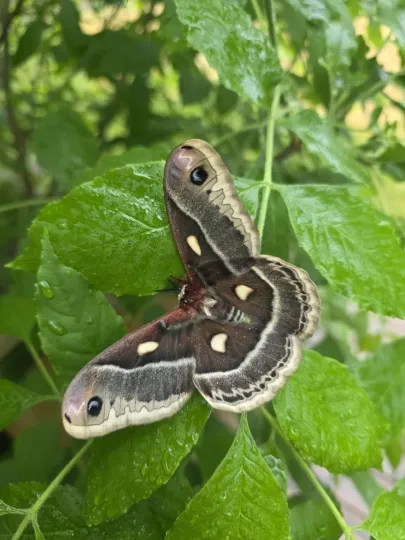
The Columbia silkmoth (Hyalophora columbia) is a large, striking member of the Saturniidae family, often referred to as giant silk moths. These insects are easily recognized by their massive wingspan, often reaching up to 12 centimeters in width.
Adult moths feature a rich brown coloration on their wings with prominent white bands and distinct, transparent discal spots. These features are unique diagnostic traits that separate them from other species within the Hyalophora genus.
The caterpillars undergo several larval stages, transforming significantly in appearance as they grow. Mature larvae are large, bright green, and covered in colorful tubercles that serve as a defense mechanism against avian predators.
Taxonomically, they belong to the order Lepidoptera. They are specialized organisms perfectly adapted to temperate climates where their life cycle aligns with the growing season of their host plants.
In the field, their distinct wing patterns and size make them one of the most recognizable, albeit elusive, moths found in Northern coniferous forest ecosystems.
What it damages
The primary host for the larvae is the larch tree (Larix species, particularly Larix laricina). The caterpillars feed exclusively on the needles of these conifers, which can lead to significant defoliation during outbreak years.
While feeding, the larvae consume large quantities of foliage, which stresses the host tree. Chronic defoliation reduces the tree's ability to photosynthesize and store essential energy reserves for the following season.
The impact of this damage is most severe in weakened or drought-stressed stands. Heavily defoliated trees may experience reduced growth rates and increased susceptibility to secondary pests like bark beetles.
Since the larvae are large, their feeding damage is localized but can be intense. A single tree may host several caterpillars that strip entire branches of their needles within a short period.
Although widespread mortality is rare, the cumulative effect of recurring infestations can degrade the health and aesthetic value of larch stands in nurseries and parks.
When it appears
The Columbia silkmoth has a univoltine life cycle, meaning it produces only one generation per year. Adults emerge in early summer, focusing their activity on mating and egg-laying on the needles or twigs of host trees.
Larval development occurs throughout mid-to-late summer. During this time, the caterpillars are highly active, progressing through several instars and consuming substantial amounts of coniferous foliage.
As autumn approaches, the larvae seek suitable sites to pupate. They spin dense, protective cocoons that are securely attached to the larch twigs, which serve as their overwintering quarters.
The pupal stage spans the winter months. This dormancy is essential for their survival, as the thick silk cocoon provides insulation against extreme temperatures and protection from winter weather conditions.
In the following spring, the pupae complete their metamorphosis, and the cycle repeats with the emergence of new adult moths, perfectly synchronized with the budding of larch needles.
Control measures
In natural forest settings, biological control through natural predators, such as birds and parasitic wasps, is usually sufficient to maintain the population at levels that do not cause significant economic damage.
In ornamental or nursery environments where the aesthetics or health of the larch trees are at risk, manual removal of the overwintering cocoons during the dormant season is an effective and environmentally friendly solution.
If direct intervention is required for severe infestations, bio-insecticides containing Bacillus thuringiensis are highly effective against these caterpillars while remaining safe for non-target organisms.
Integrated Pest Management (IPM) practices should prioritize the conservation of native parasitic insects, which play a crucial role in regulating Hyalophora columbia populations.
Chemical insecticides should be avoided whenever possible, as they can disrupt the balance of the local ecosystem and harm beneficial pollinating insects that inhabit the same forest areas.
Taxonomy
- Latin name
- Hyalophora columbia
- Order
- Lepidoptera (butterflies)
- Family
- Saturniidae
- EPPO code
- HYAOCO
Discussion
No discussions yet — be the first.