
Hyalesthes
Hyalesthes
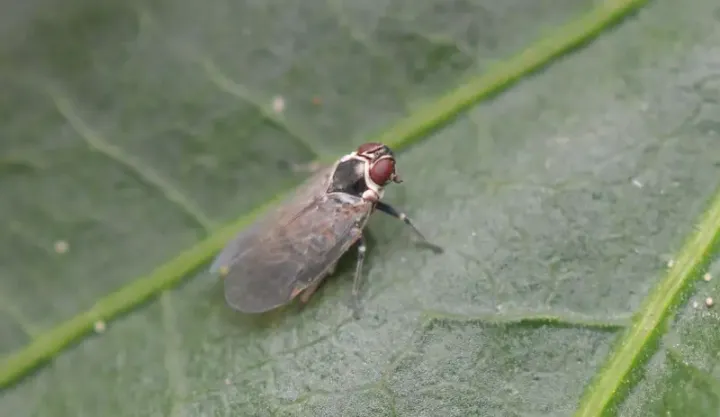
Description
How to identify
Hyalesthes is a genus of insects in the Cixiidae family, part of the order Hemiptera. These small planthoppers, typically measuring 4–5 mm, are recognized by their characteristic transparent or dark-tinted wings, which they hold in a roof-like position over their backs.
The adult insects are usually dark brown or blackish, allowing them to blend into soil surfaces and crop residues effectively. The nymphs live primarily underground, feeding on the roots of host plants, which makes them very difficult to detect during the early stages of infestation.
The species Hyalesthes obsoletus is the most significant member of this genus due to its role as a vector for serious plant diseases. These insects are agile and can move rapidly across fields, spreading pathogens with high efficiency.
Monitoring for Hyalesthes involves using yellow sticky traps placed near the base of plants. This is crucial because adults are often found near the root zone or the lower parts of stems during early morning or evening hours.
In the field, these insects can be identified by their jumping behavior when disturbed. Their cryptic appearance, combined with their tendency to hide in dense foliage or near the soil, requires diligent scouting during the active season.
What it damages
The primary damage caused by Hyalesthes is not from direct feeding, but from its role as a vector for phytoplasma diseases, most notably stolbur. The insect transmits the pathogen through its saliva while feeding on plant tissues.
The pest attacks a wide range of essential crops, including solanaceous plants like tomatoes, peppers, eggplants, and potatoes. Additionally, it thrives on various weeds, most notably field bindweed (Convolvulus arvensis), which acts as a disease reservoir.
When nymphs feed on roots, they impair the plant's vascular system, hindering the transport of water and nutrients. This results in stunted growth, reduced stress tolerance, and general weakening of the crop.
As phytoplasma infection spreads through the plant, it causes systemic issues. This leads to reduced yield, poor fruit quality, and in severe cases, the complete collapse of the plant due to metabolic disruption.
The economic impact is severe because the virus spread by Hyalesthes can devastate entire crops within a single season, leading to significant financial losses for farmers in affected regions.
When it appears
The lifecycle of Hyalesthes is closely tied to soil temperature and the availability of specific host weeds. They typically overwinter as nymphs at various developmental stages, hiding deep in the soil near the roots of perennial plants.
As soil temperatures rise in the spring, nymphs resume feeding and eventually move toward the surface. Pupation occurs in the root zone, typically early in the summer, which leads to the emergence of adult planthoppers.
The mass emergence of adults usually occurs between June and July. This period is critical, as adults migrate from weed reservoirs to susceptible crop fields, facilitating the transmission of the stolbur pathogen.
Adults remain active for several weeks, feeding and laying eggs in the soil around host plants. This reproductive cycle ensures the continuity of the pest population throughout the growing season.
Cold autumn temperatures trigger the movement of nymphs to deeper soil layers, where they find protection against winter conditions, ensuring the survival of the population for the following year.
Signs of infestation
Symptoms of Hyalesthes-borne infection include the yellowing of apical leaves and the upward curling of leaf margins. This is often accompanied by chlorosis or reddening (anthocyanosis) of the foliage.
Infected plants often exhibit significant stunting, with shortened internodes. The leaves may become smaller, and the entire plant can develop a bushy, woody appearance as it tries to produce excessive lateral growth.
Flower development is severely impacted; blossoms are often deformed, green-colored, or sterile. This leads to a lack of fruit set, which is a major indicator of severe stolbur infection.
Fruit that does form on infected plants is usually small, malformed, and of poor taste. These fruits have low market value and are often discarded during harvest.
- Chlorosis (yellowing) of apical leaves.
- Anthocyanin accumulation (reddening).
- Upward curling of leaf edges.
- Deformed and sterile flowers.
- Stunted growth and excessive lateral branching.
Control measures
Effective management of Hyalesthes requires an integrated approach that targets both the insect population and the sources of phytoplasma infection.
The most important cultural practice is aggressive weed management, especially the removal of field bindweed. By eliminating the primary reservoir of both the pest and the disease, the infection pressure is greatly reduced.
Insecticide applications should be timed to target adult emergence. Using systemic products can help reduce the population density before they can transmit pathogens to the crop.
Establishing spatial isolation between crop fields and weed-infested areas helps minimize the migration of adult planthoppers into the sensitive crop stands.
Crop rotation and the use of resistant varieties, where available, serve as long-term strategies to lower the prevalence of the pest and mitigate the spread of phytoplasma diseases within the field.
Taxonomy
- Latin name
- Hyalesthes
- Order
- Hemiptera (bugs, aphids, leafhoppers)
- Family
- Cixiidae
- EPPO code
- HYAESP
Discussion
No discussions yet — be the first.