
Hippotion scrofa
Hippotion scrofa
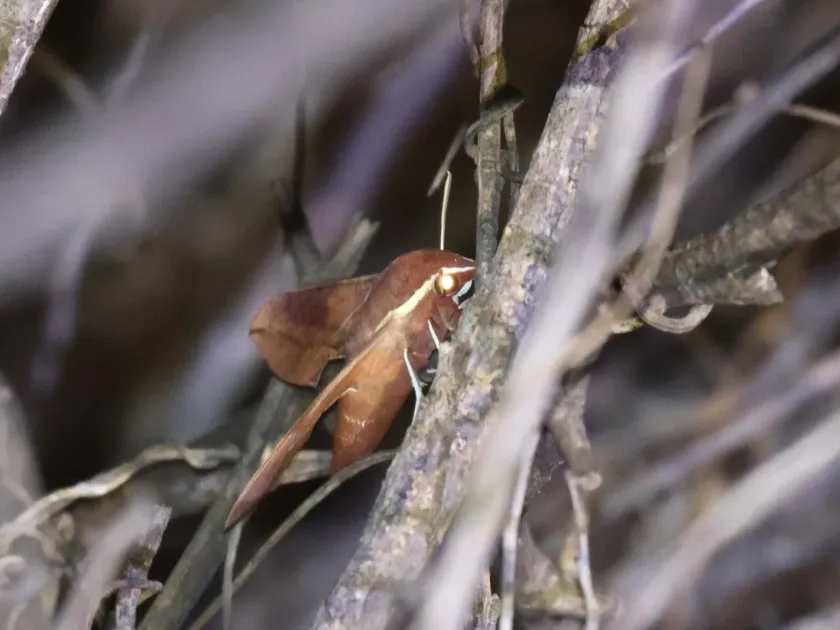
Description
How to identify
Hippotion scrofa is an insect from the order Lepidoptera, belonging to the family Sphingidae (hawkmoths). These are large nocturnal moths with streamlined bodies and powerful wings designed for rapid and agile flight.
The adult moth features a greyish-brown coloration with a characteristic pattern on the forewings. The caterpillars of this species, like those of other sphingids, are identified by a distinct horn-like protrusion on the posterior end of their body, which serves as a reliable diagnostic feature.
The insect undergoes a complete life cycle, consisting of four stages: egg, larva (caterpillar), pupa, and adult (imago). Understanding these stages is essential for determining the most effective timing for protective measures in the field.
Caterpillar coloration may vary depending on the developmental stage and environmental factors, facilitating camouflage among plant foliage. When at rest, the larvae often adopt a posture resembling a sphinx, which gives the entire family its common name.
Imago activity occurs during twilight and nighttime hours, making visual population monitoring difficult without the use of light traps or specialized attractants.
What it damages
The primary damage is caused by the larval stage, which has a highly intensive metabolism and consumes significant amounts of plant biomass. Host plants include various types of herbaceous crops and ornamental vegetation.
In regions where it is prevalent, this pest can cause severe damage to plantations by consuming leaves and young shoots, leading to reduced photosynthetic activity and overall weakening of the plant.
During mass outbreaks, caterpillars can rapidly defoliate entire bushes, significantly slowing growth, hindering the maturation of shoots, and reducing yields for the following growing season.
Damage to young plants often leads to their death or significant developmental delays due to the loss of the growth point and disruption of nutrient supply from the root system.
In agroecosystems, this pest shows a preference for nutrient-rich plants, making consistent population control a critical component of integrated pest management (IPM) programs.
When it appears
The pest's life cycle is closely linked to regional temperatures, as hawkmoths are thermophilic insects. Active flight of adults typically begins when stable nighttime temperatures reach above +15 degrees Celsius.
The first generation usually appears in late spring or early summer, coinciding with the active growth phase of many host plants, when egg-laying on foliage typically occurs.
Caterpillars pass through several instars, with food requirements increasing exponentially as they grow. The peak of damage is observed in the second half of the summer when larval biomass is at its maximum.
Pupae generally overwinter in the upper soil layer or within leaf litter, which provides protection against short-term sub-zero temperatures during the winter months.
In favorable climates, two generations can develop within a single growing season, significantly increasing the risk of severe infestation levels toward the end of the summer.
Signs of infestation
The first sign of infestation is coarse feeding along the margins of leaf blades. Unlike smaller pests, hawkmoth caterpillars consume entire leaves, often leaving only the main veins and sometimes completely stripping stems bare.
A vital indicator of pest presence is the caterpillar frass (excrement), which appears as small dark pellets accumulating on the soil surface or lower foliage levels of the host plant.
Specific egg-laying sites on the undersides of leaves, appearing as small, round, greenish or yellowish structures, serve as an early warning for pest monitoring efforts.
Because caterpillars are generally secretive, they are best spotted during inspections in the early morning or late evening, when they emerge from deep within the foliage to actively feed.
Occasionally, the presence of natural entomophages or signs of bird activity—such as birds hunting for large larvae—can alert the grower to an ongoing infestation.
Control measures
Preventive measures include deep autumn cultivation of the soil around host plants to destroy overwintering pupae, which significantly reduces the population for the following year.
For controlling larvae at early stages, the use of biological agents based on Bacillus thuringiensis is effective, as they target the caterpillars while sparing beneficial insects and maintaining human safety.
In cases of high infestation, the application of systemic or contact-stomach insecticides may be necessary, provided that harvest interval regulations are strictly observed.
Manual collection of caterpillars is feasible on small plots or in ornamental gardens, especially during morning hours when the pests are less mobile and more visible against the foliage.
The use of pheromone or light traps helps track the emergence of adults, allowing for timely protective interventions before intensive egg-laying and subsequent larval outbreaks occur.
Taxonomy
- Latin name
- Hippotion scrofa
- Order
- Lepidoptera (butterflies)
- Family
- Sphingidae
- EPPO code
- HIPTSC
Discussion
No discussions yet — be the first.