
Hidari irava
Hidari irava
Description
How to identify
Hidari irava is a moth species belonging to the Hesperiidae family, widely recognized as a significant defoliating pest of coconut palms.
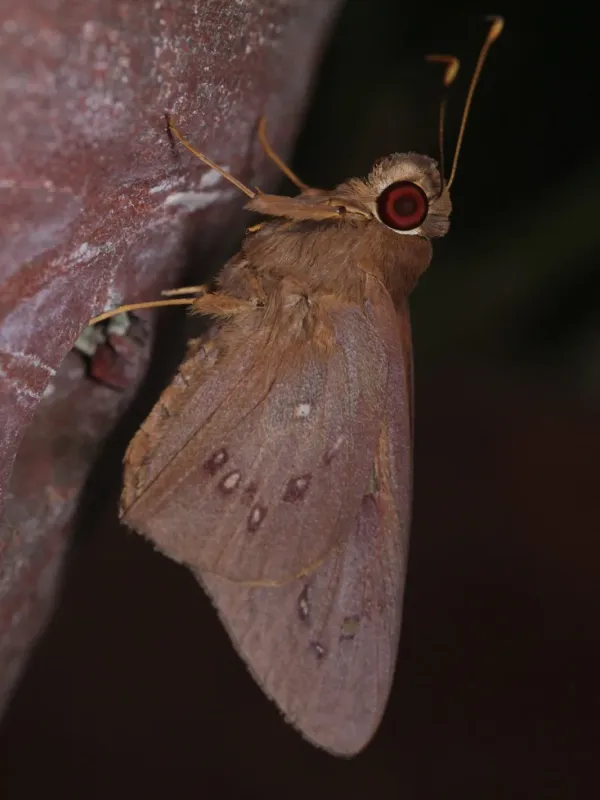
The adult moth has a wingspan of approximately 40–50 mm, characterized by brown to dark-ochre wings adorned with small, pale-colored spots.
Larvae pass through several distinct instars, initially appearing pale green and gradually developing a vibrant green color with a dark lateral stripe.
Pupae are typically green, providing excellent camouflage while attached to the underside of palm fronds or within rolled leaf structures.
The life cycle duration is highly dependent on ambient temperatures, with faster development rates observed in warmer tropical environments.
What it damages
The primary host for Hidari irava is the coconut palm (Cocos nucifera), where larvae consume the leaf tissue, causing severe defoliation.
The pest may occasionally infest other palm species found in the vicinity of coconut plantations within its native range in Southeast Asia.
Feeding by large larval populations leads to a substantial loss of photosynthetic capacity, which directly negatively impacts palm development.
Young seedlings are particularly vulnerable and may suffer from stunted growth or complete mortality if heavy defoliation occurs early on.
In mature palms, persistent feeding damage reduces nut production and can weaken the tree's overall resistance to secondary diseases.
When it appears
In tropical regions, Hidari irava remains active throughout the year, as temperature and humidity levels typically support continuous breeding.
Population peaks often align with the flush of new growth on coconut trees, providing an abundance of fresh food for the developing larvae.
The average generation time ranges from four to six weeks, facilitating multiple generations annually under favorable environmental conditions.
Dry periods may sometimes trigger population outbreaks, as the efficacy of certain natural predators and pathogens may decrease during these times.
Consistent monitoring of plantation foliage is essential to detect the presence of egg masses before larvae begin widespread feeding.
Signs of infestation
The most evident sign of infestation is the presence of notched or skeletonized leaf margins resulting from larval feeding activity.
Larvae construct shelters by folding leaf edges and securing them with silk, which are easily visible upon close inspection of the palm canopy.
Frass (larval excrement) accumulation at the base of leaflets or trapped within rolled leaf shelters is a strong indicator of an active colony.
Heavy infestations result in a ragged, tattered appearance of the palm fronds, significantly reducing the aesthetic and productive health of the trees.
Finding the larvae or pupae tucked inside these silk-bound leaf folds confirms the identity of the pest responsible for the damage.
Control measures
Biological control, utilizing natural enemies like parasitic wasps and predators, is the most sustainable approach for managing Hidari irava populations.
Mechanical control, involving the manual removal and destruction of infested leaves and larval shelters, is effective for small-scale plantations.
Chemical interventions with systemic insecticides should be reserved for severe outbreaks where biological methods are insufficient to prevent yield loss.
The application of bio-insecticides containing Bacillus thuringiensis offers a targeted, environmentally friendly solution for controlling larval stages.
Maintaining high levels of plant biodiversity around plantations helps support a healthy population of natural insect predators and parasitoids.
Taxonomy
- Latin name
- Hidari irava
- Order
- Lepidoptera (butterflies)
- Family
- Hesperiidae
- EPPO code
- HIDAIR
Discussion
No discussions yet — be the first.