
Large Chequered Skipper
Heteropterus morpheus
Description
How to identify
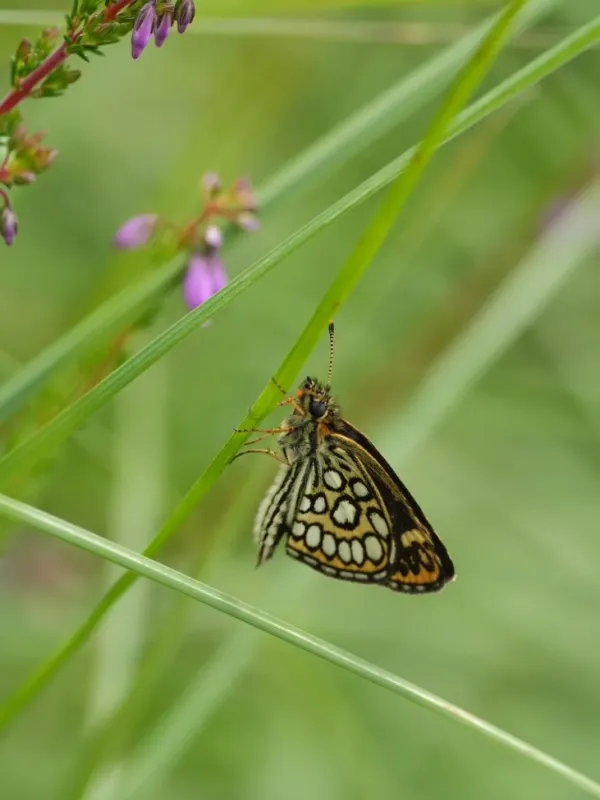
The Large Chequered Skipper (Heteropterus morpheus) is a butterfly species within the Hesperiidae family. Adults have a wingspan of approximately 30–35 mm, with dark brown upper wings and distinctive white, checkerboard-like spots on the undersides of the hindwings.
Larvae are pale green with a darker dorsal line and a light-colored head. Their bodies are covered in fine, short hairs, which allows them to blend in effectively with the foliage of their host grasses.
This species is univoltine, meaning it produces one generation per year. Older larvae hibernate during the winter, concealed within rolled-up grass leaves secured with silk threads.
Pupation occurs in the spring, typically within the same leaf shelters used for overwintering. The pupal stage lasts about two to three weeks before the adult butterflies emerge in early summer.
Females lay eggs individually on the leaves of host grasses. The larvae emerge shortly after and begin feeding on the leaf tissue until they enter diapause for the winter season.
What it damages
The primary hosts for Heteropterus morpheus are wild grasses such as Calamagrostis epigejos and Elymus repens, commonly found in meadows and woodland edges.
While not a major agricultural pest, the larvae may occasionally infest commercial grain crops if fields are situated near wild grasslands or uncultivated borders.
Feeding damage involves the consumption of leaf tissue, which can reduce the photosynthetic area of the plant, potentially leading to weakened growth and lower yields in affected patches.
The impact is usually localized and sporadic, rarely resulting in large-scale economic losses across vast agricultural areas.
Despite their limited impact on large-scale crops, their presence in dense populations can contribute to the degradation of pasture lands and adjacent grain field margins.
When it appears
Adult flight occurs from June through August, depending on the latitude and local climatic conditions, with peak activity observed in sunny weather.
Adults feed on floral nectar to fuel their activity, which is concentrated in warm, open environments where host grasses are abundant.
The larvae hatch in late summer and proceed to feed during the autumn months before temperatures drop, triggering the start of their hibernation phase.
During the winter, larvae remain inactive within their silken shelters, protected from predators and harsh environmental conditions until the spring warmth prompts growth to resume.
Fluctuations in spring temperatures can cause variation in the timing of butterfly emergence, sometimes delaying the lifecycle by several weeks in cooler years.
Signs of infestation
The most reliable sign of a presence is the observation of leaf rolls, where grass blades are folded and secured with visible silken threads.
Feeding activity is identified by irregular notches and holes along the edges of grass leaves, often accompanied by larval frass (excrement) within the shelters.
Monitoring for larvae requires careful inspection of host plants at the edges of fields during the early stages of the growing season.
Because the larvae are well-camouflaged, looking for the specific leaf-rolling habit is more effective than searching for the insects themselves.
- Rolled leaves on grasses.
- Presence of silken webs on leaf blades.
- Irregular feeding damage on the edges of leaves.
Control measures
Effective management begins with controlling host grasses and weeds like couch grass (Elymus repens) along field perimeters to minimize breeding sites.
Deep autumn plowing of field margins helps destroy overwintering larvae residing in plant residues, significantly reducing the population for the following year.
Chemical intervention with insecticides is rarely necessary and should be reserved only for cases where the economic injury level is exceeded on valuable crops.
Biological control, including the protection of natural predators and parasitoid wasps, plays a vital role in keeping populations of this species at manageable levels.
Regular surveillance of field borders is the most efficient strategy to prevent the migration of larvae from wild habitats into agricultural cultivation zones.
Taxonomy
- Latin name
- Heteropterus morpheus
- Order
- Lepidoptera (butterflies)
- Family
- Hesperiidae
- EPPO code
- HTERMO
Discussion
No discussions yet — be the first.