
Saddled prominent
Heterocampa guttivitta
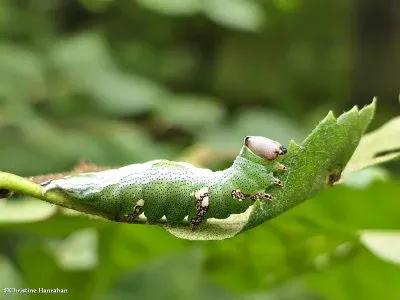
Description
How to identify
The saddled prominent (Heterocampa guttivitta) is a moth species belonging to the Notodontidae family. Adults are inconspicuous, greyish-brown moths that blend perfectly into tree bark, making them rarely seen by the casual observer during the day.
The larvae are distinct in their appearance, featuring a series of colorful, saddle-like markings on their backs as they reach later instars. Their body shape and texture help them camouflage among the leaves while they feed throughout the summer months.
What it damages
This species is a significant defoliator of hardwoods. It has a broad host range, including maple, beech, birch, oak, and various fruit trees, often causing substantial damage during population outbreaks.
The primary concern is the total loss of leaf surface area, which hinders the tree's ability to produce energy through photosynthesis. Repeated annual defoliation can kill branches or weaken the entire tree, making it susceptible to pathogens and wood-boring insects.
When it appears
The life cycle of the saddled prominent consists of a single generation per year. Adult moths emerge and mate during the early summer, laying eggs individually on the underside of the foliage.
Feeding larvae are present from July through September. Once they complete their growth, they descend to the ground to pupate within the soil or leaf litter, where they remain throughout the winter until the next season.
Signs of infestation
Early signs include minor leaf chewing, which eventually progresses to severe skeletonization. As the larvae grow larger, they consume entire leaves, often leaving only the main veins behind, leading to a thin and sparse canopy.
Frass (larval droppings) accumulating on leaves or on the ground beneath the canopy is a strong indicator of an active infestation. In severe cases, the sound of larvae feeding in the treetops can be audible on quiet days.
Control measures
Integrated Pest Management (IPM) is crucial for controlling this moth. Biological controls, such as the application of Bacillus thuringiensis (Bt), are highly effective for managing larvae while preserving beneficial species.
Encouraging natural predators such as parasitic wasps and predatory beetles can help keep population numbers in check. Chemical interventions should be used sparingly, targeting only high-value ornamental trees during the early larval development stage to minimize environmental impact.
Taxonomy
- Latin name
- Heterocampa guttivitta
- Order
- Lepidoptera (butterflies)
- Family
- Notodontidae
- EPPO code
- HETCGU
Discussion
No discussions yet — be the first.