
Skipper butterfly
Hesperia
Description
How to identify
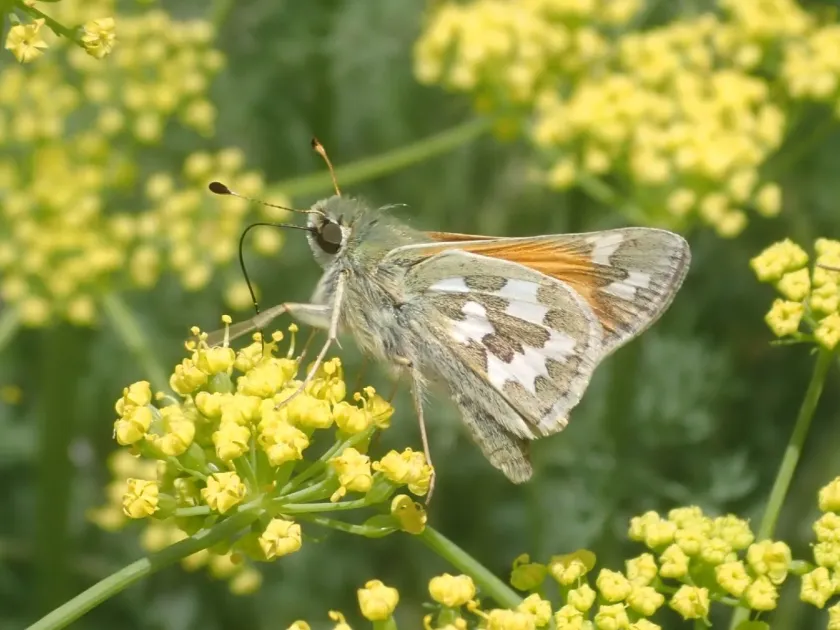
Skipper butterflies (family Hesperiidae) are members of the order Lepidoptera. They are easily distinguished from other butterflies by their stout, muscular bodies and proportionally large, wide heads.
Adult skippers often have a distinct, darting flight pattern, which makes them appear almost like flies or moths rather than typical slow-flying butterflies.
When resting, they frequently hold their wings in a unique "V" shape, with forewings held at a different angle than the hindwings, providing a clear visual cue.
The larvae are characterized by a cylindrical body that tapers significantly at both ends, accompanied by a large, distinct head capsule that is often dark in color.
Understanding their taxonomy is crucial for effective monitoring, as they belong to the superfamily Papilionoidea but are biologically distinct due to their specialized morphological features.
What it damages
The primary agricultural concern stems from the larval stage, where caterpillars feed on the foliage of various grasses, including cereal crops and pasture forage.
Feeding damage involves skeletonizing leaves or consuming large portions of the leaf blade, which directly interferes with the plant's photosynthetic efficiency.
In high-density populations, the caterpillars can cause significant defoliation, leading to stunted growth, reduced tillering, and overall yield loss in grain production.
Because they often infest wild grasses before moving to crops, they pose a significant threat to fields adjacent to uncultivated borders or weedy areas.
The economic threshold varies by crop, but even minor infestations can be detrimental if they occur during the critical early growth stages of the plant.
When it appears
The life cycle of the skipper butterfly is heavily influenced by regional climate and the phenology of their host plants, typically peaking during the warmer months.
Adults emerge from overwintering sites in late spring and begin searching for suitable host plants to lay their eggs, often preferring thick, succulent foliage.
Larval development progresses rapidly during the summer, with several generations often occurring in warmer temperate regions, resulting in continuous pressure throughout the season.
Pupation usually occurs within a protective enclosure made of silk and leaves, which helps the pupa survive environmental fluctuations and minor predator attacks.
As autumn approaches, the final generation enters a dormant stage, typically overwintering as larvae within protective silken shelters near the soil surface.
Signs of infestation
The most tell-tale sign of a skipper infestation is the presence of "leaf shelters," where larvae fold or roll a leaf and secure it with silken threads.
Searching for these rolled leaves provides a highly reliable method for detecting larval presence before damage becomes extensive across the field.
Feeding damage is often observed as irregular, ragged edges on the leaves, where the caterpillar has consumed portions while anchored in its shelter.
The accumulation of frass (caterpillar excrement) near the entrance of the silk-lined shelter serves as a secondary indicator of active infestation.
Visual spotting of adults flitting rapidly between plants can also act as an early warning sign that egg-laying is occurring in the vicinity.
Control measures
Effective management strategies for skipper populations prioritize prevention through robust agronomic practices to minimize favorable habitats.
- Elimination of volunteer grasses and weeds within and around fields to remove oviposition sites.
- Strategic tillage operations to disrupt pupal overwintering sites and reduce population carry-over.
- Monitoring fields during critical growth stages to assess larval activity and infestation levels.
When chemical intervention is necessary, the use of contact or systemic insecticides is most effective during the early larval instars before leaf rolling begins.
It is important to select products that are selective where possible to protect beneficial insects, while ensuring sufficient coverage to reach larvae inside their leaf shelters.
Taxonomy
- Latin name
- Hesperia
- Order
- Lepidoptera (butterflies)
- Family
- Hesperiidae
- EPPO code
- HSPESP
Discussion
No discussions yet — be the first.