
Sweet potato hornworm
Herse cingulata
Description
How to identify
The sweet potato hornworm, scientifically known as Agrius cingulata (often referred to as Herse cingulata), is a large moth belonging to the Sphingidae family. Its wingspan can reach up to 10–12 centimeters.
The forewings have a gray-brown color with a complex wavy pattern, providing excellent camouflage against tree bark or soil. The hindwings feature distinctive pink bands, which serve as a key identification mark.
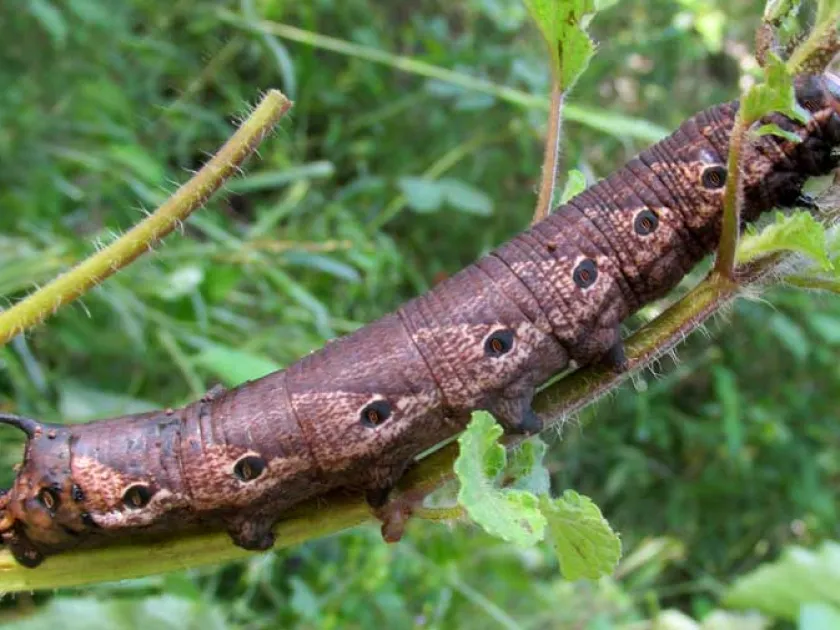
The larvae, or caterpillars, of this species are massive, growing up to 9 centimeters in length. They display a range of colors from light green to dark brown or black, usually with a characteristic tail "horn."
These moths are nocturnal and act as pollinators, but their larval stage is considered a significant agricultural pest that can strip foliage rapidly.
Pupae are dark brown and typically reside in the soil at a shallow depth, which is their primary overwintering and protective stage.
What it damages
The primary host plant for these larvae is the sweet potato (Ipomoea batatas). The caterpillars are voracious feeders and can consume large amounts of leaf tissue in a short time.
Beyond sweet potatoes, the hornworm may attack other plants within the Convolvulaceae family and occasionally members of the Solanaceae family, including tobacco and potato crops.
In areas with high population densities, these insects are capable of causing widespread defoliation, which severely hampers the plant's ability to produce tubers.
While the larvae primarily feed on leaves, heavy infestations cause the plant to exhaust its energy reserves, leading to stunted tuber growth and significant yield losses.
For commercial growers, an uncontrolled infestation can lead to a complete loss of the green canopy, negatively impacting the overall health and economic value of the harvest.
When it appears
The life cycle of the sweet potato hornworm is heavily dependent on temperature, making them most prevalent and active during warm seasons in tropical and subtropical regions.
Females lay eggs singly, usually on the underside of host leaves. The egg stage is short, typically hatching within 3 to 7 days depending on the thermal conditions.
The larval stage lasts for approximately 3 to 4 weeks, during which the caterpillars molt several times and increase in size significantly as they feed aggressively.
Upon maturity, the larva burrows into the soil to pupate. The entire cycle from egg to adult takes approximately one to two months, allowing for multiple generations per year.
Because multiple overlapping generations can occur in warm climates, constant monitoring is required to prevent sustained damage throughout the growing season.
Signs of infestation
The most visible sign of an infestation is the appearance of large, irregular holes in the leaf blades, often resulting in complete skeletonization of the plant's canopy.
Large, cylindrical fecal pellets (frass) accumulating under the plants are a clear indicator of the presence of active caterpillars feeding above.
During the early morning or evening hours, the large, fleshy larvae can be easily spotted resting on the stems or undersides of the leaves.
Severe infestations lead to rapid yellowing, wilting, and the eventual destruction of the leaves, which causes the vines to wither and stop growing.
- Large, irregular holes in leaves.
- Accumulation of dark, cylindrical frass on the ground.
- Visible large caterpillars on stems or leaves.
- Premature yellowing and desiccation of the vines.
Control measures
Hand-picking larvae is a practical and effective method for small-scale gardens or when infestations are localized. Early detection is crucial to prevent further damage.
Biological control methods, particularly the use of products containing Bacillus thuringiensis, are highly effective against younger larvae while remaining eco-friendly.
Chemical insecticides should be utilized only when economic damage thresholds are exceeded, ensuring that all safety pre-harvest intervals are strictly followed.
Tilling the soil after harvest is a vital cultural practice, as it disrupts the pupal stage in the soil, effectively reducing the population for the next growing season.
Managing weeds, especially those in the Convolvulaceae family surrounding the fields, helps eliminate secondary host sources and reduces the moth population in the area.
Taxonomy
- Latin name
- Herse cingulata
- Order
- Lepidoptera (butterflies)
- Family
- Sphingidae
- EPPO code
- HERSCI
Discussion
No discussions yet — be the first.