
Black soldier fly
Hermetia illucens
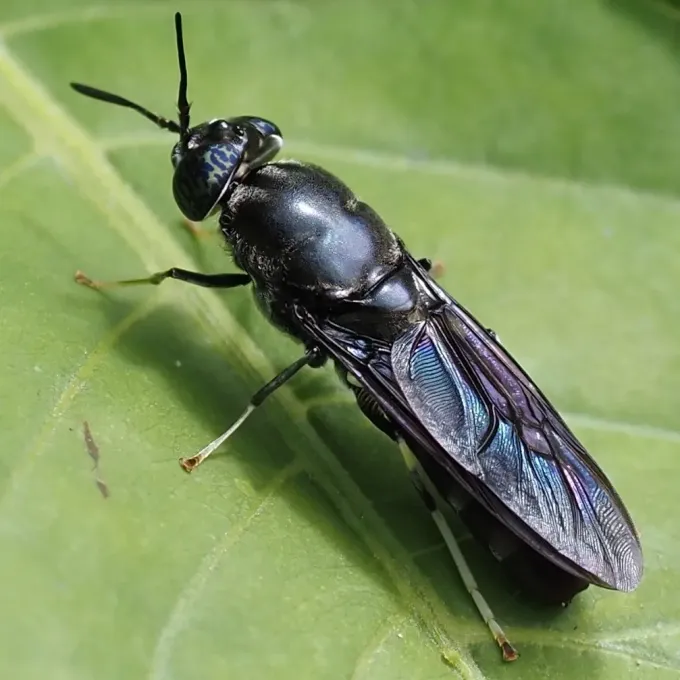
Description
How to identify
The black soldier fly (Hermetia illucens) belongs to the family Stratiomyidae. The adult fly is a large insect, typically 15-20 mm long, with a dark, wasp-like appearance.
The larval stage is the most recognizable, characterized by a segmented, flattened body with a tough, leathery exoskeleton, ranging from creamy white to brownish in color.
Adult flies possess vestigial mouthparts, meaning they do not feed and do not act as vectors for plant diseases in the way typical fruit flies or pests do.
The life cycle involves complete metamorphosis: eggs are laid in crevices near decaying organic matter, followed by larval growth, pupation, and the emergence of adults.
Developmental rates are highly dependent on temperature and moisture levels, allowing the species to proliferate rapidly in favorable conditions.
What it damages
The black soldier fly is not considered a pest of agricultural crops. It does not feed on living plant tissues, leaves, or roots, thus posing no direct threat to harvest yields.
The larvae are saprophagous, meaning they derive nutrition exclusively from decaying organic matter, such as manure, food scraps, and rotting vegetation.
While they are beneficial in waste management, their presence in large numbers within a greenhouse may suggest poor sanitation and an accumulation of decomposing debris.
There are no recorded instances of this insect causing direct damage to healthy horticultural or field crops.
Their presence should be viewed as an indicator of organic accumulation rather than an active infestation of a plant pest.
Control measures
Managing the black soldier fly in a farming environment relies purely on cultural and sanitation practices rather than chemical applications.
The primary control measure is to keep the greenhouse or farm area free of accumulated rotting plant material and decaying organic waste.
Ensure proper drainage and irrigation management to prevent waterlogging, as damp conditions near decomposing matter attract females for oviposition.
Chemical insecticides are neither recommended nor necessary, as the organism provides valuable ecological services as a decomposer and is not a target pest.
Maintain high standards of hygiene, rotate compost piles effectively, and remove potential breeding sites to discourage the presence of the insect in cultivation zones.
Taxonomy
- Latin name
- Hermetia illucens
- Order
- Diptera (flies)
- Family
- Stratiomyidae
- EPPO code
- HEREIL
Discussion
No discussions yet — be the first.