
Nevada buck moth
Hemileuca nevadensis
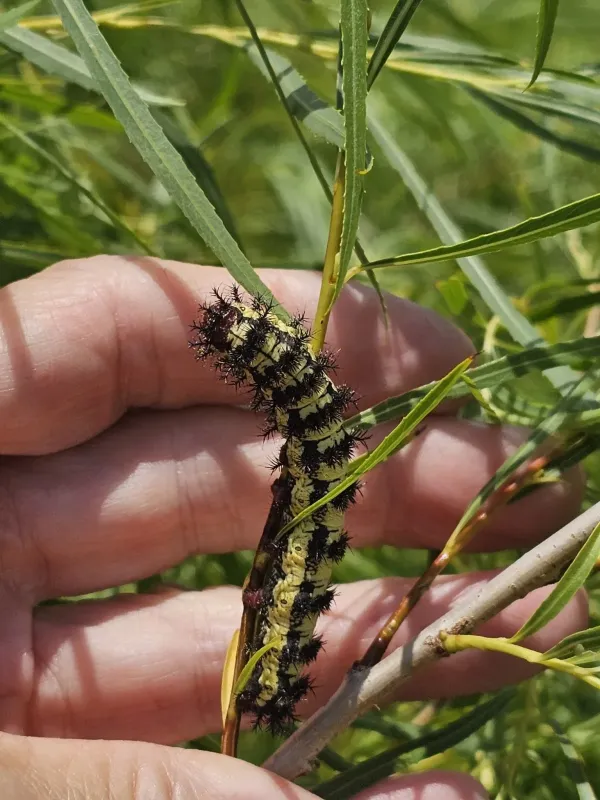
Description
How to identify
The Nevada buck moth (Hemileuca nevadensis) is a member of the Saturniidae family, commonly known as the giant silkmoth family. Adult moths are relatively large with wings featuring striking patterns and colors, usually blending black and white or yellow tones.
Larvae, or caterpillars, are the most recognizable stage. As they mature, they become covered in dense, branched spines, which serve as a primary defense mechanism against avian and insect predators.
The coloration of the larvae typically involves a dark base with distinctive orange or yellow tubercles. It is important to note that these spines can be irritating to human skin, so handling them directly is not recommended.
Taxonomically, this species is closely related to other moths within the genus Hemileuca. Field identification often relies on the specific geographical range and the host plants on which the larvae are found.
The species undergoes complete metamorphosis. Its lifecycle is finely tuned to the specific environmental conditions of its habitat, ensuring survival through the distinct stages of egg, larva, pupa, and adult.
What it damages
The primary host plants for the Nevada buck moth are trees within the Salicaceae family, specifically various species of willow (Salix) and cottonwood or poplar (Populus).
The larvae are voracious feeders. Early instars typically feed in groups, skeletonizing the leaves by consuming the soft tissues between veins. As they grow, they move to solitary or semi-gregarious feeding, consuming whole leaves.
Heavy infestations can lead to significant defoliation of the host trees. This stress weakens the tree's health, making it more susceptible to environmental stressors, such as drought, and secondary infestations by wood-boring insects.
For ornamental trees in landscape settings, the damage ruins the aesthetic appeal, causing sparse canopies and reduced vigor. In forest health contexts, it may negatively impact the growth rates of young riparian stands.
While mature trees can often withstand moderate defoliation, repeated annual attacks can lead to branch dieback or reduced vitality, eventually impacting the overall lifespan of the host tree.
When it appears
The Nevada buck moth follows a strict seasonal schedule dictated by local climate patterns. Adults typically emerge and are active in the late summer or early autumn months.
After mating, females deposit their eggs in clusters on the twigs of host trees. These eggs serve as the overwintering stage, staying dormant throughout the cold winter months to survive harsh weather.
Larvae emerge in the spring, which is timed perfectly with the budding of their preferred host trees. This synchronization ensures that the caterpillars have immediate access to high-quality, tender foliage.
The active feeding phase occurs during late spring and into early summer. During this time, the larvae pass through several molting stages, increasing their size and the volume of plant tissue consumed.
Pupation occurs in the soil or leaf litter beneath the host tree. The pupa remains in this state through the heat of the summer, undergoing metamorphosis before emerging as an adult moth to begin the cycle again.
Signs of infestation
The most prominent sign of an infestation is the presence of caterpillar clusters on the branches of willow or poplar trees. Their communal feeding behavior makes them easy to spot during the early stages.
Look for evidence of skeletonized leaves, where only the veins remain. As the caterpillars grow larger, irregular feeding patterns on the edges of the leaves become more apparent across the tree canopy.
Frass (caterpillar droppings) accumulating on the leaves below or on the ground at the base of the tree is a classic indicator that a colony is currently feeding in the branches above.
During the transformation period, one might find discarded larval skins on the bark or branches. Occasionally, moths can be seen flying near artificial light sources at night during the late summer.
If a tree shows unexpected leaf loss during mid-season, a visual inspection of the canopy can usually reveal the presence of larvae or the damage patterns they have left behind.
Control measures
On a small scale, such as in private gardens, manual removal of larval clusters is often the most effective method. This keeps the population under control and prevents extensive damage to the tree.
For larger infestations or professional forestry applications, biological insecticides like Bacillus thuringiensis are highly recommended. These are effective against caterpillars while being safe for most beneficial insects.
When populations reach outbreak levels, targeted application of appropriate insecticides may be necessary. It is crucial to time these applications with the early larval stages to maximize effectiveness.
Promoting general tree health through proper irrigation and soil management helps trees recover more quickly from defoliation events. A vigorous tree can tolerate larval feeding with minimal long-term harm.
Encouraging natural predators, such as insectivorous birds and parasitic wasps, can provide long-term natural suppression of the moth population and reduce the need for chemical interventions.
Taxonomy
- Latin name
- Hemileuca nevadensis
- Order
- Lepidoptera (butterflies)
- Family
- Saturniidae
- EPPO code
- HMLCNE
Discussion
No discussions yet — be the first.