
Buck moth
Hemileuca maia
Description
How to identify
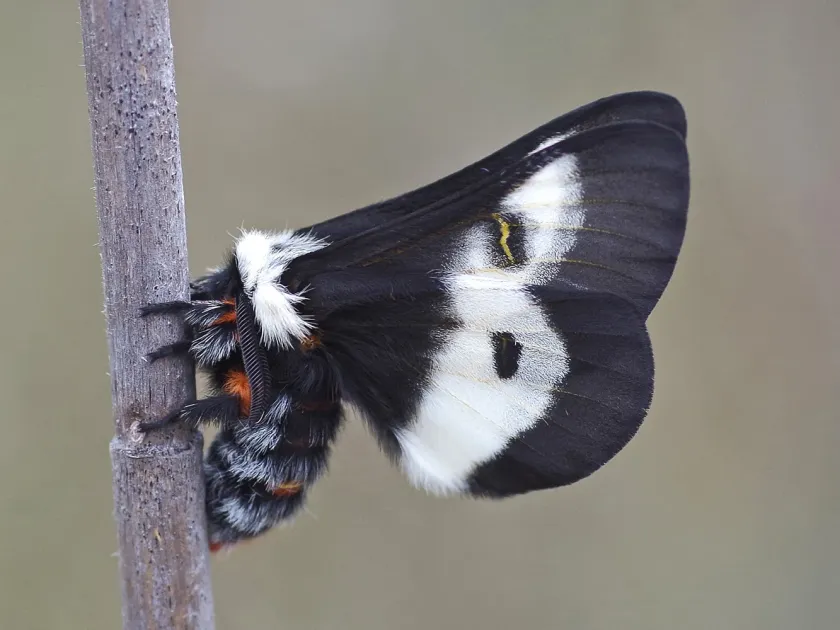
The Buck moth (Hemileuca maia) is a species of moth in the family Saturniidae. The adult moth is characterized by a black velvety appearance with a broad white band across the wings and a distinctive eyespot in the center.
The larvae, or caterpillars, are notable for their size, reaching up to 7 centimeters. Their bodies are covered with tufts of branched spines, which are connected to venom glands that can cause significant skin irritation and painful stings to humans.
The coloration of the caterpillars ranges from dark brown to almost black, providing effective camouflage while feeding on the leaves and bark of their host trees.
Pupation occurs in the soil or under leaf litter, where the insects form dense, dark-brown cocoons to survive the summer months and prepare for the autumn emergence.
This species is uniquely identified by its late-season emergence, as adult moths are primarily active during the autumn, which distinguishes it from many other seasonal defoliators.
What it damages
The primary host plants for Buck moth larvae are various species of oak (Quercus), where they can cause significant foliage loss in forest ecosystems and urban landscapes.
While oaks are the preferred host, caterpillars may also feed on other hardwood trees such as willow, birch, and cherry if population densities are high and resources become limited.
Initial larval feeding is gregarious, where young caterpillars skeletonize leaves. As they grow, they disperse and consume entire leaf blades, which can lead to rapid and widespread defoliation of the canopy.
Severe infestations weaken the host trees, reducing their vigor and making them susceptible to secondary pests and various types of fungal pathogens that target stressed specimens.
The timing of the damage occurs during the peak growth season, which interferes with the tree's ability to produce the energy required for its long-term survival and health.
When it appears
The Buck moth completes one generation per year. The species overwinters exclusively in the egg stage, with females laying eggs in distinct rings around the twigs of host trees.
Egg hatch occurs in the spring, coinciding with the budbreak of oak trees. This synchronization ensures that the emerging larvae have immediate access to high-quality food for rapid development.
The larval stage lasts approximately two months, after which the caterpillars enter the soil to pupate, remaining there throughout the summer season in a state of diapause.
Adult moths emerge in late summer or autumn. During this time, they engage in mating and egg-laying, ensuring the next generation is secured on the twigs before the winter sets in.
Understanding this distinct phenology is essential for planning management practices, as targeting the overwintering egg stage is the most efficient way to prevent infestation.
Signs of infestation
The most reliable sign of an impending infestation is the presence of egg masses, which look like dark, band-like clusters encircling small twigs, easily visible in winter.
Observing small, dark-colored caterpillars feeding in groups on the underside of leaves indicates the beginning of the active larval season and potential future damage.
Characteristic damage includes skeletonized leaves with missing tissue and irregular holes, as well as the accumulation of frass (caterpillar droppings) on the ground beneath the canopy.
Fully grown caterpillars, due to their size and distinct spiny appearance, are easily spotted as they disperse throughout the branches of the host tree.
An increase in bird activity near the canopy or the sight of silk strands used by caterpillars for movement are secondary indicators that a population is active in the vicinity.
Control measures
Mechanical control is highly effective: pruning and destroying twigs that contain egg masses during the winter months eliminates the population before the caterpillars can even emerge.
Manual removal of caterpillars is possible but requires the use of thick protective gloves to avoid contact with the venomous spines, which can cause severe dermatitis.
Biological control using Bacillus thuringiensis (Bt) is recommended for larger-scale infestations, as it specifically targets the larvae while remaining safe for most beneficial insects.
Chemical insecticides should be reserved for severe outbreaks where tree health is at immediate risk, ensuring that applications are timed to minimize impact on non-target species.
Maintaining tree health through proper fertilization and watering helps plants recover from foliage loss more quickly and increases their natural resistance to insect damage.
Taxonomy
- Latin name
- Hemileuca maia
- Order
- Lepidoptera (butterflies)
- Family
- Saturniidae
- EPPO code
- HMLCMA
Discussion
No discussions yet — be the first.