
Hemileuca lucina
Hemileuca lucina
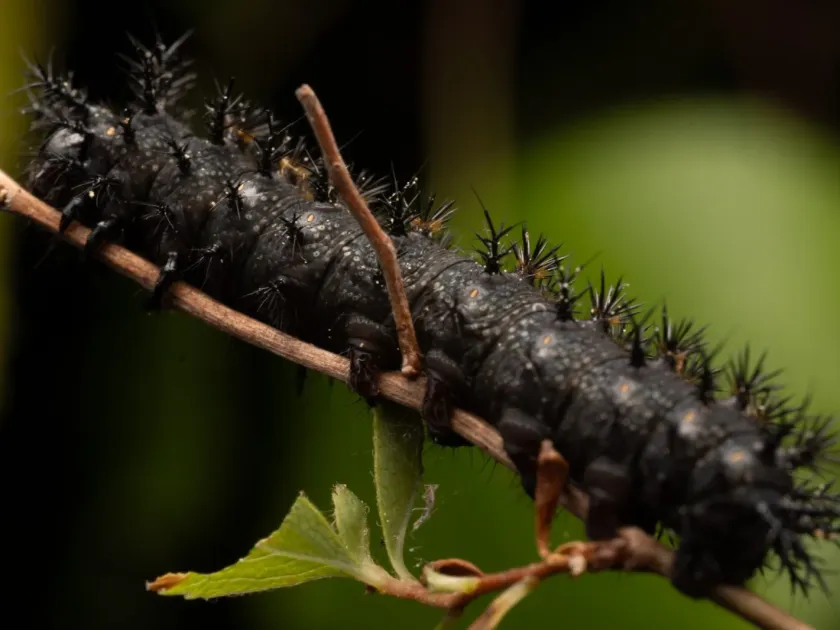
Description
How to identify
Hemileuca lucina, commonly known as the New England buck moth, is a member of the Saturniidae family. These moths are characterized by their striking appearance, with dark wings featuring broad white or cream-colored bands, adapted for life in northern temperate climates.
The larvae, or caterpillars, undergo several developmental stages known as instars. Early stages are often gregarious, feeding and resting in clusters. Their bodies are covered in specialized hairs and spines, which serve as a defense mechanism against predators and can cause irritation to human skin upon contact.
As the larvae mature, they become solitary and more active. Their coloration may change slightly, but they maintain their distinct appearance, making them recognizable to those familiar with regional Lepidoptera. Their growth is strictly tied to the seasonal availability of their preferred host plants.
The life cycle of the moth is uniquely adapted to its environment. After reaching maturity, the larvae descend to the soil to pupate. The pupal stage is a crucial period of transformation, leading to the emergence of adults in late summer, which is when the breeding cycle begins again.
Understanding the life stages of this insect is essential for effective monitoring. Because the species spends the winter in the egg stage, attached to host plant stems, they remain vulnerable to targeted management efforts during the dormant season.
What it damages
The primary host plant for Hemileuca lucina is Spiraea alba (narrow-leaf meadowsweet). While this is their preferred source of nutrition, they can occasionally be found on other Spiraea species commonly used in ornamental landscaping.
Feeding damage begins as small holes in the leaves but quickly progresses to skeletonization, where only the major leaf veins remain. This extensive defoliation can significantly reduce the photosynthetic capacity of the plant, leading to stunted growth and reduced vigor.
In cases of severe infestation, the cumulative stress on the shrub can be immense. Frequent defoliation over several growing seasons can weaken the root system and diminish the plant's ability to produce flowers, ultimately marring the aesthetic appeal of the garden.
Younger or newly planted specimens are particularly vulnerable to larval damage. Without sufficient energy reserves, these plants may struggle to recover from the loss of foliage, making them more susceptible to secondary environmental stresses like drought or heat.
Although typically considered a localized pest, their tendency to gather in groups means that a single colony can rapidly defoliate a significant portion of an individual shrub. Early intervention is key to preventing the spread to neighboring plants in a dense garden setting.
When it appears
The life cycle of Hemileuca lucina is highly seasonal. Eggs hatch in late spring, aligning with the emergence of new foliage on host plants. This timing ensures that larvae have an immediate food source to support their rapid growth.
Active larval feeding continues throughout early to mid-summer. As the caterpillars reach their final instar, they prepare for pupation. By mid-summer, the majority of larvae have descended to the leaf litter or soil to enter the pupal stage.
Adult moths emerge in late summer, typically August or September. This is the period of mating and oviposition. Females lay clusters of eggs on the branches of host plants, which will remain there through the autumn and winter months.
Winter survival is dependent on the eggs' ability to withstand freezing temperatures. The eggs are cemented to the twigs, protected by a dark, hardened secretion that also helps them blend in with the bark, reducing predation during the winter.
Gardeners should monitor their shrubs during the autumn pruning season to look for these egg masses. Identifying the eggs before spring is the most efficient way to break the cycle and prevent caterpillar damage from occurring in the new season.
Signs of infestation
Visible signs of infestation include the presence of larval clusters on the tips of branches. These groups are often easy to spot, especially as they feed and create noticeable areas of damage on the shrub's foliage.
The signature damage pattern is skeletonized leaves, which give the plant a tattered, lace-like appearance. As the larvae grow, they consume more leaf tissue, making the skeletonized damage more obvious to the casual observer.
Accumulated frass, or larval excrement, is another tell-tale sign of an active colony. Dark, pellet-like droppings on the leaves below the feeding site or on the ground at the base of the plant indicate that caterpillars are nearby.
During the dormant season, winter egg masses are the primary sign. These appear as small, dark, firm clusters tightly wrapped around twigs. They are often found near the base of the plant or at branch junctions, appearing as dark nodules on the bark.
Overall plant health degradation is also a sign. If a spiraea shrub appears stressed, shows premature yellowing, or loses its leaves in mid-summer, it is worth inspecting for the presence of larvae or evidence of past skeletonizing activity.
Control measures
Manual removal of egg masses during late autumn and winter is the most effective and eco-friendly control method. Pruning and destroying infested twigs effectively eliminates the next generation of larvae before they even hatch.
For early-season infestations, physical removal of larval clusters is highly effective. Since the larvae aggregate, gardeners can simply prune out the affected branch tips containing the colony and dispose of them, preventing further spread.
Biological controls such as Bacillus thuringiensis (Bt) are highly effective against Hemileuca lucina larvae. This bacterial agent is specific to caterpillars, posing little to no risk to beneficial insects, pets, or humans, making it ideal for home gardens.
In cases of heavy infestation where manual removal is impractical, systemic insecticides may be considered. However, these must be applied outside of flowering periods to protect pollinator populations, as the chemical can remain in plant tissues for some time.
Promoting general plant health is a vital long-term strategy. Proper watering, mulching, and regular pruning help the spiraea shrub remain vigorous, allowing it to recover more quickly from minor pest pressure without the need for chemical intervention.
Taxonomy
- Latin name
- Hemileuca lucina
- Order
- Lepidoptera (butterflies)
- Family
- Saturniidae
- EPPO code
- HMLCLU
Discussion
No discussions yet — be the first.