
Hemileuca eglanterina
Hemileuca eglanterina
Description
How to identify
Hemileuca eglanterina, commonly known as the Western sheep moth, belongs to the Saturniidae family, which includes some of the most visually striking moths.
The adult moth features a wingspan of approximately 50 to 75 mm, characterized by bright patterns of yellow, pinkish-red, and black, which serve as warning coloration.
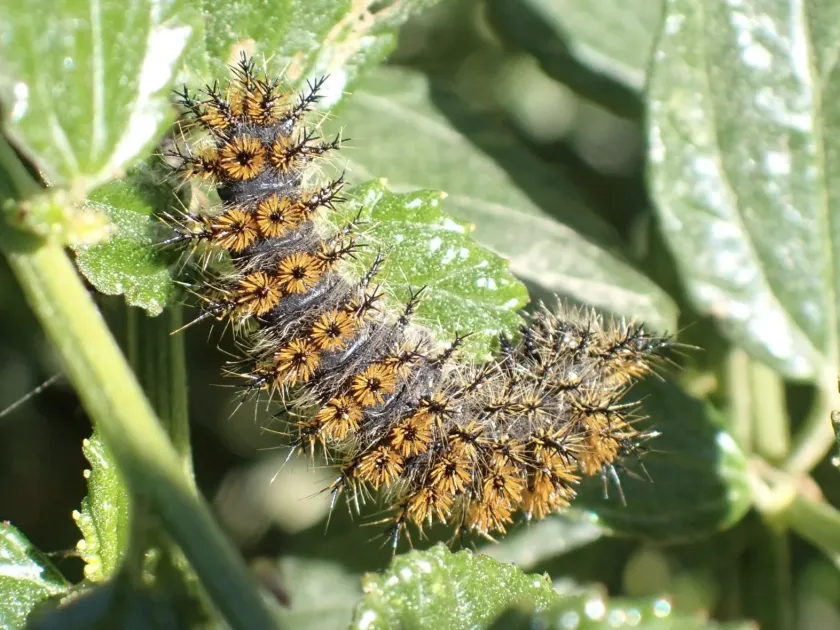
Larvae, or caterpillars, are the stage that concerns gardeners. They are densely covered in branching spines that can deliver a painful sting if handled without caution.
The species is primarily native to Western North America, inhabiting meadows, forest edges, and areas rich in shrubby vegetation like wild roses and chokecherry.
The life cycle involves a single generation per year, with eggs overwintering on host plant branches until spring when the larvae emerge to feed on developing leaves.
What it damages
The damage caused by Hemileuca eglanterina is primarily due to the voracious feeding habits of the larvae, which can quickly consume large quantities of foliage.
Common host plants include various species within the Rosaceae family, such as wild roses (Rosa), apple trees, and different types of Spiraea used in landscaping.
Heavy infestations lead to significant defoliation, which severely stresses the host plant, resulting in reduced vigor, poor growth, and potential susceptibility to diseases.
When populations are high, entire branches or even small shrubs can be stripped of leaves, leaving behind only the veins and petioles, which is known as skeletonization.
While mature shrubs often recover, young nursery stock or recently planted saplings may suffer permanent damage or stunted development due to repeated attacks.
When it appears
Adult moths are typically active during the mid-summer period, generally from July through August, during which time they mate and deposit their eggs.
The eggs remain in a dormant state throughout the fall and winter, securely attached to the twigs of host plants, awaiting the return of warmer spring temperatures.
Larval emergence correlates with the budding of host plants in the spring, typically starting when new leaf tissue is available for consumption.
The caterpillars grow through several instars, with the most intense feeding activity occurring in late spring and early summer before they descend to pupate.
Pupation takes place in the soil, where the insect remains safely tucked away until the cycle begins again the following summer.
Signs of infestation
One of the earliest signs of an infestation is the presence of skeletonized leaves on the outer periphery of the plant canopy where larvae have been feeding.
Dark, granular droppings (frass) visible on the ground or on lower leaves are a clear indicator that larvae are present in the upper foliage of the shrub.
During the dormant season, observant gardeners can find egg masses, which appear as tight, dark rings or clusters encircling the smaller twigs of the host plant.
The presence of large, brightly colored, spiny caterpillars clustered together on leaves is the most obvious sign of an active colony during the growing season.
Some larvae may produce light silk webbing around their feeding sites, which can be seen upon close inspection of damaged branches.
Control measures
The most effective cultural method is to manually inspect host plants during the winter for egg masses and prune them out before they hatch in the spring.
For smaller infestations, caterpillars can be removed by hand; however, it is essential to wear thick gloves to protect skin from the irritating spines.
Biological control agents, particularly products containing Bacillus thuringiensis, are highly effective against larvae and have minimal impact on beneficial insects.
Chemical intervention should be reserved for severe outbreaks and applied according to local agricultural regulations to ensure safety and target precision.
- Monitor plants frequently during early spring.
- Promote biodiversity to encourage natural predators.
- Avoid broad-spectrum insecticides to protect pollinators.
- Keep shrubs healthy through proper irrigation and fertilization.
Taxonomy
- Latin name
- Hemileuca eglanterina
- Order
- Lepidoptera (butterflies)
- Family
- Saturniidae
- EPPO code
- HMLCEG
Discussion
No discussions yet — be the first.