
Hemileuca
Hemileuca
Description
How to identify
Hemileuca is a genus of moths belonging to the Saturniidae family, commonly known as buck moths. Adults are robust insects often characterized by distinct, often banded patterns on their wings.
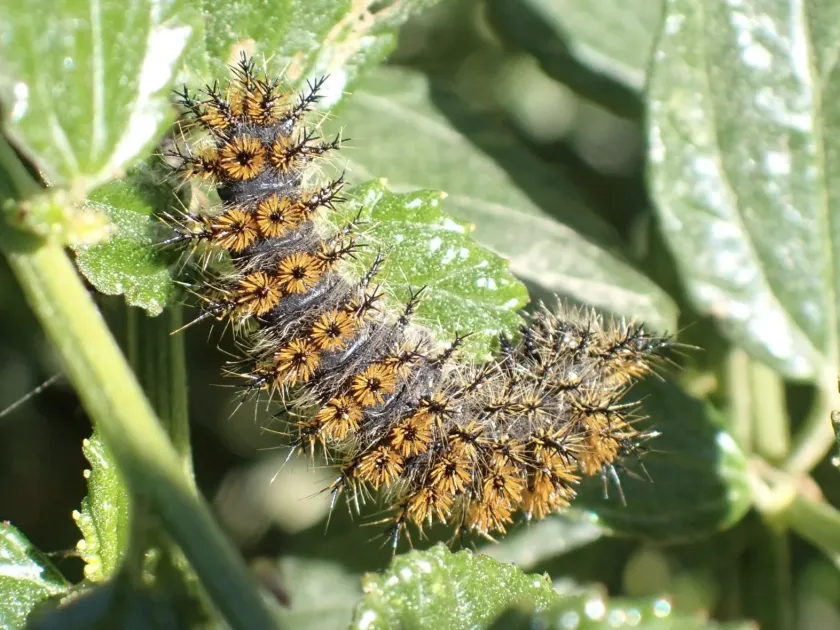
The larvae are particularly well-known for their branched, stinging spines that cover their bodies. These spines are connected to venom glands, providing a potent defense against predators.
The coloration of the caterpillars varies significantly, ranging from yellow and orange to dark brown or black, often with contrasting patterns or markings.
These insects undergo a complete metamorphosis, consisting of egg, larva (caterpillar), pupa, and adult stages. Most species complete only one generation per year.
Pupation typically occurs underground or within leaf litter, where the pupae remain in a state of diapause until favorable conditions for emergence occur.
What it damages
Hemileuca caterpillars are voracious defoliators, feeding on a variety of deciduous trees and shrubs, with a preference for oaks, willows, and rosaceous plants.
During outbreak years, large populations of these caterpillars can completely strip trees of their foliage, leading to significant stress and overall decline in tree health.
Severe defoliation disrupts the plant's photosynthetic capacity, reducing the energy reserves necessary for the following growing season and winter survival.
Young saplings are at the highest risk, as they cannot recover from complete defoliation as effectively as mature, established trees.
While the adult moths do not feed, the female's egg-laying behavior results in localized areas of high caterpillar density, which can cause heavy localized damage.
When it appears
The lifecycle of Hemileuca is strictly synchronized with the seasons, with adult moths typically emerging in late summer or autumn depending on the region.
Females deposit eggs in clusters on the twigs of host plants, where they overwinter, ensuring that the next generation hatches at the optimal time.
Larvae hatch in the spring, coinciding with bud break, which ensures a steady supply of nutritious, tender foliage for the developing caterpillars.
Peak feeding activity usually occurs during late spring and early summer, as the larvae grow through several instars, rapidly increasing their mass.
By mid-summer, the caterpillars reach their final size and descend from the host tree to pupate in the soil or ground cover.
Signs of infestation
The most evident sign of infestation is the presence of caterpillar groups feeding on the leaves, leading to ragged leaf edges or total skeletonization.
Accumulations of larval frass (droppings) on the ground beneath the host tree are a clear indicator of high caterpillar activity in the canopy.
Care must be taken when examining infested plants, as the venomous spines on the caterpillars can cause severe skin irritation and allergic reactions upon contact.
Egg masses can be spotted on twigs during winter, often appearing as dark, solidified bands wrapped around the stems.
Premature leaf drop and visible thinning of the canopy during the growing season serve as major warning signs that the tree is under heavy grazing pressure.
Control measures
Manual removal and destruction of egg masses during the dormant winter months is a highly effective way to prevent spring infestations.
Biological control agents, such as formulations of Bacillus thuringiensis (Bt), are effective against young larvae while minimizing impact on beneficial insects.
Chemical insecticides should be reserved for severe outbreaks, as they can negatively impact the populations of natural predators and parasitoids.
Encouraging natural predators, such as birds and parasitic wasps, can provide long-term, sustainable control of Hemileuca populations in the garden.
Monitoring adult flight using pheromone or light traps helps in timing control measures and assessing the potential risk for the upcoming season.
Taxonomy
- Latin name
- Hemileuca
- Order
- Lepidoptera (butterflies)
- Family
- Saturniidae
- EPPO code
- HMLCSP
Discussion
No discussions yet — be the first.