
Vagrant emperor
Hemianax ephippiger
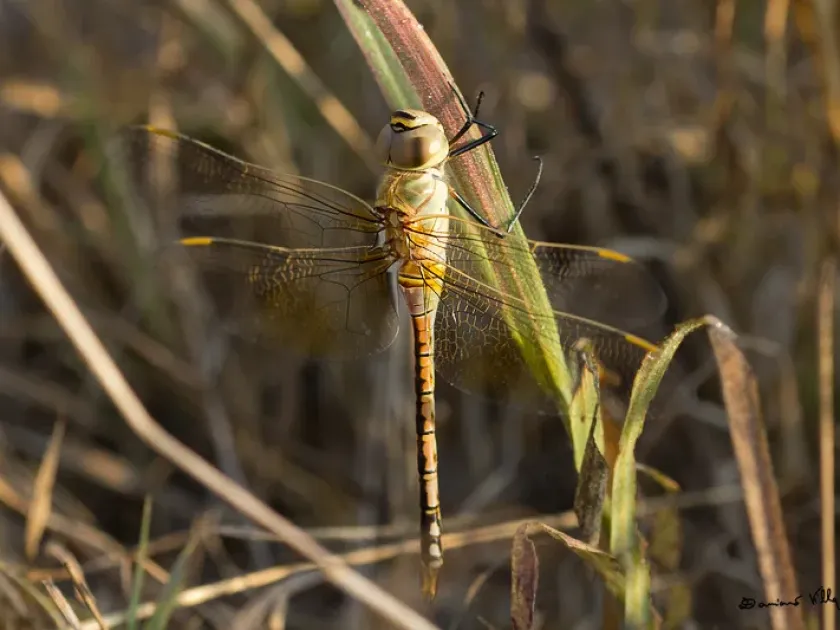
Description
How to identify
The vagrant emperor (Hemianax ephippiger) is a large dragonfly belonging to the Aeshnidae family, widely known for its extensive migration capabilities.
The adult dragonfly typically measures about 60–70 mm in length with a wingspan reaching up to 100 mm, making it a prominent presence in the field.
Its body coloration is predominantly ochre-yellow to brownish, with a distinct saddle-shaped marking on the second abdominal segment.
The larvae are aquatic and possess a slender, elongated body, utilizing a specialized labial mask to capture their prey underwater.
This species is highly mobile, often traveling across continents, which differentiates it from more sedentary dragonfly species found in similar climates.
What it damages
The vagrant emperor is not a phytophagous insect and does not consume parts of agricultural crops, meaning it causes no direct tissue damage to plants.
However, it can be considered a pest in commercial fish farming, as its larvae prey on fish fry in breeding ponds and irrigation reservoirs.
In intensive rice cultivation systems, large populations of dragonfly larvae can compete for resources, affecting the balance of the aquatic environment.
Adult dragonflies are generalist predators, and while they may help control some insect populations, they are not managed as agricultural targets.
Most agronomic interest in this species relates to ecological monitoring rather than the implementation of eradication programs for crop protection.
When it appears
The flight season for adults typically occurs from spring through late summer, synchronized with favorable thermal conditions for migration.
Reproduction takes place in freshwater environments, where eggs are laid directly into the water or onto aquatic plant stems.
The emergence of adults is highly dependent on wind patterns and temperature, leading to sudden appearances in specific geographic locations.
Larval development in aquatic settings spans several months, depending on water temperature and the availability of food sources.
As winter approaches, the vagrant emperor migrates toward southern latitudes, as it cannot survive the freezing temperatures of temperate winters.
Signs of infestation
A primary indicator is the sudden mass arrival of large dragonflies hovering over rice fields, irrigation canals, or artificial ponds.
Their flight behavior is distinct, characterized by high-speed maneuvers and long periods of hovering above the water surface.
Exuviae (cast-off larval skins) found on reeds or other near-water vegetation are clear signs that the larvae have successfully emerged.
Aquatic samples from irrigation ditches may reveal the presence of dragonflies in their nymph stage during the warmer months.
During peak migration events, large numbers of these insects may be observed resting on fences, shrubs, and field borders.
Control measures
Direct chemical control measures against the vagrant emperor are rarely necessary, given that it does not pose a threat to standard field crops.
In aquaculture environments, managing water levels and conducting periodic pond drainage are the most effective ways to disrupt the larval cycle.
Promoting biological balance by encouraging natural predators, such as waterfowl and piscivorous fish, helps keep the population in check naturally.
Maintaining clean irrigation infrastructure by removing excessive aquatic debris reduces suitable egg-laying sites for the female dragonflies.
Avoiding broad-spectrum insecticide usage is recommended to preserve beneficial insect populations that provide natural biological pest control.
Taxonomy
- Latin name
- Hemianax ephippiger
- Family
- Aeshnidae
- EPPO code
- HANXEP
Discussion
No discussions yet — be the first.