
Brown hawker
Aeshna grandis
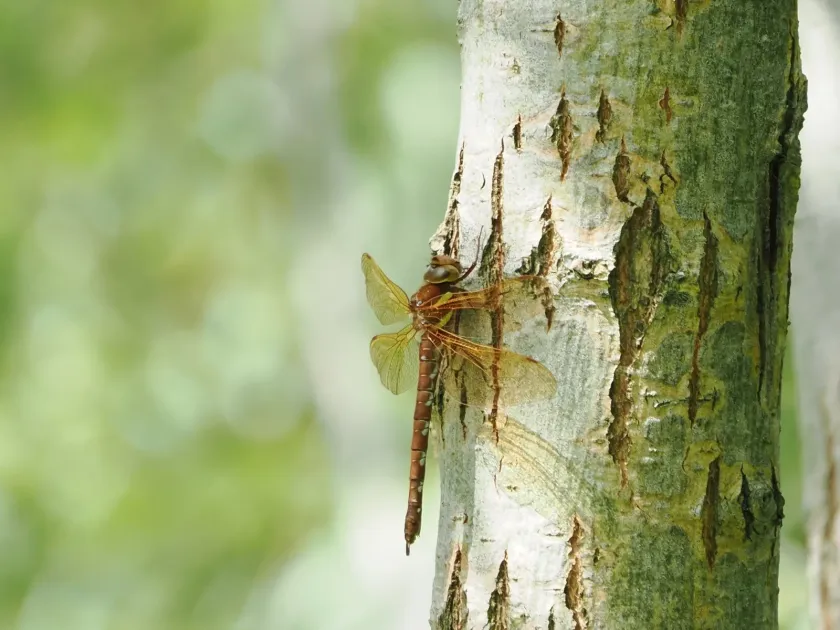
Description
How to identify
The Brown Hawker (Aeshna grandis) is a large species of dragonfly belonging to the Aeshnidae family within the Odonata order.
It is easily recognized by its distinctive brownish-orange body and wings, which give it a unique appearance compared to other dragonflies.
The wingspan of adults typically ranges from 10 to 11 centimeters, enabling them to be powerful and agile flyers in their hunting territories.
Larvae, or nymphs, are aquatic and inhabit freshwater ponds, lakes, and slow-moving streams where they develop over several seasons.
This species is widely distributed across temperate regions and is commonly found in gardens, forest clearings, and near agricultural wetlands.
What it damages
The Brown Hawker is not classified as a plant pest. It does not feed on crops, foliage, or roots of agricultural plants.
Instead, both adults and larvae act as efficient predators, making them highly beneficial for sustainable agriculture.
Adults consume a wide variety of small flying insects, including pests such as mosquitoes, flies, and certain types of beetles that can damage crops.
Larvae provide biological control in water bodies by feeding on the larvae of other insects, effectively reducing the population of potential pests.
Their presence on an farm or garden is an indicator of healthy, diverse local biodiversity and natural pest suppression.
When it appears
Adult Brown Hawkers are typically observed flying from mid-summer through early autumn, with peak abundance occurring in August.
The life cycle involves an aquatic stage where nymphs grow and develop over one to two years before emerging as adults.
During the mating season, adults are highly active in sunny weather, patrolling territories and hunting for food near water sources.
Development is influenced by water temperature and the availability of prey, which determines the overall survival rate of the population.
As temperatures drop in late autumn, adult activity ceases, and the population begins its overwintering or death phase depending on the life stage.
Control measures
No control measures are needed for the Brown Hawker, as it poses no threat to agricultural productivity or crops.
On the contrary, farmers and gardeners should focus on protecting these beneficial insects by minimizing the use of broad-spectrum pesticides.
Preserving water quality and maintaining aquatic habitats around fields are effective ways to support populations of dragonflies.
Because they act as natural controllers of harmful insect populations, they should be encouraged as part of an integrated pest management strategy.
There is no economic incentive or ecological reason to target this species; it remains an ally to farmers worldwide.
Taxonomy
- Latin name
- Aeshna grandis
- Family
- Aeshnidae
- EPPO code
- AESCGR
Discussion
No discussions yet — be the first.