
Blue Emperor
Anax imperator
Description
How to identify
The Emperor Dragonfly is one of the largest dragonfly species, belonging to the Aeshnidae family. It can reach lengths of up to 80 millimeters.
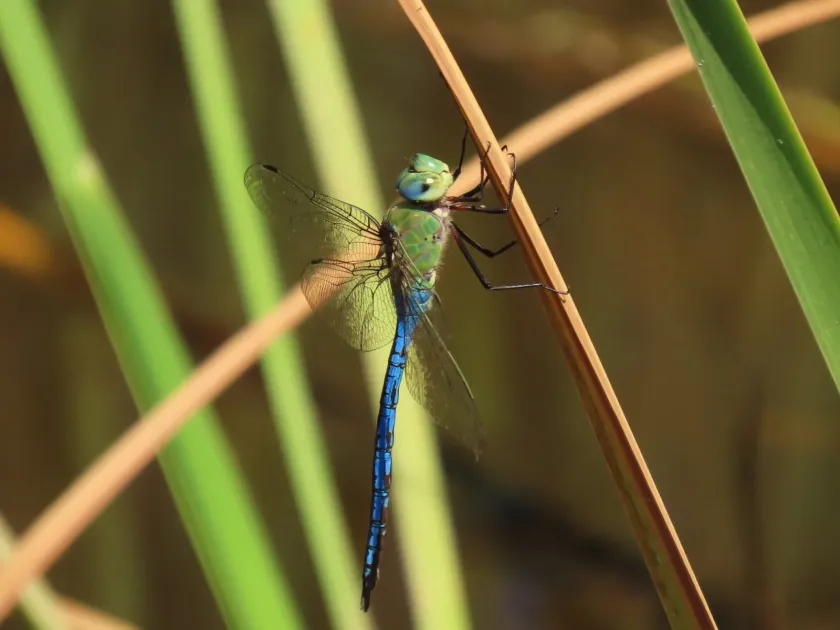
The males exhibit a striking blue abdomen with a black longitudinal stripe, while females are predominantly green to blend in with vegetation.
They possess exceptionally large eyes that allow them to track prey with high precision while flying at considerable speeds.
The wings are clear with a slight yellowish tint, enabling highly agile and sustained flight patterns over ponds and fields.
Their large size and characteristic hovering behavior over water make them easy to identify in their natural habitat.
What it damages
It is crucial to clarify that the Emperor Dragonfly is not a plant pest and causes no damage to crops.
Instead, this species is a valuable natural predator that helps control populations of various insect pests in agricultural areas.
The larvae are aquatic predators, feeding on mosquito larvae, tadpoles, and other small aquatic organisms throughout their development.
As adults, they hunt on the wing, consuming flies, moths, and beetles that could otherwise potentially harm agricultural yields.
Their presence is a positive indicator of high ecological health and effective natural biological pest management in the field.
When it appears
The flight season for adults typically begins in late spring, around May, and extends through late summer or early autumn.
The life cycle of the species lasts between one and two years, depending heavily on the temperature of the water environment.
Eggs are laid directly into the tissues of aquatic plants, where the larvae hatch and undergo several growth stages underwater.
Most activity is observed on warm, sunny days, which are ideal for their hunting and patrolling behavior near water sources.
After their final larval stage, they emerge from the water and undergo a metamorphosis to become winged, predatory adults.
Control measures
No pest control measures are necessary for this species as it is considered an entirely beneficial insect for farmers.
Efforts should focus on preserving natural water habitats, which are vital for the breeding and development of these dragonflies.
Reducing the use of broad-spectrum insecticides is recommended to protect these beneficial predators and maintain ecological balance.
Integrated Pest Management (IPM) strategies emphasize the protection of such natural allies to reduce reliance on chemical agents.
Promoting biodiversity around farmland encourages the presence of Emperor Dragonflies, providing free and efficient pest control services.
Taxonomy
- Latin name
- Anax imperator
- Family
- Aeshnidae
- EPPO code
- ANXXIM
Discussion
No discussions yet — be the first.