
Hemerobius micans
Hemerobius micans
Description
How to identify
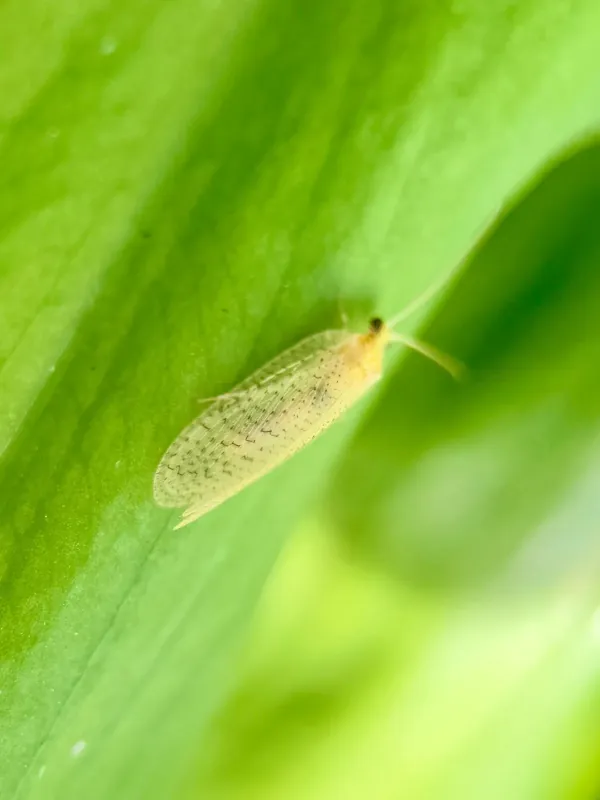
Hemerobius micans belongs to the order Neuroptera, family Hemerobiidae. This insect features characteristic net-like wings that, when at rest, fold roof-like along the body.
Adult individuals are small in size, typically not exceeding a few millimeters in length. The body color varies from light brown to dark brown, providing excellent camouflage on tree bark.
The insect's head is mobile with well-developed chewing mouthparts. The antennae are thread-like and of medium length, while the eyes are prominent and dark.
The larvae of the brown lacewing have a spindle-shaped body and powerful sickle-shaped jaws. They are very active and move across branches in search of food sources.
This species is often confused with beneficial green lacewings, however, Hemerobiidae are distinguished by the lack of bright green coloration and specific wing venation patterns.
What it damages
Although the Hemerobiidae family is known primarily for its predatory habits, under certain ecological conditions or high population density, Hemerobius micans can exhibit trophic activity on young shoots of woody plants.
Most often, their targets include deciduous tree species such as beech, oak, birch, and various fruit tree varieties in forest-park areas.
The pest prefers the tender tissues of young leaf blades, damaging the epidermis while seeking moisture or plant juices during periods when the primary food base is scarce.
Damage manifests as microscopic punctures, which can later lead to deformation of the leaf blade and stunted shoot growth.
Mass outbreaks of this species can lead to the weakening of young seedlings, making them vulnerable to secondary infections and pathogenic fungi.
When it appears
The active life cycle of Hemerobius micans begins in early spring, immediately after stable positive temperatures are established.
Peak abundance of adults is observed in mid-summer, when conditions are optimal for egg-laying and the development of larval stages.
In autumn, insects prepare for diapause, finding refuge in bark crevices or under fallen leaves, where they spend the winter months.
The development of generations depends heavily on the climatic conditions of the region; in warmer latitudes, several generations can develop within a single vegetative season.
Activity peaks often coincide with the periods of mass tree flowering, facilitating the search for mating partners and food sources.
Signs of infestation
The first sign of the pest's presence is the appearance of damaged areas on the leaves, which look like small necrotic spots or transparent patches.
Detailed examination of the canopy in the evening can reveal the active movement of adult individuals on the underside of leaves or along the veins.
The presence of larvae is often indicated by their characteristic movements on tree bark while hunting or searching for plant-based food.
Sometimes, traces of the pest's excrement can be spotted on affected areas, appearing as tiny dark specks visible against the green foliage.
Curling of young leaves and premature yellowing can also serve as indirect signs of high insect population density.
Control measures
The main method of control is an agrotechnical approach, including regular sanitary pruning of the canopy and removal of dead branches where pests overwinter.
Biological control methods include attracting natural entomophages, such as birds, which effectively reduce insect numbers in gardens.
The use of broad-spectrum insecticides is justified only in cases of severe infestation that threatens the survival of young seedlings or significant crop loss.
It is recommended to use products based on natural pyrethrins, which have lower toxicity to the environment and beneficial entomofauna.
- Regular monitoring of tree health during May-June.
- Ensuring optimal water management to boost plant immunity.
- Cleaning trunks of dead bark in autumn.
Taxonomy
- Latin name
- Hemerobius micans
- Family
- Hemerobiidae
- EPPO code
- HEMBMI
Discussion
No discussions yet — be the first.