
Narrow-bordered bee hawk-moth
Hemaris tityus
Description
How to identify
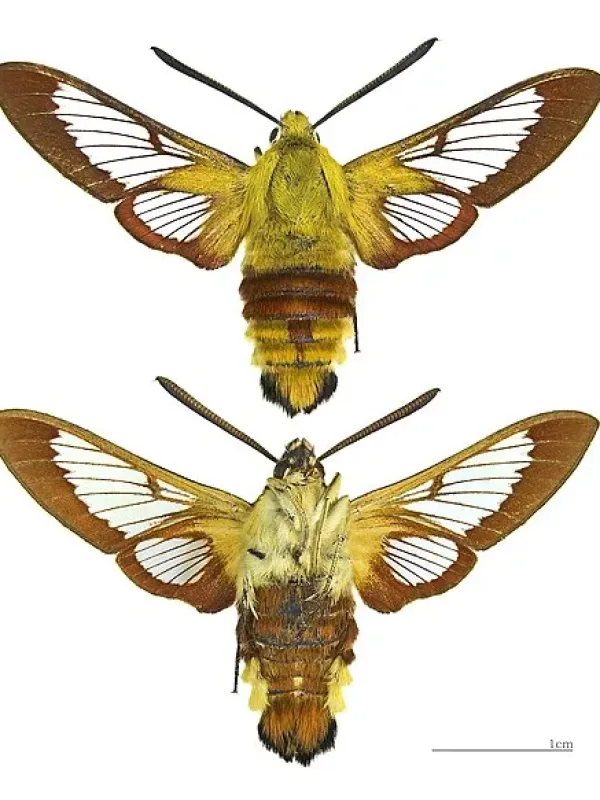
The Narrow-bordered bee hawk-moth is a fascinating day-flying moth belonging to the Sphingidae family, known for its strong resemblance to bumblebees.
Adult moths feature transparent, scale-free patches on their wings and a dense covering of hair on the body, which aids in their mimicry of Hymenoptera.
The larvae, or caterpillars, are typically bright green with distinct white lateral lines and a characteristic horn located at the posterior end of their body.
As members of the Lepidoptera order, they undergo complete metamorphosis, progressing through the stages of egg, larva, pupa, and adult.
The species is considered relatively rare in many habitats, often leading to it being protected under local conservation legislation rather than targeted as a pest.
What it damages
Caterpillars feed primarily on leaves of plants from the Dipsacaceae family, including Scabiosa and Knautia species, as well as some Lonicera.
While they are not major agricultural pests, large numbers of caterpillars can cause significant defoliation of ornamental plants in gardens.
Feeding damage involves irregular holes or edges chewed out of leaves, which can reduce the aesthetic value of the affected host plants.
Younger larvae cause minimal damage, but as they grow, their consumption rate increases significantly, potentially stressing the host plant.
Total defoliation is rare, and damage is usually localized to specific plants that serve as preferred hosts for oviposition.
When it appears
The adult moth flight period typically occurs from late spring to mid-summer, specifically between May and June, depending on regional temperatures.
Larvae are active throughout the summer months, feeding on foliage to accumulate energy reserves required for the upcoming pupation phase.
The species produces only one generation per year, limiting the duration of potential plant damage during the growing season.
Adults are highly active during sunny daylight hours, visiting various nectar-rich flowers while hovering in the air like hummingbirds.
Overwintering occurs in the pupal stage, usually hidden within the soil or amongst leaf litter, providing thermal protection against cold winter conditions.
Signs of infestation
Key indicators of infestation include irregular leaf margins and skeletonized foliage, particularly on host plants like field scabious.
The presence of larval frass (droppings) on the leaves or the soil surface beneath the plants is a reliable indicator of active larval feeding.
Gardeners can often observe the adult moths hovering over flowers, which indicates that females are present and may be laying eggs nearby.
Regular inspection of the undersides of host plant leaves can reveal the presence of small, pale eggs, marking the beginning of a potential infestation.
- Notched leaf edges
- Visible larval droppings on foliage
- Adult moth activity around host plants
- Slight wilting of severely chewed foliage
Control measures
Due to its relative rarity and minor impact, hand-picking larvae from affected plants is usually the preferred method for control in home gardens.
Maintaining a clean garden environment by removing unwanted weeds can help reduce the number of potential host plants available for egg-laying.
Soil cultivation around host plants during the autumn or spring may help disrupt the overwintering pupae, naturally reducing the population.
If population levels reach a threshold requiring action, biological control agents such as B. thuringiensis are safer than synthetic pesticides.
Chemical intervention should be avoided to protect biodiversity and beneficial insects that naturally keep moth populations in check.
Taxonomy
- Latin name
- Hemaris tityus
- Order
- Lepidoptera (butterflies)
- Family
- Sphingidae
- EPPO code
- HEMATI
Discussion
No discussions yet — be the first.