
Hummingbird clearwing
Hemaris thysbe
Description
How to identify
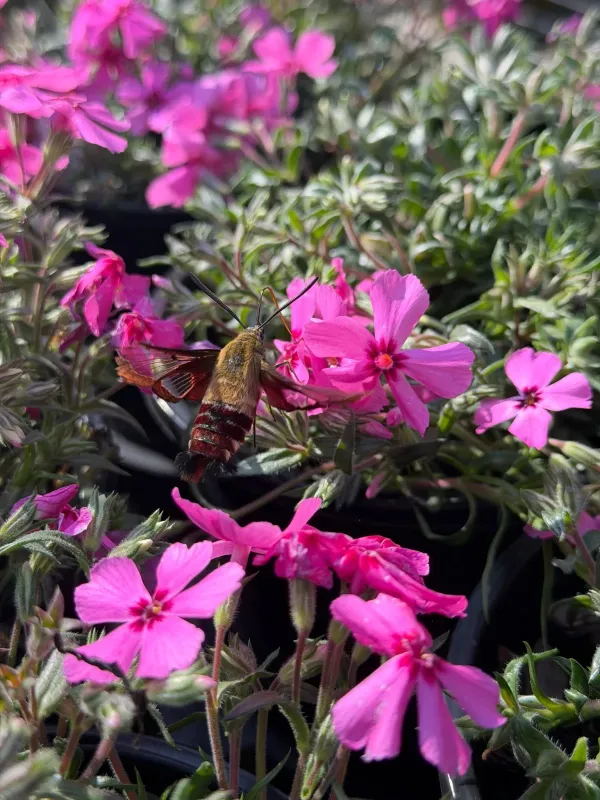
The Hummingbird clearwing (Hemaris thysbe) is a member of the Sphingidae family. It is famous for its mimicry, as adults look remarkably like hummingbirds or bumblebees, possessing clear patches on their wings.
The larvae, or caterpillars, typically reach 40–50 mm in length. They are usually bright green with pale lateral stripes and possess a characteristic caudal horn, which is typical for most hawk moth species.
The life cycle undergoes complete metamorphosis, including egg, larva (five instars), pupa, and adult (imago) stages. Females deposit eggs individually on the underside of leaves.
The species overwinters as a pupa, protected by a loose cocoon nestled within leaf litter or the top layer of soil beneath the host plant.
Adult moths emerge in late spring to begin their mating cycle, ensuring the survival of the population through the summer months.
What it damages
The primary food sources for the larvae are plants in the Caprifoliaceae family, most notably garden honeysuckle and viburnum species.
Damage is exclusively caused by the larval stage, which feeds on foliage. Larvae strip leaves, often leaving only the midribs, which leads to significant defoliation of host plants.
Defoliation reduces the plant's ability to photosynthesize, which can severely stress young or newly planted shrubs, potentially stunting their seasonal growth.
In ornamental settings, extensive damage ruins the aesthetic value of the shrubs, which is a major concern for garden owners and nurseries.
While rarely causing total plant mortality, repeated infestations over several years can weaken a shrub, making it more susceptible to pathogens and environmental stress.
When it appears
Adult activity typically begins in late spring, around May, and continues through July, depending on the geographical region and ambient temperatures.
Larval activity is most pronounced during the warm summer months when rapid development is supported by abundant food availability and suitable climate.
Depending on the climate, the species may complete one or two generations per year, with the second generation being particularly active in late summer.
As autumn approaches and temperatures drop, larvae enter the pupal stage to overwinter in the soil or ground cover until the following spring.
Adult moths are often seen visiting flowers for nectar during the day, which coincides with their egg-laying period across host plants.
Signs of infestation
The most obvious sign of infestation is ragged or skeletonized leaves, where only the vascular structure of the leaf remains after the larvae have fed.
Accumulation of caterpillar frass (droppings) on the leaves below or on the ground beneath the canopy is a clear indicator of larval presence.
Because the larvae are green and blend perfectly with the plant, they can be difficult to spot; look for them feeding on the undersides of leaves or along leaf edges.
Curled or damaged leaf margins and partially eaten buds are signs of active feeding by late-instar caterpillars.
The sight of adult moths hovering near honeysuckle or viburnum flowers is a strong indication that eggs may be deposited on those specific plants.
Control measures
Hand-picking caterpillars is a highly effective and eco-friendly control method for small-scale garden infestations, preventing the need for chemical intervention.
Tilling the soil gently around the base of host plants in the fall or spring can destroy overwintering pupae, significantly reducing the next generation's size.
Biological controls such as Bacillus thuringiensis (Bt) are highly effective against larvae and pose no risk to pollinators or beneficial insects.
In cases of severe infestation, targeted application of soft chemical insecticides may be used, provided they are labeled for the specific ornamental plants involved.
- Maintain garden hygiene by removing excess leaf litter where pupae might overwinter.
- Encourage local bird populations, as they are natural predators of large moth larvae.
Taxonomy
- Latin name
- Hemaris thysbe
- Order
- Lepidoptera (butterflies)
- Family
- Sphingidae
- EPPO code
- HEMATH
Discussion
No discussions yet — be the first.