
Broad-bordered bee hawk-moth
Hemaris fuciformis
Description
How to identify
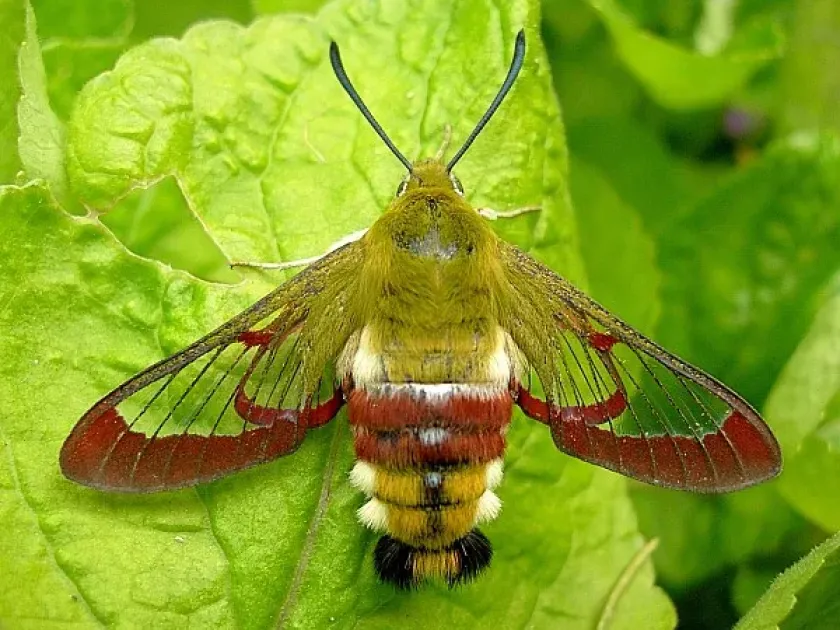
The Broad-bordered bee hawk-moth (Hemaris fuciformis) is a day-flying moth that mimics the appearance of a bumblebee. Its wings feature transparent areas devoid of scales, contributing to its resemblance to hymenopterans.
The moth's body is covered in dense hairs with yellow and brown coloration, featuring a distinct dark band across the abdomen. Adults typically have a wingspan ranging from 38 to 50 millimeters.
The larvae are generally bright green, providing excellent camouflage against the foliage of host plants. They possess a characteristic horn-like appendage at the posterior end of the body.
Eggs are laid singly on the underside of leaves by the female. This usually takes place during the warmer months when host plants are in their active growth phase.
The life cycle involves egg, five larval instars, a pupal stage in a cocoon often near the soil surface, and the adult moth phase which feeds on nectar.
What it damages
The primary host plants for the larvae are species of honeysuckle (Lonicera), including both wild varieties and ornamental garden cultivars. Occasionally, bedstraw species may be affected.
Damage is caused by larvae actively consuming leaf tissue. In cases of high pest density, significant defoliation can occur, weakening the plant's overall vigor.
Young larvae begin by skeletonizing the leaves, leaving only the larger veins intact, while older larvae are capable of consuming entire leaves down to the petiole.
Severe infestations reduce the aesthetic value of the bushes and may negatively impact the development of fruit buds in berry-producing varieties for the following year.
While not typically a mass-outbreak pest, local populations can cause sufficient damage to warrant observation and intervention in a gardening context.
When it appears
Adult moths are active from May through July, typically flying during sunny and warm weather to feed on nectar from various flowering plants.
Larval development occurs throughout the summer months when foliage is abundant. Depending on the climatic zone, the species may produce one or two generations per year.
The insect typically overwinters as a pupa within a cocoon, which is situated in the leaf litter, soil surface, or amongst dense vegetation at the base of the host plant.
With the arrival of stable spring temperatures, pupation is completed and adults emerge to mate and seek suitable honeysuckle plants for oviposition.
Monitoring for adult presence should begin in late spring, specifically focusing on blooming honeysuckle shrubs during clear, bright days.
Signs of infestation
The primary sign of infestation is missing or consumed leaf tissue on honeysuckle branches, though larvae are often overlooked due to their effective cryptic coloration.
Small, dark granular droppings found beneath the shrubs are a reliable indicator of active larval feeding occurring within the canopy above.
Visible gaps in the foliage, where only main veins remain, indicate that larvae have matured and are feeding intensely on the host plant.
Larvae themselves can be located by carefully inspecting the underside of leaves, particularly during the early morning or late evening hours.
Since damage is often focal, it is critical to perform a thorough and regular inspection of all shrubs in the garden to ensure early detection.
Control measures
Manual removal of larvae is the most environmentally friendly method, ideally performed during the morning when they are less mobile and easily spotted.
To reduce overwintering success, gardeners should practice light soil cultivation and remove dead leaf litter from beneath shrubs during the autumn months.
In cases of significant population density, biological insecticides based on Bacillus thuringiensis are effective against lepidopteran larvae while remaining safe for beneficial insects.
Chemical insecticides should be reserved for severe outbreaks and applied with strict adherence to harvest safety intervals if the honeysuckle produces edible berries.
Fostering an environment that supports natural predators, such as insectivorous birds and parasitic wasps, will help maintain the pest population at a manageable level.
Taxonomy
- Latin name
- Hemaris fuciformis
- Order
- Lepidoptera (butterflies)
- Family
- Sphingidae
- EPPO code
- HEMAFU
Discussion
No discussions yet — be the first.