
Snowberry clearwing
Hemaris diffinis
Description
How to identify
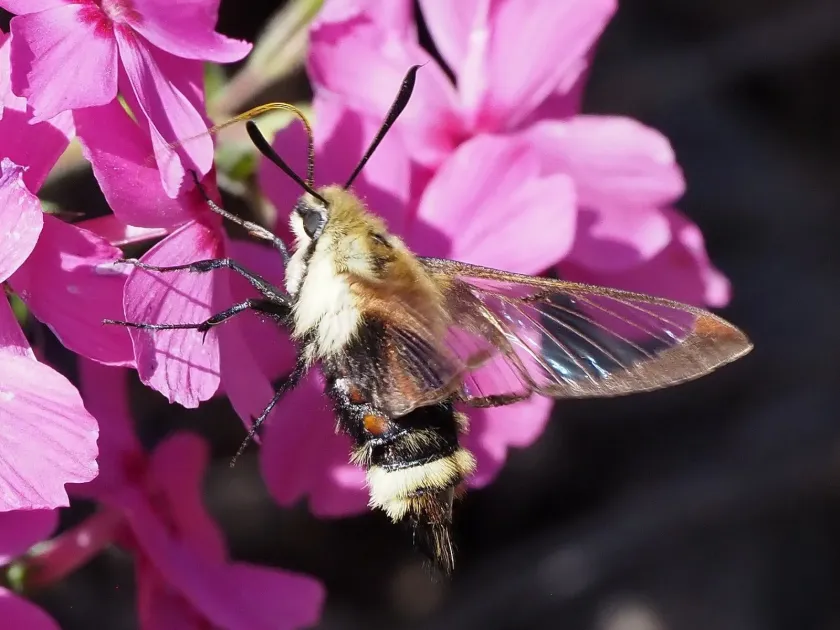
The Snowberry clearwing (Hemaris diffinis) is a species of moth in the family Sphingidae (hawk moths). It is famous for its mimicry, appearing very similar to a bumblebee due to its yellow and black markings.
Adult moths feature transparent patches on their wings, which is a signature trait of the genus Hemaris. They are diurnal, often seen hovering over flowers during the day to feed on nectar with their long proboscis.
The life cycle undergoes complete metamorphosis. Females lay eggs on host plants, and the subsequent larvae develop into light green, plump caterpillars with a distinct caudal horn at the posterior end.
Pupation typically occurs in the soil, where the insect spends the winter. Adults emerge in spring or early summer, depending on local environmental conditions and temperature patterns.
These moths are highly mobile and can travel significant distances, making their presence in a garden potentially sporadic but intense if the environment is favorable for breeding.
What it damages
The primary hosts for the larvae of Hemaris diffinis include plants in the Caprifoliaceae family, specifically various species of honeysuckle (Lonicera) and snowberry (Symphoricarpos).
The caterpillars are the destructive stage of the life cycle. They consume large quantities of foliage, which reduces the plant's ability to undergo photosynthesis and store energy for the next growing season.
In ornamental garden settings, the aesthetic value is the primary concern. Significant defoliation caused by a group of caterpillars can ruin the appearance of hedges or specimen shrubs.
Young plants are particularly vulnerable to larval feeding. Intense damage can stunt growth, weaken the plant structure, and potentially lead to secondary issues such as disease susceptibility.
While the moth is generally not considered a major agricultural pest like some other Lepidoptera, its ability to quickly defoliate specific branches can lead to localized branch dieback in sensitive species.
Signs of infestation
One of the earliest signs of an infestation is the presence of frass (caterpillar droppings) on the leaves or the ground directly beneath the foliage of the host plant.
Visual inspection often reveals ragged edges on leaves where the caterpillars have been feeding, progressing toward the midrib as the larvae grow larger and more voracious.
Searching for the caterpillars themselves can be challenging because they blend perfectly with the green foliage. The best time to search is during the cooler parts of the day.
Increased activity of the adult moths around honeysuckle shrubs is a major indicator that eggs have likely been laid and that young larvae will soon appear.
In cases of heavy infestation, you may notice partially skeletalized leaves where only the tough veins remain, indicating the caterpillars have been present for an extended period.
Control measures
Hand-picking is the most environmentally friendly and effective control method for smaller gardens. Simply inspect the shrubs and remove the caterpillars manually.
Maintaining healthy soil by light cultivation or tilling around the base of the bushes in autumn can destroy pupae located in the soil, breaking the life cycle of the pest.
Biological insecticides containing Bacillus thuringiensis (Bt) are highly effective against caterpillars while remaining safe for honeybees, butterflies, and other beneficial insects.
Encouraging natural predators such as birds and parasitic wasps can help keep the population in check naturally without the need for synthetic chemical intervention.
- Regular monitoring of host plants in late spring.
- Pruning back heavily infested branches to reduce local populations.
- Using row covers on young, sensitive plants during egg-laying season.
- Promoting biodiversity to attract natural insect predators.
Taxonomy
- Latin name
- Hemaris diffinis
- Order
- Lepidoptera (butterflies)
- Family
- Sphingidae
- EPPO code
- HEMADI
Discussion
No discussions yet — be the first.