
Hummingbird clearwing
Hemaris
Description
How to identify
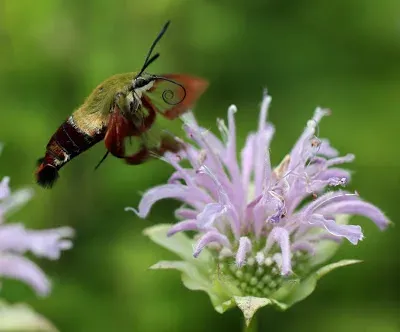
The hummingbird clearwing (Hemaris) is a genus of day-flying moths belonging to the family Sphingidae. Adults bear a striking resemblance to bumblebees due to their coloration, clear wings, and dense, fuzzy bodies.
The moths have a wingspan ranging from 40 to 50 millimeters. Their bodies are covered in thick yellow or olive hairs, which serves as a mimicry strategy to evade potential predators like birds.
Hemaris larvae are typical of the sphinx moth family, featuring a distinctive horn-like protrusion on the posterior end. They are usually green, providing excellent camouflage within foliage.
The life cycle involves complete metamorphosis: egg, larva, pupa, and adult. These insects typically overwinter as pupae within the topsoil or among leaf litter.
It is important to note that in most regions, these moths are considered rare and do not cause significant damage to agriculture, meaning they are rarely classified as primary pests.
What it damages
The primary host plants for Hemaris larvae are members of the Caprifoliaceae (honeysuckle) and Rubiaceae (madder) families.
In gardens, they feed mainly on honeysuckle (Lonicera) leaves. Damage occurs exclusively during the larval stage, while adult moths feed on nectar and pose no threat to plants.
Damage to vegetation is localized. Due to the generally low population density, serious economic impact on agricultural operations is virtually non-existent.
In private gardens, during periods of high population, larvae may partially defoliate ornamental honeysuckle shrubs, which affects the plant's aesthetic appeal.
The feeding habits of the larvae are characterized by consuming entire leaf blades, often leaving only the stems, which makes their presence noticeable if numbers are high.
When it appears
Adult flight typically begins in May and continues through early July. In warmer climates, it is possible for two generations to develop within a single growing season.
Adult moths are active during the day, particularly under sunny conditions. Unlike most sphinx moths, Hemaris species are strictly diurnal.
Eggs are laid singly by females on the undersides of host plant leaves. Larval development occurs throughout the second half of the summer.
Pupation takes place in late summer or early autumn. The pupae overwinter in the soil, protected by a cocoon of silk and soil particles.
Monitoring the appearance of adults allows gardeners to assess the potential risk to ornamental honeysuckle plantings for the current season.
Signs of infestation
The primary sign of infestation is defoliation of honeysuckle leaves, with larvae often consuming the entire leaf blade, leaving only the midrib or stem.
The presence of frass (larval droppings) on the leaves or the ground beneath the canopy is a clear indicator that a large caterpillar is feeding on the plant.
Larvae are often difficult to spot due to their green color and sedentary nature, which allows them to remain hidden among the leaves during the day.
Careful inspection of the inner parts of the shrub is recommended, as larvae tend to remain concealed in the denser areas of the foliage.
Occasionally, one may observe the adult moths hovering over flowers, moving rapidly from one bloom to another, which confirms their presence in the area.
Control measures
Due to their status as rare insects and their minor impact on plants, the use of chemical pesticides against Hemaris is generally unnecessary.
For population control in private gardens, manual removal of larvae is sufficient if their numbers become high enough to threaten the aesthetics of the honeysuckle.
Cultural methods, such as tilling or loosening the soil beneath host plants in the autumn, can disturb and destroy overwintering pupae.
In cases of critical damage to ornamental plants, biological control agents such as Bacillus thuringiensis are effective against Lepidoptera larvae.
- Implement crop rotation and remove weeds in the Rubiaceae family.
- Conduct regular inspections of honeysuckle leaves throughout June and July.
- Encourage natural predators such as birds and beneficial insects in the garden.
Taxonomy
- Latin name
- Hemaris
- Order
- Lepidoptera (butterflies)
- Family
- Sphingidae
- EPPO code
- HEMASP
Discussion
No discussions yet — be the first.