
Hellinsia balanotes
Hellinsia balanotes
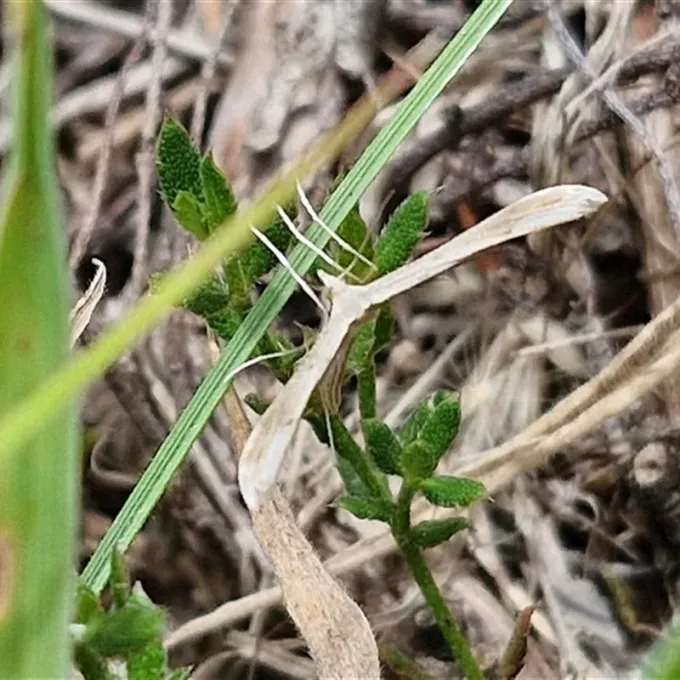
Description
How to identify
Hellinsia balanotes belongs to the Pterophoridae family, commonly known as plume moths, within the order Lepidoptera. These moths are characterized by their uniquely cleft wings that appear as individual plumes or feathers when at rest.
Adult moths possess cryptic coloration, allowing them to camouflage effectively against plant debris or tree bark. The insects typically have slender bodies and long, thin legs, which are diagnostic traits for most species within this family.
The larvae, or caterpillars, of this species typically exhibit a hairy or bristled appearance, which aids in their attachment to the foliage of host plants.
Accurate species identification often requires microscopic examination of genital structures, as the external appearance of many Hellinsia species is remarkably similar.
The life cycle involves complete metamorphosis, consisting of egg, larva, pupa, and adult stages, each presenting distinct morphological characteristics and ecological roles.
What it damages
The primary host plants for Hellinsia balanotes are members of the Asteraceae family. Damage is mainly caused by caterpillars feeding on leaf tissue, developing buds, and floral structures.
During outbreaks, these pests can significantly damage the reproductive organs of the plants, leading to a reduction in seed yield and overall commercial quality of the crop.
In field conditions, larvae are known to bore into stems or floral stalks, causing structural deformation, wilting, and potential death of the affected plant parts.
Feeding activities often create entry points for secondary pathogens, including fungi and bacteria, which can exacerbate plant decline and lead to systemic rot.
The total economic impact depends on infestation density, ranging from minor cosmetic leaf damage to complete crop failure in localized areas.
When it appears
Adult moth activity and egg-laying typically occur during the warmer months of the growing season when host plants are in their peak vegetative growth phase.
The species usually overwinters as late-instar larvae or pupae, seeking refuge in plant debris or within the top layer of the soil substrate.
In spring, as temperatures rise, the overwintered larvae resume feeding, rapidly accumulating biomass prior to the transition into the pupal stage.
The flight period of adults is often staggered, which complicates the timing of insecticide applications, necessitating the use of pheromone traps for precise monitoring.
The number of annual generations is highly dependent on regional climatic conditions, typically ranging from one to two generations in temperate zones.
Signs of infestation
Early symptoms of infestation include skeletonized or partially eaten leaves, accompanied by the presence of larval frass (excrement) on the plant surface.
Deformed flower heads and visible entry holes in stems are classic indicators of the internal feeding habits characteristic of this species.
Wilting of specific shoots or terminals, without signs of root pathogens, is often a diagnostic indicator of stem-boring activity by plume moth larvae.
Detailed inspections during dusk or nighttime hours may reveal adult moths resting on the undersides of leaves of the host plants.
Fine webbing surrounding flower buds or inflorescences is also a strong secondary sign of larval activity and colonization within the plant canopy.
Control measures
Cultural control is the cornerstone of management, involving autumn deep tillage to destroy overwintering pupae and larvae located in crop residues.
Maintaining proper crop rotation and the rigorous removal of Asteraceae weeds from field margins helps eliminate alternative hosts and reservoirs for the population.
During periods of high pest density, the application of registered contact or systemic insecticides is recommended to suppress larval populations effectively.
Biological control strategies include the conservation of natural enemies, such as parasitic wasps, which play a crucial role in maintaining pest population equilibrium.
- Application of biological products based on Bacillus thuringiensis during early larval stages.
- Utilization of light traps for monitoring and adult population reduction.
- Consistent scouting during the budding phase to identify and treat hotspots before damage spreads.
Taxonomy
- Latin name
- Hellinsia balanotes
- Order
- Lepidoptera (butterflies)
- Family
- Pterophoridae
- EPPO code
- HLLSBA
Discussion
No discussions yet — be the first.