
Red-backed firebug
Haematoloma dorsata
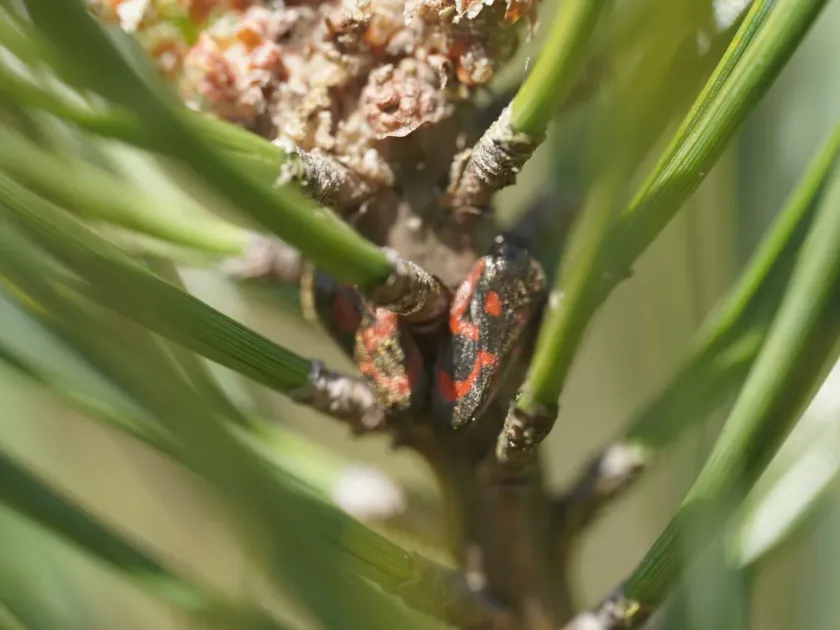
Description
How to identify
The red-backed firebug (Haematoloma dorsata) is a species of true bug belonging to the Pyrrhocoridae family. It is a specialist insect primarily associated with pine trees, standing out due to its distinctive and vivid color pattern.
Adult bugs typically measure between 7 and 9 millimeters in length. They are characterized by a black head and pronotum, while their hemelytra (wing covers) exhibit a vibrant reddish or orange-red coloration, often accented with dark markings.
As true bugs, they undergo incomplete metamorphosis. The nymphs resemble miniature, wingless versions of the adults, although their color intensity is usually lower compared to fully mature specimens.
These insects are highly heliophilous, meaning they prefer sun-drenched environments. They are most commonly observed on the trunks and branches of coniferous trees that receive direct sunlight, particularly on the southern exposure of the bark.
The species displays high adaptive capabilities, allowing it to survive in various climatic conditions across its range. During the cold winter months, the bugs enter a state of diapause, sequestering themselves in protected sites near their host plants.
##damage##The primary hosts of the red-backed firebug are pine species. Both adults and nymphs feed on the plant sap, using their specialized piercing-sucking mouthparts to penetrate the soft tissues of needles and thin bark.
Feeding leads to localized tissue necrosis. When insects feed on needles, they cause them to yellow and eventually wither, which disrupts the photosynthetic ability of the tree and diminishes its overall vitality.
Damage to young shoots is particularly problematic, as it may stunt the growth of the tree and cause structural deformities in developing branches. Weakened trees become significantly more susceptible to secondary fungal pathogens and environmental stress.
In nurseries and ornamental conifer plantations, the red-backed firebug can cause substantial aesthetic and economic loss. Heavy infestations can lead to premature needle drop and the overall decline of saplings.
While mature trees are generally more resilient to moderate infestation, persistent high-density feeding can weaken even established trees, making them less robust against drought or other forest pests.
When it appears
The activity cycle of the red-backed firebug begins in early spring, as temperatures rise, signaling the emergence of adults from their overwintering sites. This initial movement is typically directed toward the most sun-warmed parts of host trees.
The peak of the life cycle occurs throughout the summer months. June and July represent the height of nymphal development, with the population density reaching its maximum as environmental conditions remain optimal.
As autumn approaches, the insects become less active. In response to decreasing temperatures and daylight, they begin to search for suitable overwintering habitats, such as crevices in bark or the forest litter layer.
Seasonal dynamics are strongly influenced by weather patterns. Warm and dry springs promote faster development, potentially leading to multiple small cohorts, whereas excessive rainfall can adversely impact nymphal survival rates.
By late October, most of the population has entered winter diapause. The bugs rely on their ability to tolerate low temperatures to survive the winter, remaining largely dormant until the following spring.
Signs of infestation
The most prominent sign of infestation is the gregarious behavior of the bugs. They often form large, visually striking clusters on the bark of pine trees, making them easy to identify during the day.
Signs of feeding damage include yellowing or browning patches on needles. Upon close inspection, one may find minute entry holes or weeping sap wounds on the bark of young branches where the bugs have been feeding.
Increased presence of debris, such as frass (insect excrement), around the base of the trunk or on lower branches can also indicate a high concentration of the insects feeding above.
- Visible clusters of red and black bugs on trunks.
- Yellowed or necrotic spots on individual needles.
- Small, bleeding sap wounds on young shoots.
- Premature needle fall in mid-summer.
Because these bugs are quite mobile, an infestation might manifest as localized patches of damaged foliage rather than an even distribution across the entire canopy of the tree.
Control measures
Effective management of the red-backed firebug involves a mix of silvicultural practices and targeted chemical interventions when economic thresholds are exceeded in sensitive areas.
Cultural control is the first line of defense. This includes maintaining clean plantation floors, removing heavy leaf and litter buildup around trunks, and ensuring proper tree spacing to increase airflow and sunlight penetration.
In cases of severe infestation in nurseries, systemic or contact insecticides may be necessary. It is crucial to choose products that are specifically registered for use on conifers to prevent foliage burn.
Encouraging natural predators, such as insectivorous birds and parasitic wasps, plays a vital role in keeping populations at manageable levels within natural forest ecosystems.
Routine scouting is essential for proactive management. Early detection of colonies allows for localized treatment, which is significantly more cost-effective and environmentally friendly than broad-spectrum application.
Taxonomy
- Latin name
- Haematoloma dorsata
- Order
- Hemiptera (bugs, aphids, leafhoppers)
- Family
- Cercopidae
- EPPO code
- HAELDO
Discussion
No discussions yet — be the first.