
Camel cricket
Hadenoecus subterraneus
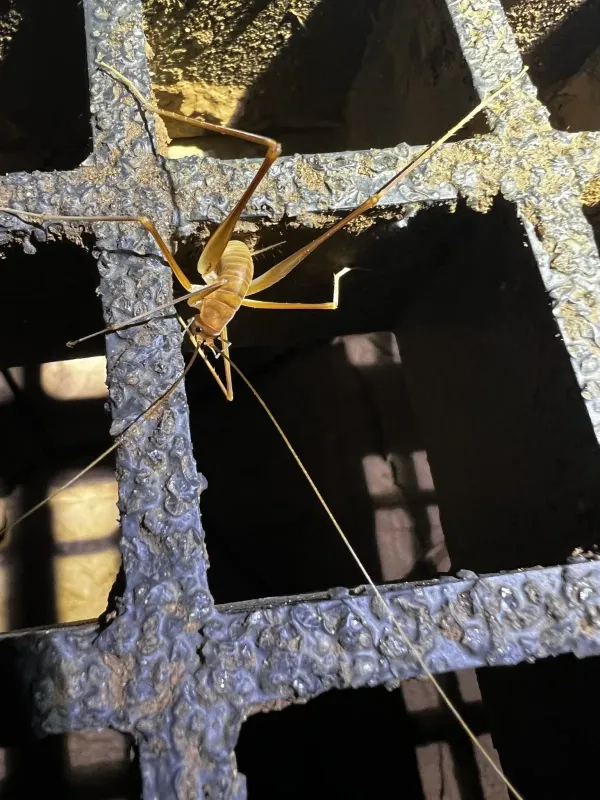
Description
How to identify
The camel cricket, scientifically known as Hadenoecus subterraneus, belongs to the family Rhaphidophoridae. These insects are easily recognized by their humped back and extremely long, sensitive antennae which allow them to navigate in complete darkness.
They are wingless insects with a light to dark brown color, often featuring mottled patterns that help them blend into subterranean environments. Their powerful hind legs are designed for jumping long distances when threatened.
Adults range from 2 to 5 cm in body length, significantly smaller than their total span when considering their elongated legs. They lack eyes, relying entirely on touch and vibration sensing to interact with their surroundings.
The life cycle involves incomplete metamorphosis, meaning the nymphs look essentially like smaller adults. They grow through several molting stages, shedding their chitinous exoskeleton as they increase in size.
These crickets thrive in high-humidity environments with stable, cool temperatures. They are naturally adapted to life in caves, yet they frequently migrate into human-made structures, basements, and agricultural storage areas.
What it damages
While they are not traditional agricultural pests on a large scale, they can cause significant localized damage. In greenhouses and storage sheds, camel crickets are known to consume seedlings and harvested produce.
They are omnivorous and often target the succulent parts of young vegetable crops. By feeding on the base of stems or roots, they can stunt plant growth or cause young plants to wither and die rapidly.
Storage areas pose the highest risk, as these crickets can contaminate and destroy large quantities of stored vegetables. By gnawing on root crops, they create entry points for secondary infections such as fungal rots and bacteria.
Their presence in irrigation systems or technical equipment rooms can lead to operational disruptions. In some cases, they chew on plastic components, cables, or rubber seals within greenhouse infrastructure.
Economic damage is typically tied to their high population densities in confined spaces. When they gather in large numbers, the cumulative impact on tender vegetation or stored produce becomes noticeable and detrimental.
Signs of infestation
The primary sign of infestation is irregular, ragged feeding patterns on plant foliage. Unlike caterpillars, which may consume entire leaves, camel crickets often leave behind rough, torn edges on stems and low-hanging leaves.
Fecal droppings, often found near baseboards or plant containers, are a clear indicator of their activity. These droppings appear as small, dark, cylindrical pellets scattered in areas where the crickets shelter during the day.
Discarded molted skins found in dark corners or under equipment indicate that the population is growing and reproducing on-site. The presence of these skins suggests a long-term infestation rather than accidental entry.
Visible feeding damage on stored root vegetables, characterized by deep, jagged pits, is a hallmark of camel cricket activity. Such damage is distinct from the smooth surface feeding associated with slugs or snails.
Using a flashlight during night hours is the most reliable way to confirm an infestation. Camel crickets are strictly nocturnal and will be seen scurrying away toward dark crevices when disturbed by light.
Control measures
Sanitation is the most important defense against camel crickets. Keeping basements, sheds, and greenhouse floors free of debris, leaf litter, and unnecessary boxes eliminates the damp, dark hiding spots they prefer.
Reducing moisture levels is highly effective, as these insects require high humidity to survive. Using dehumidifiers or improving ventilation in storage areas can create an environment that is hostile to the pests.
Mechanical control includes the use of sticky traps placed in corners or near doorways. These are highly effective for monitoring populations and capturing individual insects before they can establish a colony.
Chemical control should be limited to areas where the pest is established and causing economic loss. Residual insecticides applied to surfaces where they travel can provide effective control for significant outbreaks.
- Seal cracks and crevices in foundation walls to prevent entry.
- Install mesh screens on all ventilation openings.
- Remove excess vegetation and organic waste from the perimeter of storage buildings.
- Implement regular monitoring programs during the growing season.
Taxonomy
- Latin name
- Hadenoecus subterraneus
- Order
- Orthoptera (locusts)
- Family
- Rhaphidophoridae
- EPPO code
- HADESU
Discussion
No discussions yet — be the first.