
Greenhouse camel cricket
Diestrammena marmorata
Description
How to identify
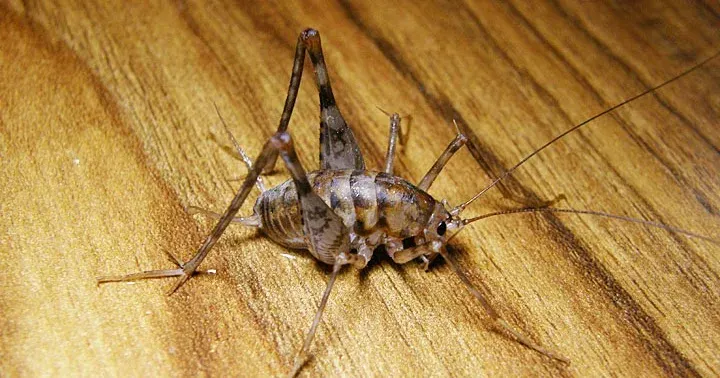
The greenhouse camel cricket (Diestrammena marmorata) belongs to the Rhaphidophoridae family. These insects are easily identified by their humped back appearance, wingless body, and remarkably long antennae that often span several times their body length.
Their coloration ranges from light tan to dark brown with mottled spots, providing camouflage in damp and dark environments. They have large, powerful hind legs adapted for jumping, which they use to escape threats rapidly.
This species is nocturnal, spending the daylight hours in cool, dark, and humid locations such as under benches, potting containers, or debris. They are relatively large, typically reaching lengths of 15–20 mm.
The life cycle proceeds through egg, nymph, and adult stages without a pupal phase. In climate-controlled greenhouses, they can breed continuously throughout the year, leading to overlapping generations.
Females are equipped with a prominent ovipositor, which they use to deposit eggs into soft substrates, soil crevices, or rotting organic matter, ensuring the survival of the next generation.
What it damages
Greenhouse camel crickets are generalist feeders. In greenhouse settings, they can cause significant damage to a variety of plants, particularly young seedlings, soft-tissue ornamental flowers, and vegetables.
They feed by gnawing on leaves, stems, and buds, which can severely stunt plant growth and ruin the visual appeal of ornamental crops. Their feeding habits often lead to ragged leaf edges.
Young seedlings are particularly vulnerable; a small population of crickets can consume substantial portions of a plant overnight, leading to total loss or irreversible structural damage to the crop.
The physical injury caused by their mandibles creates entry points for secondary pathogens. Fungal infections and bacteria often colonize the damaged tissue, leading to plant decay and death.
Because they feed at night, the damage is often discovered only after significant harm has occurred. Identifying them early is crucial for preventing widespread outbreaks throughout the greenhouse.
Signs of infestation
The primary sign of infestation is irregular, ragged-edged holes in leaves. These injuries are distinct from the circular holes left by some beetles or the slimy trails left by mollusks.
Direct observation is possible during night checks using a flashlight. Crickets are sensitive to light and will jump away immediately, often retreating into dark crevices or dense foliage to hide.
Droppings, appearing as small granular pellets near the base of plants or on growing surfaces, indicate their activity. Finding these pellets is a reliable way to map the infested areas.
Nocturnal sounds, such as clicking or rustling movements near plant debris, are a telltale sign of their presence. Experienced growers often look for these disturbances in humid corners.
If you notice young tips of plants vanishing and can rule out slugs by the lack of slime, it is highly likely that a population of camel crickets has established itself in the area.
Control measures
Sanitation is the first line of defense. Removing leaf litter, old pots, and general debris eliminates the hiding spots that these crickets require to survive during the day.
Sticky traps placed strategically on the floor or near greenhouse structures are highly effective for monitoring and reducing the number of adults without chemical interference.
In cases of severe infestation, targeted insecticides approved for greenhouse use can be applied. Treatments are most effective when applied in the evening to coincide with the insects' peak activity.
Exclusion methods, such as fine-mesh screening on vents and doors, prevent external crickets from entering the greenhouse. Maintaining dry, well-ventilated conditions can also make the environment less favorable for them.
- Regular removal of organic waste.
- Use of non-toxic sticky monitors.
- Sealing cracks and entry points in greenhouse structures.
Taxonomy
- Latin name
- Diestrammena marmorata
- Order
- Orthoptera (locusts)
- Family
- Rhaphidophoridae
- EPPO code
- DIESMA
Discussion
No discussions yet — be the first.