
Azam's cave cricket
Dolichopoda azami
Description
How to identify
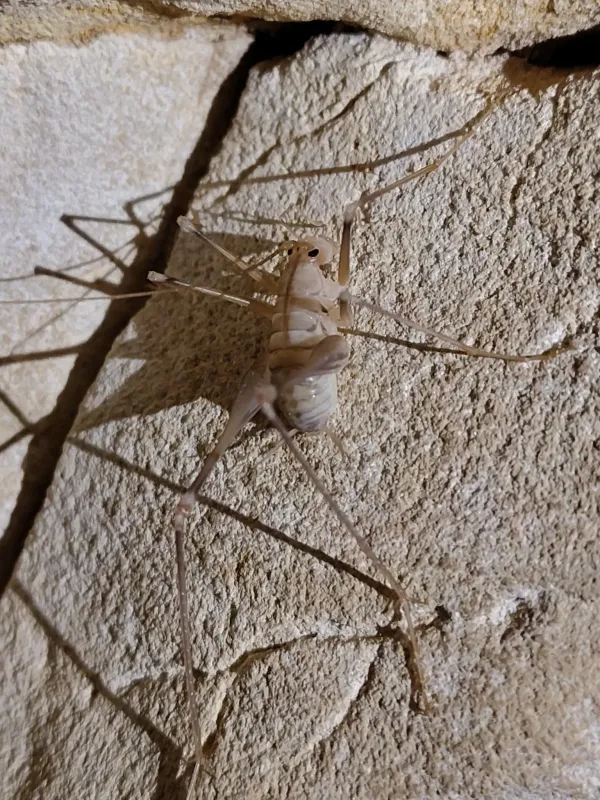
Azam's cave cricket (Dolichopoda azami) is a species of the Rhaphidophoridae family. These insects are easily recognized by their long, slender legs and antennae, which are significantly longer than their bodies, aiding navigation in low-light environments.
As wingless insects, they rely entirely on jumping and walking for mobility. Their coloration typically ranges from light brown to ochre, providing effective camouflage in damp, dark niches such as cellars, caves, and sheltered greenhouse structures.
They are primarily nocturnal, remaining hidden during the day. In agricultural settings, they are often overlooked until their population grows large enough to cause visible damage to crops in greenhouses or indoor farming systems.
The life cycle involves incomplete metamorphosis. Nymphs closely resemble adults but are smaller and sexually immature. They undergo several molting stages, increasing in size before reaching the final, reproductive adult form.
Being moisture-loving insects, they thrive in environments with high relative humidity and stable temperatures. When they invade a greenhouse, they seek out cracks, crevices, and underneath equipment to establish their colonies.
What it damages
In greenhouses, these crickets act as polyphagous pests, capable of damaging a wide variety of plants. Common vegetable crops, including tomato and cucumber seedlings, as well as various greenhouse herbs, are particularly susceptible.
Both nymphs and adults feed on plant tissues. They show a preference for tender parts, such as new leaves and shoots. Feeding leads to physical damage that disrupts photosynthesis and can cause severe stunting or the total death of young seedlings.
Reproductive organs of plants are also targeted. Feeding on buds and small fruits results in lower harvest yields and ruined commercial quality, which is especially problematic for high-value greenhouse crops intended for market.
Damage symptoms include large, irregular holes in leaves. Unlike the precise bite marks of smaller pests, these crickets consume significant portions of the foliage, often leaving only the thickest veins behind as a sign of their feeding activity.
In cases of high infestation, the crickets may also gnaw on the root collar or stems near the soil surface. This girdling effect is particularly destructive, often leading to rapid wilting and collapse of the entire plant.
When it appears
In temperature-controlled greenhouses, Dolichopoda azami can remain active throughout the entire year. Their development is not restricted by seasonal cycles as long as the indoor climate remains stable and moist.
The reproduction rate peaks in periods of sustained high humidity. Females lay their eggs in damp soil or substrate, providing the ideal conditions for the nymphs to emerge and grow without the risks of desiccation.
Invasion often happens during warmer months when insects move into buildings seeking shelter. Once inside, if the conditions are favorable, they quickly settle and begin the life cycle, leading to permanent resident populations.
Activity levels remain relatively constant in indoor environments, but the presence of irrigated zones often attracts these insects, causing them to concentrate in areas where moisture is most accessible to them.
Winter does not typically affect their survival if they are housed within building structures or heated greenhouses. Thus, the pest can represent a continuous threat to crop production cycles regardless of the outdoor season.
Signs of infestation
Nighttime inspection is the most effective way to identify a presence. Using a flashlight after dark will reveal the insects, as they are easily startled by light and will move quickly to escape detection when approached.
Visible feeding damage, characterized by jagged edges and missing leaf parts, serves as a primary indicator. If such damage appears overnight, it is a strong sign of nocturnal feeding activity by larger insects like cave crickets.
Fecal pellets found near the base of plants are another sign. These crickets tend to produce droppings in their hiding areas, such as under irrigation pipes, containers, or wooden pallets, indicating where they spend their daylight hours.
On soft, damp soil surfaces, their large feet leave distinctive tracks. These marks are often visible in the mornings and can help track the movement of the population across the greenhouse floor.
- Large, uneven holes in foliage.
- Wilting seedlings due to stem damage.
- Nocturnal sightings of insects in greenhouses.
- Presence of fecal pellets in shelter areas.
Control measures
Sanitation is the most crucial control measure. Removing organic debris, wooden piles, and unnecessary equipment creates a hostile environment that discourages the crickets from establishing hiding spots within the growing area.
Glue traps placed in strategic locations, especially near damp corners or structural cracks, are highly effective for monitoring and controlling local populations by physically removing adults before they can reproduce.
Biological control methods, particularly the use of entomopathogenic fungi, can be very effective in humid greenhouse environments. These natural agents target the crickets without introducing toxic chemicals into the crop production area.
Chemical intervention should be reserved for high-population scenarios. If insecticide use is necessary, applications should be timed to late evening when the crickets are active and feeding, ensuring maximum exposure to the chemical.
Management of irrigation systems is also a key strategy. Reducing standing water and preventing excessive moisture around the base of the greenhouse structures makes the habitat less inviting to these humidity-dependent pests.
Taxonomy
- Latin name
- Dolichopoda azami
- Order
- Orthoptera (locusts)
- Family
- Rhaphidophoridae
- EPPO code
- DLCPAZ
Discussion
No discussions yet — be the first.