

Description
How to identify
The pale potato cyst nematode (Globodera pallida) is a serious quarantine pest belonging to the Heteroderidae family. It is a microscopic roundworm that parasitizes the root systems of solanaceous plants, primarily potatoes.
The life cycle involves the development of sedentary females, which eventually become spherical cysts. These cysts, which are actually the dead body of the female, contain hundreds of eggs and serve as a highly protective mechanism against environmental stressors.
Male nematodes are vermiform and motile, enabling them to locate females within the host roots. Their sole purpose is reproduction, and they do not feed on the plant tissues in the same way that females and juveniles do.
Juveniles in the second larval stage emerge from cysts triggered by chemical signals released from host roots. Once they penetrate the roots, they establish a permanent feeding site, causing the host to form giant cells that provide nourishment to the nematode.
Because these cysts can remain dormant in the soil for over a decade, detecting and managing this pest is a significant challenge for potato growers globally, requiring strict biosecurity measures.
What it damages
Globodera pallida primarily attacks potatoes, but it also has a significant impact on tomatoes and eggplants. The damage is cumulative and can render land unsuitable for potato production for many years if not managed correctly.
By hijacking the plant's nutrient transport system to feed itself, the nematode causes severe disruption in water and nutrient uptake. This leads to reduced plant vigor, stunted foliage, and a significant decrease in tuber size and quality.
In highly infested soils, the yield loss can be catastrophic. The root system becomes heavily damaged, making the crop susceptible to secondary pathogens such as Verticillium or Rhizoctonia, further weakening the plant.
The presence of this pest results in massive economic losses due to reduced yields and the imposition of movement restrictions on agricultural produce. Farmers often face long-term land quarantine until population levels are reduced to safe limits.
Furthermore, because the nematodes are easily spread through soil movement, even a small infestation can rapidly contaminate a larger farm area if hygiene protocols are not rigorously followed during harvest and transport.
Signs of infestation
Early signs of infestation are often observed as patches of stunted, yellowing plants in the field. These patches usually appear in circular patterns, reflecting the initial point of contamination and slow spread of the nematode population.
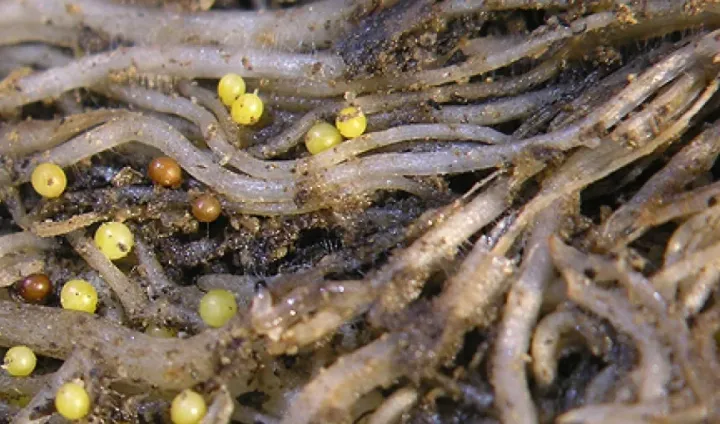
When affected plants are carefully unearthed, the roots often appear overly branched and dense, a phenomenon known as "root proliferation." Upon close inspection, tiny, spherical, white or creamy-colored cysts may be seen attached to the roots.
The lack of proper water uptake makes infested crops show signs of wilting even when soil moisture is seemingly adequate. This is particularly noticeable on hot, sunny days when the plant's transpiration demand is highest.
At harvest, the most obvious sign is the reduction in tuber size. The tubers are often small, unmarketable, and significantly fewer in number, as the plant lacked the resources to support healthy tuber development throughout the growing season.
- Patches of stunted, chlorotic potato plants.
- Severe wilting during periods of peak transpiration.
- Dense, stunted root systems with visible cyst bodies.
- Significant decrease in tuber yield and individual tuber size.
- Increased susceptibility to other soil-borne root diseases.
Control measures
The primary control strategy is the prevention of spread through strict adherence to quarantine regulations. This includes ensuring that only certified, nematode-free seed potatoes are used and that equipment is thoroughly cleaned before moving between fields.
Crop rotation is a vital tool for reducing population densities. By rotating potatoes with non-host crops for several years, the number of viable cysts in the soil can be gradually decreased as juveniles hatch and fail to find a food source.
The use of resistant potato varieties is the most effective long-term management strategy. These varieties are specifically bred to prevent the nematode from establishing feeding sites, which naturally forces a decline in the cyst population.
Chemical control involving granular nematicides may be used in intensive farming systems, but this is often costly and requires careful environmental management. It is generally used as a supplement to, rather than a replacement for, integrated management.
Good field hygiene is essential: cleaning soil from machinery, minimizing the movement of infested soil, and controlling weeds that might act as alternative hosts (like nightshades) are critical steps in keeping G. pallida under control.
Content graph
Connections · Pale potato cyst nematode
Most often together:
Marketplace
Products · 4


Biology
Taxonomy
- Latin name
- Globodera pallida
- Order
- Nematodes
- Family
- Heteroderidae
- EPPO code
- HETDPA
Community
Discussion
No discussions yet — be the first.