
Greater roadrunner
Geococcyx californianus
Description
How to identify
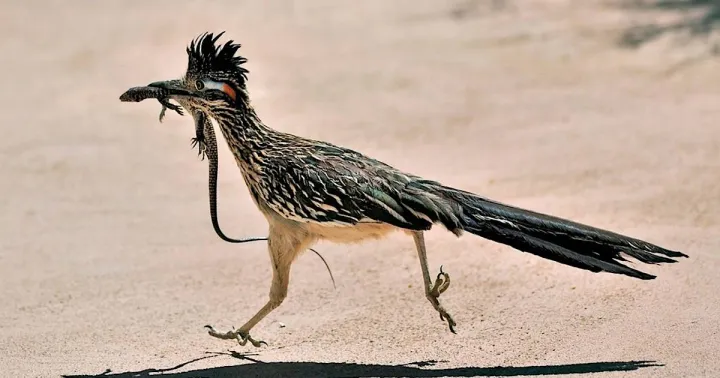
The Greater roadrunner is a member of the cuckoo family, Cuculidae, known for its ground-dwelling and running habits.
This bird features a distinctive slender body, a very long tail, and strong legs adapted for sprinting across arid terrains.
The plumage is brownish-gray with white streaks, providing excellent camouflage against sandy soil and dry vegetation.
A prominent crest on the head is often raised when the bird is alert or displaying territorial behavior.
Its heavy, strong beak is designed for capturing prey, reflecting its dietary preference for meat rather than vegetation.
What it damages
The Greater roadrunner is not an agricultural pest; it does not consume crops, seeds, fruits, or any other plant parts.
As an exclusively carnivorous species, it focuses on hunting insects, rodents, and small reptiles within the agricultural landscape.
There is no damage caused by this bird to commercial crops, making it completely harmless to the farming process.
On the contrary, it acts as a biological control agent by consuming significant quantities of agricultural pests like grasshoppers.
An agronomist should consider this bird a beneficial member of the farm ecosystem that assists in natural population control.
When it appears
These birds are permanent residents in their range and can be observed throughout the entire year.
Peak activity levels typically occur during the breeding season in the spring when food requirements for nestlings are high.
They are primarily diurnal birds, showing the most activity during the early morning and late afternoon to avoid midday heat.
Seasonal patterns are mostly tied to the availability of prey, which increases after rainfall periods in arid regions.
During the winter months, their daily movements are focused on securing territory and finding occasional reptile or rodent prey.
Signs of infestation
The most reliable sign of their presence is the characteristic zygodactyl footprint, shaped like a small letter X on the ground.
Observation of the bird quickly darting between crop rows or along field margins is the best way to detect them.
Low, mournful cooing calls heard during dawn are distinctive indicators of their presence in the surrounding brush.
Absence of plant damage is the strongest evidence that the birds spotted in the fields are indeed insectivores or predators.
Look for nesting sites in low, dense shrubs near open fields where they feel protected while remaining close to hunting grounds.
Control measures
Control measures are neither necessary nor recommended for the Greater roadrunner, as it does not negatively impact crops.
Farmers should focus on preserving the bird's habitat to encourage its role as a natural predator of agricultural pests.
Avoid using indiscriminate pesticide applications that could harm these beneficial predators or reduce their food sources.
Strictly limit the use of rodenticides, as these birds can easily ingest poisoned carcasses and suffer secondary toxicity.
Embracing the presence of this species is an excellent practice for integrated pest management and farm sustainability.
Taxonomy
- Latin name
- Geococcyx californianus
- Family
- Cuculidae
- EPPO code
- GECXCA
Discussion
No discussions yet — be the first.