
Yellow-billed cuckoo
Coccyzus americanus
Description
How to identify
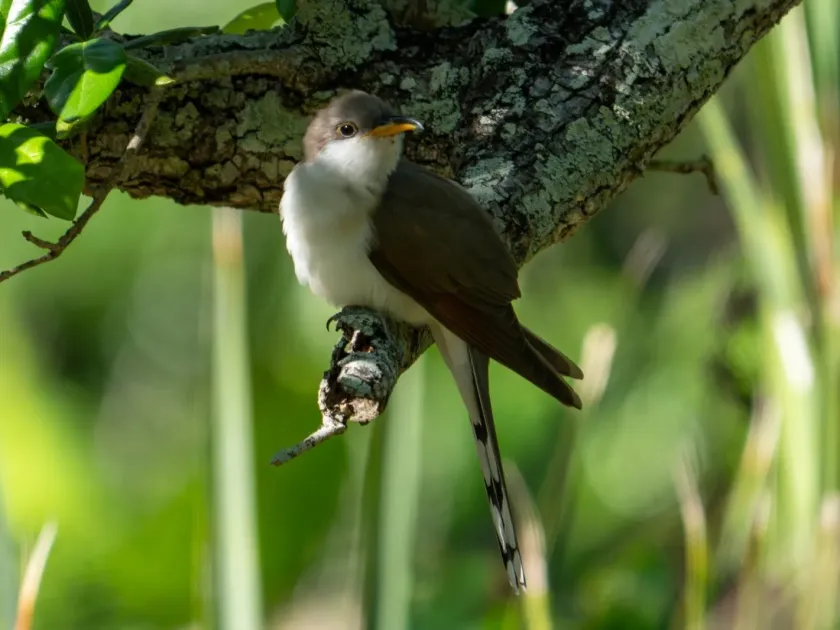
The Yellow-billed cuckoo is a slender, long-tailed bird belonging to the Cuculidae family, easily recognized by its distinctive yellow lower mandible.
The plumage on its upper body is a grayish-brown, while the underparts are white, and the underside of the tail displays large white patches when spread during flight.
Unlike its European relatives, this species is not a brood parasite; it builds its own nest in trees and shrubs, showing significant parental care.
Measuring about 30 cm in length, these birds prefer dense cover and are more often heard than seen, emitting a hollow, cuckoo-like "ka-ka-ka" call.
While often viewed as beneficial due to their insectivorous diet, their occasional consumption of fruits can cause localized economic damage in specific berry crops.
What it damages
The primary concern for growers involves the consumption of ripe soft fruits such as blackberries, raspberries, and strawberries during the peak harvest period.
Birds selectively peck at the largest and most succulent fruits, which renders the produce unmarketable and leads to significant financial losses in orchards.
Injuries caused by pecking serve as entry points for rot-causing fungi and secondary infections, leading to the rapid decay of surrounding fruits in a cluster.
While they consume various garden pests, the balance shifts to a nuisance status when the birds settle in high numbers near specialized fruit plantations.
Orchardists often observe that damage is most severe on edges of fields close to wooded areas, which provide both nesting sites and shelter for the birds.
When it appears
As a migratory species, the Yellow-billed cuckoo typically arrives at its breeding grounds in late spring, aligning with the early development of fruit crops.
The peak feeding and potential damage season occurs during the summer months, from June through August, when fruits reach their maturity.
Their activity levels increase as the young hatch and require additional food sources, leading to more frequent visits to cultivated areas.
Migration to southern overwintering grounds usually begins in late summer or early autumn, effectively ending the pressure on the current season's harvest.
Weather patterns, particularly variations in spring warmth, can shift the arrival times, requiring growers to monitor bird activity as the fruit begins to ripen.
Signs of infestation
Visible signs of infestation include partially eaten or pecked berries found on the stems or dropped on the ground below the fruit-bearing bushes.
The distinctive, rhythmic "ka-ka-ka" calls are a primary indicator of their presence within the dense foliage of the orchard or nearby field borders.
Droppings left on fruit leaves and the surface of fruits under perching spots provide clear evidence of consistent bird activity.
Visual spotting of the bird's long tail as it moves between tree branches is a common way to confirm the species responsible for the damage.
Rapid disappearance of ripe crop portions without the presence of traditional insect damage is a strong indicator of avian activity in the plantation.
Control measures
Exclusion netting remains the most effective method for completely preventing bird access to high-value fruit crops in home gardens and small orchards.
Visual deterrents, such as reflective tapes or life-sized predator decoys, can discourage birds from settling in the immediate vicinity of the crops.
Acoustic deterrent systems that broadcast distress calls or synthetic sounds can be utilized to keep the birds from lingering in the plantation area.
Maintaining clean orchard floors and practicing prompt harvesting of fully ripe fruits reduces the attractants that lure the birds in the first place.
An integrated approach, utilizing multiple control methods simultaneously, is recommended to minimize losses in areas with high bird population density.
Taxonomy
- Latin name
- Coccyzus americanus
- Family
- Cuculidae
- EPPO code
- COCZAM
Discussion
No discussions yet — be the first.