
Yellow-billed cuckoo
Coccyzus
Description
How to identify
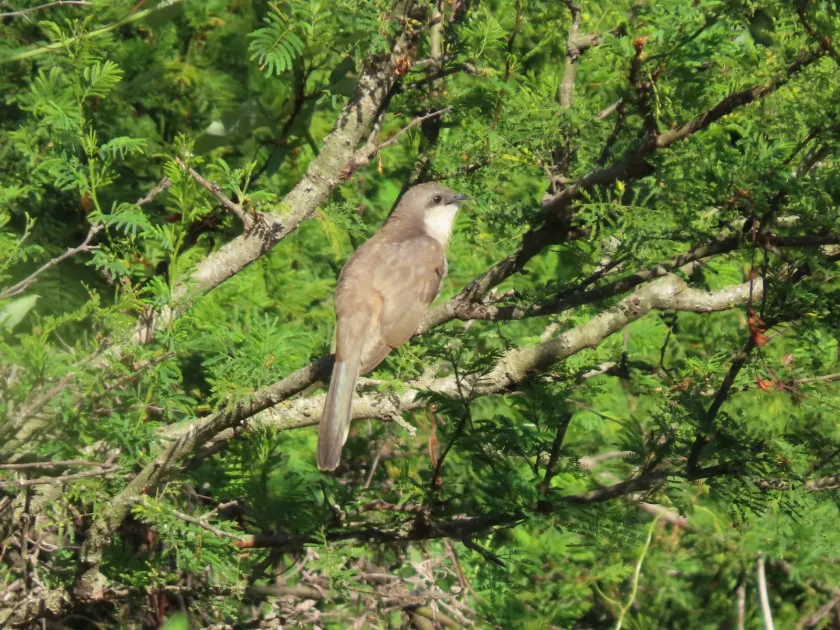
The yellow-billed cuckoo (genus Coccyzus) is a slender, medium-sized bird characterized by a long tail featuring distinct white spots on the underside.
These birds have a grayish-brown upper body and white underparts, a coloration that provides excellent camouflage within the canopy of fruit trees and dense shrubs.
Unlike many other cuckoo species, the yellow-billed cuckoo is not a brood parasite and builds its own nests, typically placed on horizontal branches.
They possess a long, slightly curved bill that is well-adapted for capturing insects, their primary natural food source, but also capable of damaging fruit.
Identifying them often involves listening for their distinctive, guttural call, which is frequently heard during the growing season and before stormy weather.
What it damages
While primarily insectivorous, these birds can become pests in orchards and berry patches, especially when insects are less abundant and fruits are ripening.
They peck at berries, cherries, and other soft fruits, causing mechanical damage that spoils the fruit and makes it susceptible to fungal decay.
Feeding behavior often involves damaging the skin of the fruit, which invites secondary infections and pests that further degrade the quality of the harvest.
In addition to fruits, they may damage young buds on fruit trees, which can suppress development and reduce the overall fruit yield for the subsequent season.
Constant feeding activity by a resident pair can result in significant cumulative losses in commercial and home garden settings over the peak ripening months.
When it appears
Their presence on agricultural land is most intense during the spring and summer months, coinciding with the peak period of insect activity and fruit development.
Adult birds become increasingly active in gardens when they are feeding their offspring, as the need for caloric intake increases significantly during this phase.
As summer progresses and fruits reach maturity, the birds turn their attention to these sugary resources, making them particularly noticeable in orchards.
With the onset of autumn and the decline of insect populations and fruit availability, these migratory birds move out of the area toward their wintering grounds.
The duration of their stay is highly dependent on local weather conditions and the availability of preferred natural habitats near the agricultural site.
Signs of infestation
The most reliable sign of their activity is the presence of partially eaten fruit scattered under the trees, showing specific beak puncture marks.
Discovering nests in the crotches of fruit trees is a definitive sign that a breeding pair has established a territory within your orchard environment.
Observation of bird droppings on tree branches and foliage confirms regular use of the trees for perching and feeding, particularly during the early morning.
Damage to the fruit skin that leads to rapid browning or rotting is a clear indicator that birds have been feeding in the immediate vicinity.
The sound of their call in the orchard is a strong indicator of their presence and suggests that management practices should be implemented immediately.
Control measures
Effective management involves deploying physical barriers and deterrents to minimize damage while maintaining the safety of the orchard ecosystem.
The use of horticultural netting is the most reliable method for protecting high-value crops from bird damage during the ripening stage of the harvest.
Visual deterrents, such as reflective tapes or movable bird scare devices, can be used to disrupt the birds' sense of security in the garden.
Practicing good sanitation, including the prompt removal of fallen fruit, prevents birds from establishing a habit of feeding in your orchard area.
- Use of netting over berry bushes and fruit trees.
- Installation of reflective flash tape.
- Implementation of ultrasonic bird repellers.
- Timely harvest of ripening produce.
- Habitat modification to reduce nesting sites.
Taxonomy
- Latin name
- Coccyzus
- Family
- Cuculidae
- EPPO code
- COCZSP
Discussion
No discussions yet — be the first.