
Greater coucal
Centropus sinensis
Description
How to identify
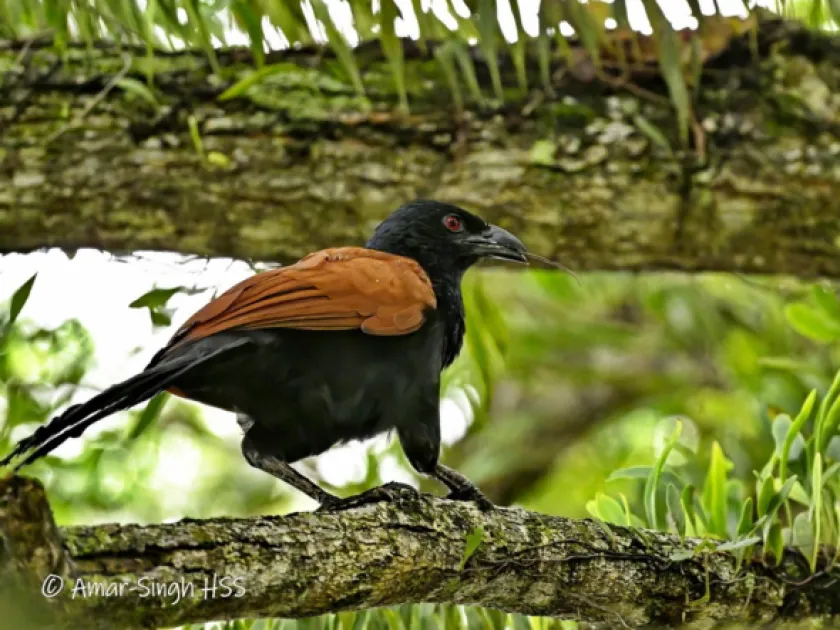
The Greater coucal (Centropus sinensis) is a large member of the cuckoo family, characterized by its long, graduated tail, black plumage, and distinct chestnut-brown wings.
These birds prefer habitats consisting of dense shrubs, tall grasslands, and forest edges, which frequently overlap with agricultural farmland in their native range.
Unlike many other cuckoo species, the Greater coucal is not a brood parasite; it constructs its own large, bulky nests within dense vegetation, allowing for steady population growth.
They are primarily terrestrial or semi-arboreal, spending much of their time moving through undergrowth, which makes them highly adaptable to various field conditions.
Their physical strength, combined with a robust, curved beak, enables them to navigate and exploit a wide range of food sources found in managed crops.
What it damages
Greater coucals are opportunistic feeders and can cause significant damage to agricultural crops, particularly during the seed maturation and fruit-ripening stages.
They are known to damage cereal crops by pecking at the grain during the milk or dough stages, leading to substantial yield losses and lower harvest quality.
In horticultural settings, these birds peck and damage juicy fruits and vegetables, such as tomatoes and peppers, creating entry points for opportunistic fungal pathogens.
Physical damage occurs when the birds walk through dense crop stands, often breaking stems or flattening areas, which interferes with plant growth and harvesting operations.
Additionally, while foraging for insects, they may disrupt the soil around the base of plants, which can potentially damage the root systems of sensitive seedlings.
When it appears
Greater coucal activity in agricultural fields spans the entire growing season, with intensity increasing as crops develop and become more attractive to the birds.
Since they are non-migratory in most of their range, they pose a consistent presence, requiring year-round monitoring depending on the local agricultural cycle.
The breeding season often coincides with the peak agricultural activity, driving the need for higher nutrient intake and causing birds to frequent farm fields more often.
During dry seasons, when natural water sources may become scarce, coucals are more likely to target succulent fruits and vegetables in irrigation-dependent plots.
Younger birds, after leaving the nest, expand their foraging range, which can lead to sudden spikes in local pest pressure during the late summer months.
Signs of infestation
The primary sign of Greater coucal presence is mechanical damage to fruit or grain, characterized by deep, distinct puncture marks from their heavy, powerful beaks.
In cereal fields, signs include damaged heads, scattered grains, and visible fecal deposits along with footprints in the soil near the feeding sites.
In vegetable gardens, damaged and partially eaten fruit found on the ground is a common indicator that these birds have been actively feeding in the area.
Frequent observations of large, dark-plumaged birds skulking in border vegetation or weeds at the edge of the field are reliable signs of their nesting or resting sites.
Damaged stems and disturbed soil patterns around high-value crops suggest that the birds are spending significant time inspecting the plants for various food sources.
Control measures
Controlling Greater coucals in agricultural settings focuses on non-lethal deterrents and habitat management to reduce the field's appeal to these pests.
Acoustic deterrents, such as playing distress calls, have proven effective at keeping the birds away from sensitive crop zones during critical ripening periods.
Visual repellents like reflective tape or hawk-shaped kites require periodic rotation to prevent habituation, as these intelligent birds can adapt to static deterrents.
Effective habitat management, such as trimming back overgrown shrubs and clearing dense weeds along field boundaries, removes their essential cover and nesting spots.
For high-value vegetable and fruit crops, the use of physical exclusion netting remains the most reliable method to ensure that the harvest is protected from avian damage.
Taxonomy
- Latin name
- Centropus sinensis
- Family
- Cuculidae
- EPPO code
- KNTPSI
Discussion
No discussions yet — be the first.