
Coucal
Centropus
Description
How to identify
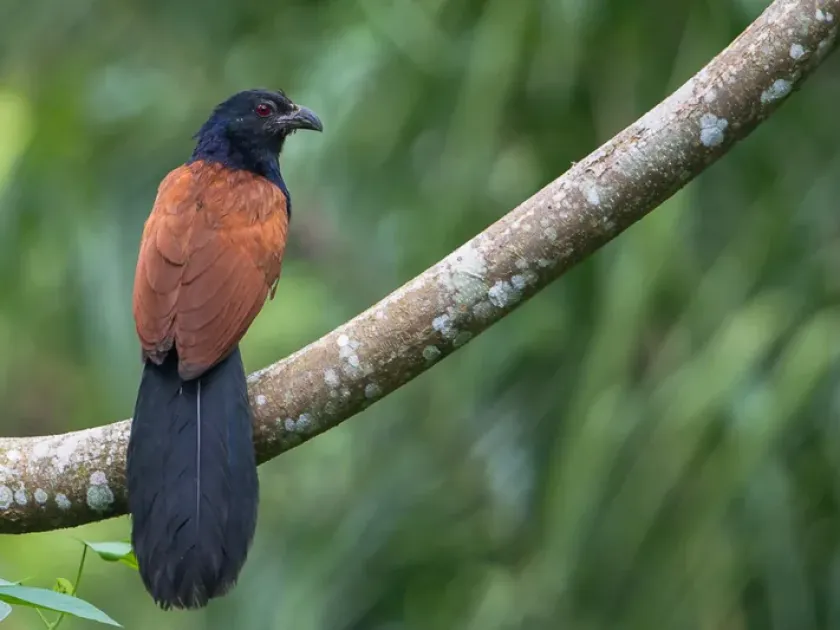
The coucal (genus Centropus) belongs to the cuckoo family, but unlike its relatives, it is a non-parasitic bird. These birds are primarily terrestrial, preferring to reside in dense vegetation, tall grasses, and shrubs, which are common in many agricultural landscapes.
Physically, the coucal is characterized by a long tail, a robust build, and strong legs. Its most distinctive feature is the long, straight claw on the hind toe, which provides stability during movement through tangled undergrowth and thick vegetation.
Coucals are well-adapted to tropical and subtropical habitats. In farming regions, they often select edges of fields bordering dense bushland or water bodies to establish their territories and search for prey.
These birds build their own dome-shaped nests using twigs and leaves, typically placed close to the ground within dense plant covers. Their breeding cycle often aligns with the vegetation period of agricultural crops, making their presence on farms more frequent.
Due to their secretive nature, coucals are often heard rather than seen. They prefer walking or short, low flights over open fields, making them masters of concealment within the dense rows of crops like grain or maize.
What it damages
The primary damage caused by coucals in an agricultural context is mechanical. As heavy birds, their constant movement through fields can lead to flattened stalks and broken stems in cereal crops, particularly during the early stages of growth or grain filling.
While coucals are largely insectivorous, they have been known to feed on fruits and ripening grains when their primary food sources are scarce. This behavior can lead to localized damage, especially on small-scale plots located near forest fringes.
Feeding activity often results in the trampling of surrounding plants. Constant traffic by pairs or family groups can reduce the overall stand density of the crop, negatively impacting the total harvest output of the affected area.
The economic impact is usually localized but can be significant for sensitive high-value crops. When coucal populations are high, they can cause consistent damage to the outer edges of fields, requiring farmers to monitor these zones closely throughout the season.
Young sprouts and seedling beds are particularly at risk. The weight of these birds can easily snap delicate stems while they hunt for terrestrial invertebrates, which are attracted to the moist soil often found near such crops.
Control measures
Effective management of coucals focuses on non-lethal deterrents, as these birds play an important role in controlling invertebrate populations. Protecting crops should be achieved through integrated strategies that discourage birds from staying in sensitive areas.
Visual deterrents such as predator decoys, reflecting tapes, and spinning reflectors are effective in keeping coucals away. It is essential to rotate these deterrents periodically to prevent the birds from becoming accustomed to them.
Acoustic deterrents, such as devices that mimic alarm calls or predatory birds, are highly recommended for larger field areas. These devices should be used strategically during the most vulnerable periods of crop development, such as seed germination or fruit maturation.
Proper field maintenance is a critical component of pest control. Clearing weeds, trimming hedges, and maintaining clean field margins significantly reduces the attractive habitats that coucals use for nesting and shelter.
For high-value or highly susceptible crops, physical barriers like exclusion netting are the most effective solution. While labor-intensive, these barriers provide 100% protection against mechanical damage caused by birds and ensure stable yields.
Taxonomy
- Latin name
- Centropus
- Family
- Cuculidae
- EPPO code
- KNTPSP
Discussion
No discussions yet — be the first.