
Gangara
Gangara
Description
How to identify
The genus Gangara belongs to the family Hesperiidae, commonly known as skippers, within the order Lepidoptera. The adults are butterflies characterized by a robust, heavy body and broad, dark-colored wings, typically shades of brown, which allow them to blend into the foliage.
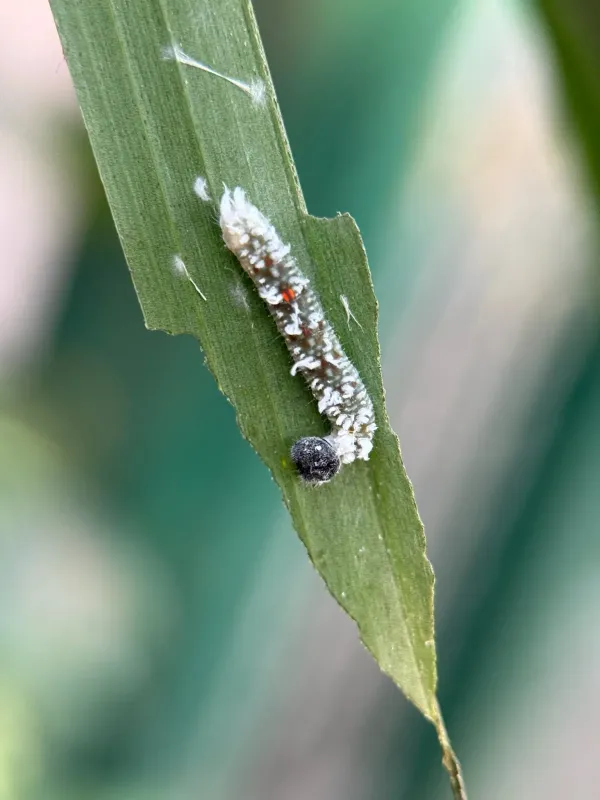
The larvae, or caterpillars, have a distinct appearance. They are often covered in a waxy, white, or cream-colored coating that masks their true body texture. They possess a large, prominent head, which is a key identifying feature of the Hesperiidae family.
The life cycle undergoes complete metamorphosis, consisting of the egg, larva, pupa, and adult stages. Females typically lay eggs individually or in small clusters on the undersides of leaves, providing a sheltered start for the offspring.
Pupation occurs within a specialized shelter on the host plant. The caterpillar spins silk threads to fold or roll a leaf section, creating a protective enclosure known as a leaf roller nest, where it transforms into a pupa.
Identification in the field is primarily based on the presence of these rolled-leaf structures. Finding these nests is the most reliable way to confirm an infestation before significant damage occurs to the crop.
What it damages
Plants in the Arecaceae (palm) family are the primary hosts for Gangara. This includes economically important species such as the coconut palm (Cocos nucifera) and oil palm, as well as various ornamental palm varieties used in landscaping.
The larvae are the destructive stage of the pest. They possess strong mandibles used to consume leaf tissues, often eating large portions of the leaf blade or creating ragged edges, which significantly reduces the photosynthetic capacity of the plant.
In cases of heavy infestation, widespread defoliation can occur. The loss of leaf surface area hampers the plant's ability to produce energy, leading to stunted growth, reduced vigor, and a decline in fruit or nut production.
Injured tissues also serve as entry points for secondary pathogens, including various fungal and bacterial infections. This can lead to necrosis of the leaves and may even cause the death of young seedlings if the damage is concentrated near the growing point.
Overall, the economic impact is significant, as the reduction in healthy canopy cover limits the yield of palm plantations and necessitates expensive management and recovery interventions.
Control measures
Integrated Pest Management (IPM) is the most effective approach for controlling Gangara. Regular scouting of the plantation is essential to detect the early signs of leaf rolling and stop the population from spreading.
Manual removal of infected leaves is a viable non-chemical strategy for small-scale operations or for early-season control. By destroying the nests, one effectively removes the larvae and pupae from the lifecycle.
Biological control using microbial insecticides, particularly those based on Bacillus thuringiensis (Bt), is highly recommended. These agents specifically target lepidopteran larvae while sparing non-target beneficial insects.
Chemical control should be employed only when necessary, using systemic insecticides. Application should be timed to hit the active larval stages, and rotation of different chemical classes is advised to prevent the development of pesticide resistance.
- Frequent field inspections for leaf nests
- Physical removal of infested foliage
- Application of Bt-based bio-pesticides
- Promotion of natural parasitoids and predators
Taxonomy
- Latin name
- Gangara
- Order
- Lepidoptera (butterflies)
- Family
- Hesperiidae
- EPPO code
- GANGSP
Discussion
No discussions yet — be the first.