
Freshwater amphipod
Gammarus pseudolimnaeus
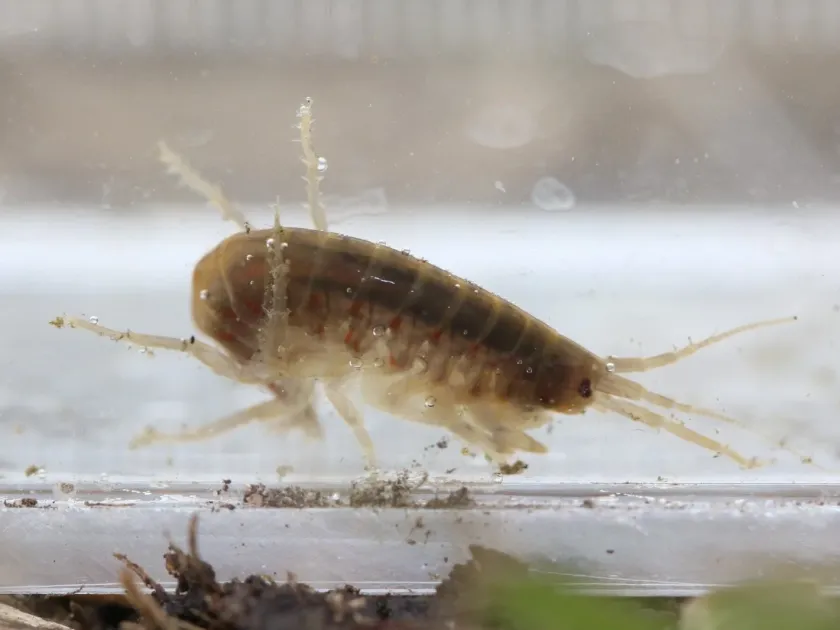
Description
How to identify
The freshwater amphipod (Gammarus pseudolimnaeus) belongs to the order Amphipoda and the family Gammaridae. These small crustaceans typically measure 10–20 mm in length and possess a laterally compressed body.
They are characterized by their distinct sideways swimming motion and a segmented exoskeleton that requires frequent molting throughout their life cycle to facilitate growth.
The species has well-developed sensory antennae and appendages, which allow them to scavenge efficiently in dark, moist environments or submerged aquatic systems.
Females carry eggs in a specialized brood pouch under the thorax, ensuring a high survival rate for the offspring in varied freshwater conditions.
They are highly adaptable and thrive in oxygen-rich water, making them common inhabitants of both natural streams and artificial hydroponic or aquaponic setups.
What it damages
Gammarus pseudolimnaeus acts as a pest primarily in controlled environments like hydroponics, where they can severely impact young crop development.
They feed on the delicate root systems of plants, causing mechanical injury that impairs the plant's ability to absorb nutrients and water effectively.
Severe infestations lead to stunted growth, yellowing foliage, and potentially the total loss of seedlings, as the roots are often eaten to the base.
Furthermore, the physical damage created by their feeding provides entry points for secondary bacterial and fungal pathogens, leading to root rot and systemic infections.
In commercial operations, large populations can clog filtration systems, drip emitters, and pumps, leading to operational inefficiencies and systemic failures.
When it appears
Activity levels are highly dependent on water temperature. The most significant damage occurs during the warmer months when temperatures range between 15°C and 20°C.
In climate-controlled indoor greenhouses, these crustaceans can maintain continuous reproductive cycles, posing a year-round threat to agricultural production.
During colder periods, their metabolism slows significantly, and they become lethargic, often retreating into deep filtration media or sediments to survive.
Population surges are often triggered by the accumulation of organic detritus in tanks, which provides both food and shelter for the amphipods.
Initial colonization of systems often happens through untreated water sources, where they enter as stowaways and rapidly adapt to the new niche.
Signs of infestation
Visual identification of small, shrimp-like organisms swimming in the nutrient solution is the primary indicator of an infestation.
Affected plants exhibit signs of distress, including drooping or chlorosis, which upon root examination reveals shredded or eaten root tips.
The accumulation of molted chitinous exoskeletons within the pump filters or drainage pipes is a clear sign of an established, growing population.
Unpleasant odors stemming from the root zone, often accompanied by slimy biofilms, suggest that the presence of amphipods has fostered a degraded microbial environment.
Frequent mechanical issues with irrigation components due to foreign debris are also indicative of significant amphipod activity within the system.
Control measures
Preventative filtration using micron-mesh screens at the water intake is the most effective strategy to keep these pests out of hydroponic installations.
Regular maintenance and sanitation of all tanks, reservoirs, and piping are essential to eliminate the organic sediment that serves as the amphipod's primary food source.
Biological control, such as introducing predator fish in aquaponics, can effectively keep amphipod populations in check without the need for chemical intervention.
Adjusting the chemistry of the nutrient solution, such as modulating pH levels to a range less suitable for crustaceans, can sometimes discourage further colonization.
Chemical control should be avoided if possible due to the sensitivity of hydroponic plant roots; mechanical exclusion and environmental management are the preferred approaches.
Taxonomy
- Latin name
- Gammarus pseudolimnaeus
- Family
- Gammaridae
- EPPO code
- GAMMPS
Discussion
No discussions yet — be the first.