
Gammarus
Gammarus
Description
How to identify
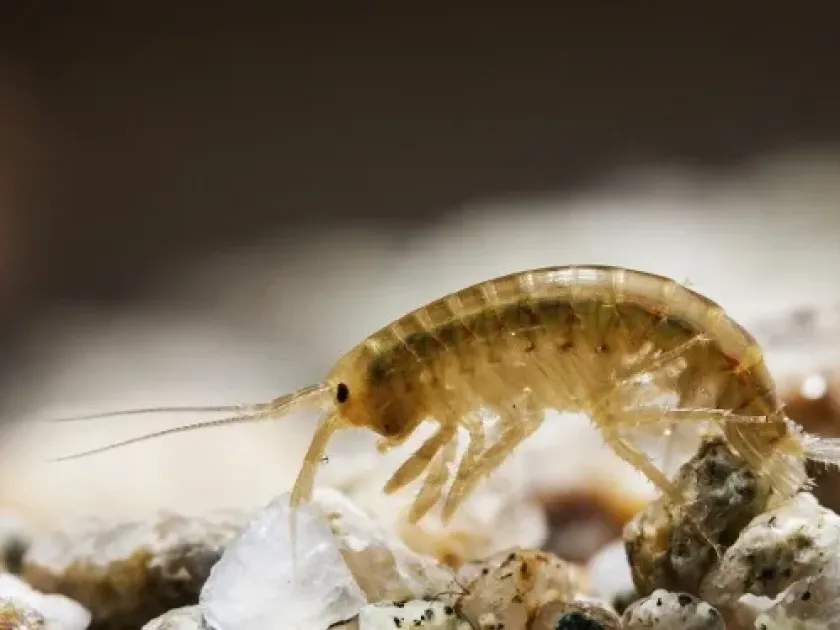
Gammarus, commonly known as scud, belongs to the order Amphipoda and the family Gammaridae. These are small crustaceans characterized by laterally compressed bodies.
An adult Gammarus usually measures between 1 and 3 centimeters in length and has a distinctive curved appearance resembling a tiny shrimp.
They possess several pairs of legs used for swimming and crawling across substrates, making them highly mobile within water-filled systems.
Their coloration varies from translucent grey to brownish, providing excellent camouflage in organic debris and aquatic environments.
While playing a vital role in natural aquatic ecosystems, they become significant pests when they infiltrate greenhouse water supply and hydroponic growing systems.
What it damages
The primary damage caused by Gammarus is the consumption of young plant roots, particularly in hydroponic setups where roots are constantly exposed to water.
Seedlings and young vegetable crops are most vulnerable, as scuds feed on the tender root tips and base of the stems, causing stunted growth.
Root damage significantly weakens the plant, making it highly susceptible to secondary pathogens such as root rot and various soil-borne fungi.
In large-scale greenhouse production, a high population of these crustaceans can lead to the destruction of entire batches of seedlings.
Furthermore, their activity disrupts the nutrient supply to the plants and can clog mechanical parts of the irrigation infrastructure.
When it appears
The prevalence of Gammarus is linked to the water source used in agricultural facilities, especially when using unfiltered pond or surface water.
Activity is continuous in climate-controlled greenhouses, as the stable temperatures and consistent water supply allow for year-round breeding cycles.
Spring is a critical period for monitoring because the introduction of new, delicate seedlings provides an abundant food source for these crustaceans.
During warmer months, metabolic rates increase, leading to faster reproduction and more aggressive feeding patterns in the root zones.
Winter months do not necessarily reduce the population if the hydroponic equipment is kept running and the water remains nutrient-rich.
Signs of infestation
A key indicator of infestation is sudden wilting of plants despite adequate moisture and nutrient levels in the growing medium.
Direct visual evidence includes observing small, shrimp-like creatures swimming in the nutrient solution or moving through the moist substrate.
Physical inspection of the root system often reveals missing root tips, ragged edges, and dark excrement scattered around the root zone.
Accumulation of debris near pump intakes or filter screens is a common sign that the crustaceans are thriving within the plumbing system.
Damage is typically more concentrated in areas where water flow is slow, allowing the organisms to anchor and breed more effectively.
Control measures
Effective control begins with the installation of fine-mesh filtration systems to prevent eggs and adults from entering the irrigation system.
Regular sanitation of hydroponic channels and reservoirs is essential, especially during the turnover period between different crop cycles.
Managing the nutrient solution to exclude excessive organic matter reduces the food supply available for Gammarus development.
Biological control agents that target aquatic crustaceans may be implemented, provided they are compatible with the specific crop being grown.
- Implementing multi-stage water filtration.
- Thorough cleaning of pipes and trays between harvests.
- Maintaining proper drainage to avoid stagnant water pockets.
Taxonomy
- Latin name
- Gammarus
- Family
- Gammaridae
- EPPO code
- GAMMSP
Discussion
No discussions yet — be the first.