
Dikerogammarus villosus
Dikerogammarus villosus
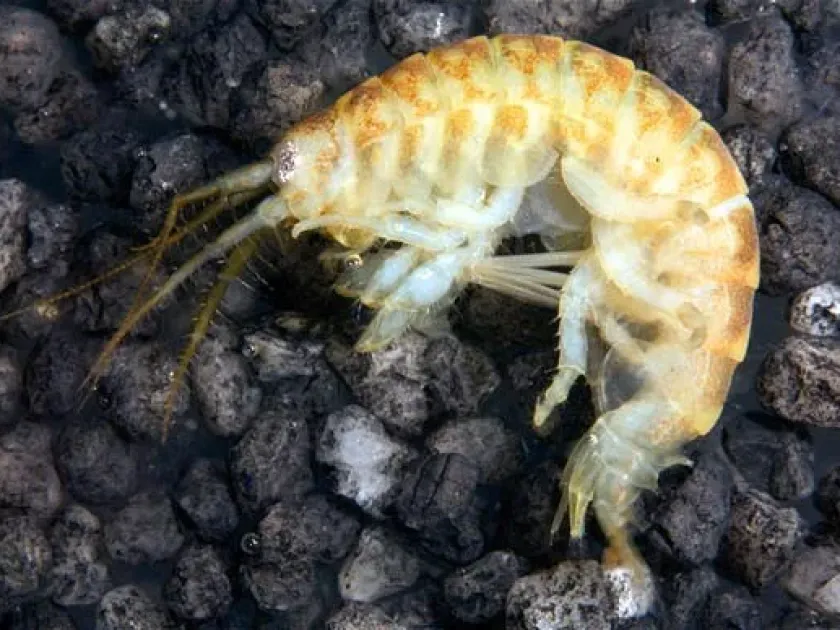
Description
How to identify
Dikerogammarus villosus, commonly known as the "killer shrimp," belongs to the order Amphipoda and the family Gammaridae. It is a highly aggressive invasive species of crustacean known for its predatory nature.
Physically, the individual has a segmented body up to 30 mm in length, often displaying striped patterns and highly developed mandibles. It is easily identified by its relatively large size and agility on the bottom of water bodies.
The species exhibits high ecological plasticity, adapting readily to varying salinity levels, water temperatures, and oxygen concentrations, allowing it to colonize new territories rapidly.
Unlike native gammarids, this amphipod remains highly active throughout both day and night. The lack of natural predators in newly invaded habitats contributes to its successful establishment.
Reproduction occurs throughout the warm season, with females producing multiple generations, leading to an exponential increase in population density.
What it damages
This object poses a direct threat to aquaculture, particularly for farms involved in raising fish fry and other crustaceans in ponds.
The predatory activity of Dikerogammarus villosus leads to the destruction of juvenile fish stocks. The pest attacks victims often larger than itself, depleting the biological resources of the reservoir.
In irrigation systems, the pest disrupts ecosystem balance by damaging aquatic vegetation and displacing beneficial organisms that perform natural water filtration.
Clogging of filtration networks and water intake structures is a common indirect damage caused by mass accumulation of this species in artificial canals.
Disruption of trophic chains leads to a decline in overall pond productivity, causing economic losses for businesses relying on water for technical and fish-farming purposes.
Signs of infestation
A primary sign of infestation is a sharp decline in the population of native amphipods and other benthic invertebrates within the water body.
The presence of empty snail shells and remnants of small hydrobionts on the pond bed often indicates the activity of a Dikerogammarus colony.
During visual inspections of the shoreline or sediment sample collection, individuals with characteristically powerful jaws and striped bodies can be detected.
In commercial fish ponds, infestation is often signaled by increased fish fry mortality that cannot be attributed to common infectious diseases.
Changes in water transparency and bottom sediment composition are observed due to the intense predation on detritivores by this active species.
Control measures
Effective management of the killer shrimp is challenging due to its high adaptability; therefore, preventive control remains the most critical strategy.
Strict monitoring of the transfer of fish stock and equipment between water bodies is necessary, as eggs and larvae can be transported in droplets of water.
Biological control methods include stocking water bodies with predatory fish that consume gammarids, which helps to suppress excessive population growth.
In cases of critical infestation within enclosed systems, temporary drainage of ponds and disinfection of the bed with authorized agents are required.
Regular monitoring of faunal composition using specialized traps is recommended for the timely detection of invasion hotspots and the initiation of rapid response measures.
Taxonomy
- Latin name
- Dikerogammarus villosus
- Family
- Gammaridae
- EPPO code
- DIKGVI
Discussion
No discussions yet — be the first.