
Poplar kitten
Furcula bifida
Description
How to identify
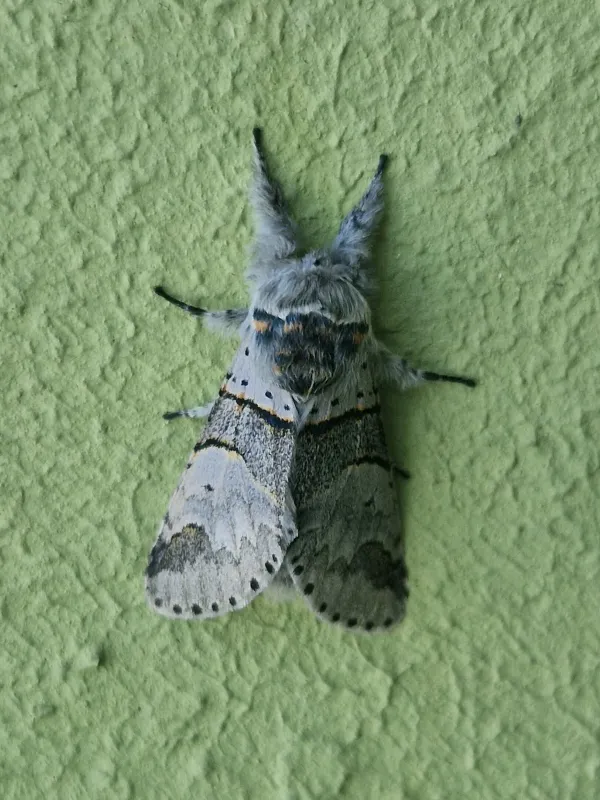
The Poplar kitten (Furcula bifida) is a moth belonging to the family Notodontidae. It is known for its distinct, hairy appearance that characterizes this group of moths.
The adult moth typically has a wingspan ranging from 40 to 50 mm, with whitish-grey wings featuring dark central markings and black spots.
The larvae are particularly unique, displaying a bright green color with a reddish-brown dorsal band bordered by white lines.
At the rear of the body, the larvae possess two long, red filaments, which act as a defensive mechanism against predators by mimicking a fork shape.
The pupa stage is protected by a tough, dense cocoon that the larva cleverly masks with wood debris, making it almost invisible against the tree bark.
What it damages
The primary host plants for the Poplar kitten are members of the Salicaceae family, specifically various species of poplars and willows.
Damage is caused by the caterpillars, which feed aggressively on the foliage, often consuming large portions of the leaf blades.
In cases of high infestation, the caterpillars can cause almost complete defoliation, which severely stresses the health and vigor of the trees.
Young trees and nursery stock are particularly vulnerable to these caterpillars, as their feeding can lead to stunted growth and poor development.
The stress caused by repeated foliage loss makes the affected trees more susceptible to secondary infestations and environmental stressors.
When it appears
The life cycle of the Poplar kitten generally consists of one or two generations per year, depending on the climatic conditions of the area.
Adult moths typically emerge in late spring, between May and June, when they start their mating flight and egg-laying process on host leaves.
The caterpillars are most active during the summer months, from June to August, when they feed and progress through several larval instars.
The species overwinters as a pupa within the hardened cocoon attached to the trunk or branches of the host tree, providing protection against winter cold.
Timing of the moth emergence is highly dependent on spring temperatures, which dictate the beginning of the seasonal life cycle.
Signs of infestation
Visible signs of infestation include ragged leaf edges and large, irregular holes in the foliage of poplar and willow trees.
The presence of larvae is often indicated by their distinct coloration and their behavior, such as the defensive pose they adopt when threatened.
Frass (caterpillar excrement) accumulating on the leaves or the ground beneath the canopy is a clear indicator of active feeding activity.
During the dormant season, one may find the hard, bark-colored cocoons on the trunks, which are signs that the pest has successfully pupated.
In severe cases, the audible sound of mass feeding in the canopy and a visible thinning of the tree crown are reliable indicators of infestation.
Control measures
Integrated Pest Management (IPM) practices are recommended, focusing on the encouragement of natural predators like birds and parasitic wasps.
Biological control using microbial insecticides, such as those based on Bacillus thuringiensis, is highly effective for managing larval populations.
Mechanical control, including the manual removal of larvae or destruction of overwintering cocoons, is practical for small garden trees.
Chemical intervention should be restricted to significant outbreaks and must be executed in accordance with local environmental regulations.
Regular monitoring of tree health during the growing season allows for early detection and mitigation of potential population spikes.
Taxonomy
- Latin name
- Furcula bifida
- Order
- Lepidoptera (butterflies)
- Family
- Notodontidae
- EPPO code
- HARYHE
Discussion
No discussions yet — be the first.