
Bean plume moth
Exelastis atomosa
Description
How to identify
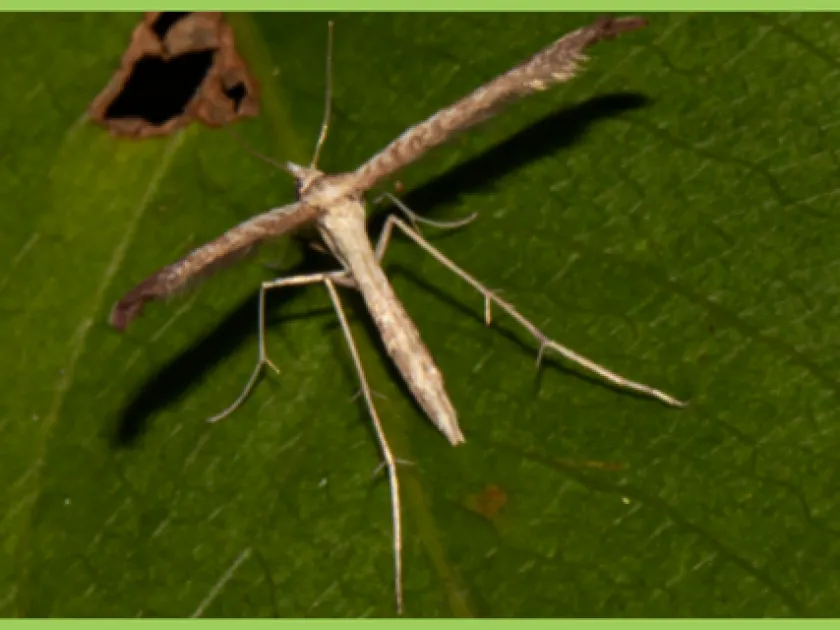
The bean plume moth, known scientifically as Exelastis atomosa, belongs to the family Pterophoridae. This insect is easily recognized by its distinctive wing structure, where both the forewings and hindwings are divided into feather-like plumes.
Adult moths are typically brownish-gray in color, providing excellent camouflage against dried plant stems and soil. Their wingspan is relatively small, usually ranging from 15 to 20 millimeters.
Larvae are caterpillar-like with a body covered in fine, short hairs. They are often green or yellowish-green, which allows them to blend in perfectly with the foliage and developing seed pods of their host plants.
The pupal stage is often found attached to the host plant itself, usually on the underside of leaves or along the stem. The pupa has an elongated, slender shape and typically mimics the color of its environment.
Exelastis atomosa undergoes a complete metamorphosis. The cycle progresses from egg to larva, then pupa, and finally to the adult moth, which is the stage responsible for reproduction.
What it damages
The bean plume moth primarily targets legumes. It is a well-known pest in various tropical and subtropical regions where crops like pigeon peas, soybeans, and beans are cultivated.
The larvae are the primary stage causing damage. They feed on floral buds and developing pods, boring inside the pods to consume the seeds, which directly impacts the yield potential.
Heavy infestations can lead to significant crop loss. Beyond direct consumption of seeds, the damage to the pods exposes them to secondary fungal and bacterial infections.
Feeding activity on reproductive structures such as flowers often results in flower drop and reduced pod set, which is a major concern for farmers during the crop's flowering phase.
The severity of the damage is correlated with the larval density; higher populations can devastate entire fields if left unmanaged during the critical reproductive stages.
Signs of infestation
One of the most obvious signs of infestation is the presence of silk webbing on flower buds and young pods, which the larvae use for protection and to hold plant parts together while feeding.
Evidence of larval feeding is visible as small holes on the surface of the pods, often accompanied by the accumulation of frass (larval waste) near the entry points.
Distorted or withered flowers that fail to develop into healthy pods are indicative of larval presence within the reproductive structures of the plant.
Direct visual observation of larvae on the underside of leaves or inside opened pods during field scouting is a reliable method for detecting early-stage infestations.
Adult activity can be monitored by observing the presence of moths, which are most active during dusk and dawn, and can be attracted to light traps for population surveys.
Control measures
Biological control plays a key role, involving the preservation of natural predators and parasitoids that help regulate the population density of the plume moth in the field.
Cultural management includes timely harvesting and the removal of crop residues, which helps in breaking the pest life cycle by destroying potential overwintering sites.
Chemical control involving insecticides is effective if applied during the early stages of larval development before they bore into the pods, where they become protected from contact sprays.
Integrated Pest Management (IPM) strategies suggest regular field monitoring and the use of pheromone traps to make informed decisions regarding the necessity of chemical treatments.
- Intercropping with non-host plants to disrupt the pest's life cycle.
- Use of microbial insecticides like Bacillus thuringiensis.
- Crop rotation to reduce the build-up of resident populations.
Taxonomy
- Latin name
- Exelastis atomosa
- Order
- Lepidoptera (butterflies)
- Family
- Pterophoridae
- EPPO code
- EXELAT
Discussion
No discussions yet — be the first.