
Eucnemidophorus
Eucnemidophorus
Description
How to identify
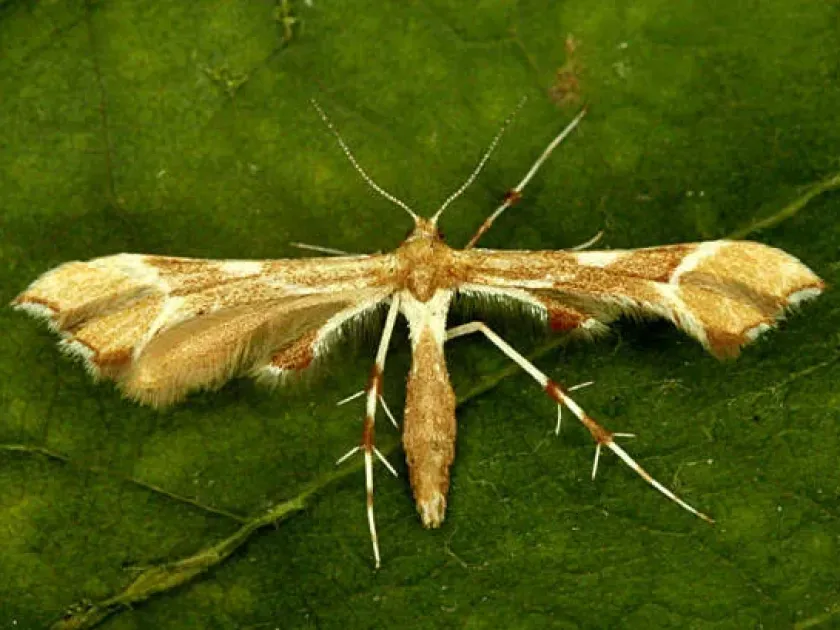
Eucnemidophorus belongs to the order Lepidoptera and the family Pterophoridae, commonly known as plume moths. These moths are characterized by wings divided into narrow lobes, which give them a feather-like appearance.
The adult stage typically possesses a camouflaged coloration that allows the insect to blend perfectly with dry plant debris and surrounding vegetation.
The larvae are typically characterized by moderate segmentation and are covered with sparse, fine hairs. They often maintain a cryptic lifestyle, living inside plant tissues or rolled leaves.
Identification of the species often requires careful examination of morphology, as many plume moths share significant visual similarities with one another.
The biology of this pest is primarily studied in the context of specialized host plants, where it functions as a host-specific herbivore.
What it damages
This pest primarily attacks plant species that are rich in specific essential oils or unique chemical compounds. In agriculture, it is often associated with particular industrial or ornamental crops.
The larvae feed on the tissues of leaves, developing shoots, and flower buds, which disrupts the normal growth and physiological development of the plant.
Damage is often localized, but during high infestation pressure, it can significantly reduce the overall biomass and yield of the crop field.
A primary concern is the damage to terminal buds, which can lead to stunted growth, stem deformation, and delayed or unsuccessful flowering.
The destruction of plant tissue integrity also leaves the plant vulnerable to secondary infections, including various bacterial and fungal pathogens.
When it appears
The life cycle of Eucnemidophorus is closely linked to the phenology of its host plants. Adult activity is typically observed during the warmer months, from late spring through mid-summer.
The insect typically overwinters in the pupal or larval stage within plant residues, bark crevices, or the upper soil layer, providing protection against winter cold.
Adult emergence occurs under optimal humidity and temperature conditions, followed by egg-laying on the most tender parts of the plants.
The duration of one generation varies from several weeks to a month, depending heavily on the prevailing ambient temperatures and food availability.
Mass outbreaks are most commonly observed following prolonged warm springs, which accelerate the metamorphosis of overwintering individuals.
Signs of infestation
The primary sign of pest presence is the appearance of small holes or leaf mines that progressively expand as the larva increases in size.
The presence of larval frass (excrement) on the leaf surface or within shoot axils serves as a clear indicator of active feeding in the field.
Leaf rolling or tying around the larvae is one of the most recognizable symptoms, which is easily detected during routine crop scouting.
- Silken threads used by larvae to secure leaf segments for protection.
- Visible stunting of individual shoots compared to the surrounding healthy plants.
- Premature yellowing or chlorosis occurring around the feeding sites.
Severe infestations lead to premature bud drop and a significant reduction in the development of the plant's reproductive organs.
Control measures
Control strategies rely on cultural practices aimed at destroying overwintering sites, such as deep plowing and the systematic removal of weeds.
The use of biological insecticides based on entomopathogenic fungi or bacteria is highly effective during the early larval stages of development.
If economic damage thresholds are exceeded, targeted applications of chemical insecticides, such as pyrethroids or organophosphates, are recommended.
Regular field monitoring using pheromone traps allows for optimized timing of chemical applications, thereby reducing the total pesticide input.
Crop rotation and maintaining spatial isolation from wild host reservoirs are essential preventive measures to minimize the overall pest population density.
Taxonomy
- Latin name
- Eucnemidophorus
- Order
- Lepidoptera (butterflies)
- Family
- Pterophoridae
- EPPO code
- EUCNSP
Discussion
No discussions yet — be the first.