
Long-horned bee
Eucera longicornis
Description
How to identify
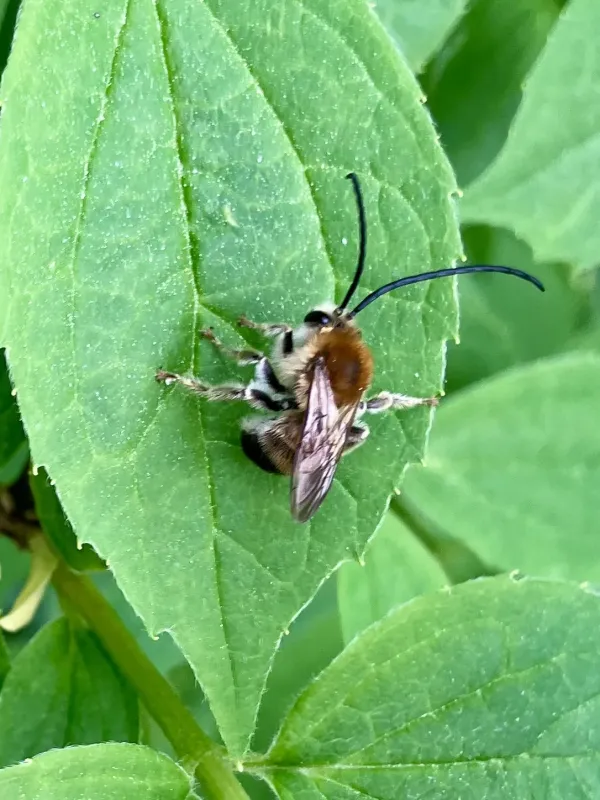
The long-horned bee (Eucera longicornis) belongs to the order Hymenoptera and the family Apidae. This solitary bee is named for the males, which possess exceptionally long antennae.
Physically, the insect resembles a small honeybee but is characterized by denser hair coverage and a unique flight pattern when hovering over flowers.
Females are more robust than males and have shorter, standard-length antennae, with coloration ranging from dark brown to grayish tones.
They are primarily found across Europe, favoring sunny open meadows, forest edges, and regions with sparse vegetation.
It is crucial to recognize that this species is a highly valuable pollinator, and its status as a "pest" is situational and rarely justified in balanced ecosystems.
What it damages
The crops most frequently visited by Eucera longicornis include members of the Fabaceae family, such as clover, peas, and alfalfa.
The perceived damage occurs when bees collect large amounts of pollen and nectar, potentially causing minor mechanical trauma to flower reproductive structures.
In cases of extremely high density, these bees can damage developing buds, which may lead to reduced seed yields in specific legume crops.
However, in most agricultural scenarios, the bee acts as a beneficial agent, significantly improving fruit set through efficient pollination.
Economic damage is generally negligible unless the bee's activity overlaps with the most sensitive stages of flowering in high-value seed crops.
When it appears
The life cycle of the long-horned bee is strictly synchronized with the flowering periods of spring and early summer nectar plants.
Adult flight activity typically peaks in May and June, coinciding with mating behavior and the establishment of nesting sites.
Nests are constructed as deep tunnels in firm, compacted soil, where the female provisions individual cells with collected pollen.
Larvae develop within these cells, feeding on stored provisions, and eventually enter a state of diapause until the following spring.
The species produces only one generation per year, limiting its presence to the early summer months.
Signs of infestation
The primary indicator of their presence is the appearance of small, round burrows in firm, dry soil in areas with limited ground cover.
Observing male bees patrolling flowering fields in a zigzag flight pattern is a clear sign that a local population is active in the area.
Visible mechanical wear on flower petals or buds during intensive foraging can suggest a very high bee density.
The presence of a low-pitched humming sound in the field during warm, sunny hours is common in areas where these bees congregate.
A high concentration of bees foraging on flowers indicates their active involvement in the local ecosystem's pollination cycle.
Control measures
Since Eucera longicornis is a beneficial pollinator, control measures should be minimal and focused only on preventing major crop yield loss.
The use of broad-spectrum insecticides is highly discouraged, as these chemicals eliminate beneficial insects and disrupt essential ecological services.
To reduce bee concentration in specific fields, farmers may manage weeds along field margins that otherwise serve as attractive food sources.
Cultural practices, such as deep tillage after the adult flight period, can naturally reduce the population size for the following season.
- Use of bee-safe, selective pesticides only when strictly necessary.
- Scheduling chemical applications during times when bees are inactive.
- Maintaining natural habitats around agricultural fields to balance populations.
Taxonomy
- Latin name
- Eucera longicornis
- Order
- Hymenoptera
- Family
- Apidae
- EPPO code
- EUCRLO
Discussion
No discussions yet — be the first.